
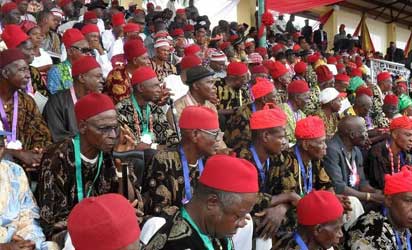
Igbo Chiefs
By Obi Nwakanma
For years, pro-democracy activists sold the idea, indeed fought on the idea, that the democratic alternative was the only means by which a free people must organize and govern themselves. Freedom ultimately comes when we have a voice in the affairs of our community, and in the larger space of the nation through effective representation: the kind of representation in the Assembly of the people gathered to determine the ways and means of our national governance.
Democracy is a beautiful idea. As an Igbo, born into a very democratic culture, in which individual freedom, and the notions of equality of the individual irrespective of status or wealth was consciously imprinted in our collective Igbo psyche, I value democracy and the republican spirit. I understand democratic culture. But it does seem that even the Igbo as a democratic, republican society, has been profoundly changed by two factors: (a) the years of institutional tyranny, starting with colonialism and followed by years of military rule, which subdued individual liberty and created absolute hierarchical authority of which the Igbo have become uneasily, but gradually acclimated; and (b) the impact of the cultural contact, following the creation of modern Nigeria, with Igbo neighbours who had developed along a different authority system and pathway, namely feudalism and monarchies; in which individual freedom is limited; access to status over-determined, and defined by a well-established “ruling class,” as is often the case among the Hausa/Fulani; the Yoruba, the Edo, and such other key Igbo neighbours.
The “new Igbo” has had to adapt to a “national model” of governance that has hybridized feudalism, monarchism, and a form of pseudo-democracy. In this model, people, the true foundational factors of any democracy, are both visible and invisible; absent and unimportant to any truly “democratic” outcomes in Nigeria.
Today, for instance, in a culture that once ritually sealed the possibility of the monarchy, contemporary Igbo land has more “monarchs” – Ndi Eze – than any other place in the world. Every town has one. Once settled town federations, created in the past under the democratic rule as ancient mutual aid societies have broken apart, and collapsed; their security pacts violated; some even now ascribe ridiculous and laughable terms like, “ancient kingdom of so and so” to themselves. There is no “ancient kingdom” in Igbo land, and there are only “ancient republics,” many older than Athens, but many now under the ignorant spell of a new monarchism, are abjuring themselves and the most ancient order of public governance among the Igbo, one of the world’s oldest republics, preserved by a very ancient law, based on the “Iwu-Ala” – the law of the earth.
The ancient Igbo legal code based on the “Iwu-Ala” in which “Ala” or “Ani” or “Ali” (often symbolized as the powerful female archetype, the earth goddess), grants every person, man or woman, born free to a land, the equal rights of citizenship, and the equal rights to life. The free male citizen, irrespective of age or social status is called the “Di-Ala” (lord of the land), and female citizen, “Nwa Okpu-Ala” or Nwa Okpu” – Daughter and trustee of the land. That law grants the transient stranger, the rights of the highest protection of the land. The laws determine that all men are the sovereigns – or lords of wherever they stand; and each man is entitled to that dignity. When you enter a man’s “obu” you bow to him; if he enters your obu, he bows to you.
The Igbo built and organized around a vast network or federation of small, organic communities because ancient Igbo law, based on the “Iwu-Ala” forbade conquest of land, and permanent violation of human boundaries. There are no kings because the Igbo law forbade the building of empires. The imperium would violate the Igbo law against the conquest of land, and its ideas of the impermanence of things which reflected its law of dynamics as permanent change and permanent regeneration, encoded in very symbolic ways in the “Mbari” museum culture. Permanence in the Igbo mind was a form of idolatry. Kings create permanent lines and are divine. The only king of the Igbo is the divine order often represented in the collective gathering of the Igbo. The Igbo thus say, “Nani Chukwu Wu Eze Ndi Igbo” – only God is the King of the Igbo, or “Oha Wu Eze” – simply put, the sovereign is established among the Igbo always only at the gathering of the people.
Traditionally, there was no “chairman” or “king” in any Igbo gathering; only a council of the eldest agnatic order of the land, often referred to as “Ndi Iche” – the oldest surviving patriarchs of the lineages – who have become, “half man, half spirit” because they occupy that twilight moment in their age, before translation into immortality. Such men are trustees of the “Ofo Ndi Iche” – or the authority of the fathers – of their various lines. They are often supported by “Ndi Di Opara/Di Okpala/ or Di Okpa” – the first born sons of every household, and “Ndi Nze/Eze,” the titled men of the land to establish the authority of the land collectively. There was never a “hightable;” the Igbo sat in a proscenium; each person finding people of their age or shared interest, or guild, in a community gathering. Everyone, including the certifiably mad, is accorded their rights to free speech.
The Igbo thus built within their democratic system, an affirmation of people’s power; a culture of debate and rhetoric, or oratory, which often allowed the men or women endowed with the finest oratorical skills to be the true spokespeople of the land. These are often called, “okwuru-oha” – the peoples advocate. Often, at the end of the often long, sometimes cyclic debates among a people who loved words, and were insistent on being heard, they stand before the Assembly to “kaa okwu onu” – basically, summarize the consensual agreements.
Such a “parliament of the people” determine when and what to tax; which age group had what responsibility to the town, to clear the roads; rebuild the markets or the communal shrines, and which guild is to be fined for violating which rule; what date to set the festivities of the land, and which disputes to be settled, at the end of which Ndi Iche would seal these collective decisions by “isu ofo” – placing their ofo on the ground four times according to the ritual laws; just as the Magistrates or Judges place their mallets on a decision. This was the Igbo way. But it is no more. Ignorant and powerful men, some of them educated in the finest western academies, have violated this social order and have established themselves, alongside petty criminals as the “Kings of the Igbo.”
The result is alienation, distrust, inaction and the kind of profound cynicism that makes the Igbo today, to circle like hawks around the burning smoke of the homeland, or worsestill, like snakes with heads cut off. That is why an Okorocha as governor in Imo state would appropriate local government funds without consequence, and still owe salaries to Imo workers and pension to pensioners while spouting the fiction of “free education.” Today, even among the most educated Igbo, as with a vast majority of Nigerians, what we practice is “touch-and-follow” democracy. The people are too alienated to act in their own interests: that is why there is yet to happen, a grassroots recall movement to put those we elected to the National Assembly on notice. Right now, too unsettled by its own internal crisis, to do their job of scrutiny, the politicians in the National Assembly seem only ready to make booty-calls in Abuja. No one is watching the president. As for the state Assemblies, they do not exist. Is this the democracy we fought for and for which the likes of Chima Ubani died? Purleease!
Disclaimer
Comments expressed here do not reflect the opinions of Vanguard newspapers or any employee thereof.