
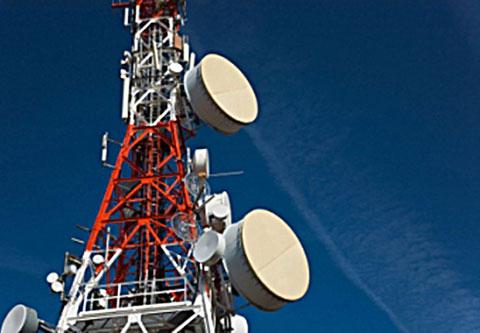
Mast
By Emmanuel Elebeke
The Nigerian Telecommunications sector witnessed a 0.8 per cent marginal decline in the first quarter of 2015. In the latest quarterly report released by the National Bureau of Statistics, NBS, the sector contributed N1,344,489.25 million (8.38%) to total economic output for the opening quarter of 2015, in real terms, as against 8.46 per cent recorded in 2014.

Mast
The opening quarter NBS said, recorded a real growth rate of 5.36 per cent, a rise of 0.61 per cent points from the 2014 average growth rate, which was 4.75 per cent According to the report, the share of telecommunications in real GDP has fluctuated between a relatively narrow margin between 2010 and Q1 of 2015, peaking at 9.32 per cent in Q1 of 2010, and reaching a low of 7.68 per cent in Q3 of 2012.
However, it noted that the annual averages of the growth showed steady marginal declines; from 9.03 per cent of real GDP in 2010, it declined to 8.68 per cent in 2011, with marginal declines of 0.04 per cent points in 2012, 0.07 per cent points in 2013 and 0.11 per cent points in 2014.
Total Subscriber base 2002-2014
The report showed that the total number of subscribers in the Nigeria’s telecom sector between 2002 and 2014 has been increasing rapidly over the period of review. From just 2.27 million registered lines in 2002, there were 127.61 million in 20141, indicating an annual growth average of 46.29 per cent between 2002-2014, with the highest rate recorded in 2004 at 153.65 per cent, whilst 2011 saw the lowest rise, of 8.53 per cent.
The 8.97 per cent growth recorded in 2014, NBS said, represented an additional 11.44 million subscribers in that year alone. The report showed that the nation’s teledensity has grown roughly equally to that of subscription rates, imply that subscription has grown at a similar rate to population growth.
However, there is no limit to the number of subscriptions per person, meaning that some individuals or even businesses may have two or more lines, inflating the figure to make it appear that a larger portion of the population has access to mobile phones.
The study revealed that in the month of April 2015, mobile subscribers using GSM dominated the market, with 98.34 per cent of the total, followed by Code Division and Multiple Access (CDMA) with 1.54 per cent of the total, whist fixed wire and wireless make up 0.09 per cent and 0.04 per cent respectively.
A total of 143,057,324 subscribers were registered with GSM technology to the fournetworks of MTN, Etisalat, Globacom and Airtel as of April 2015. From all indication, MTN dominated the number of subscriptions, with 61,218,803 subscribers or 42.84 per cent of the total number. Globacom followed with 21.00 per cent, whilst Airtel came third at 20.48 per cent and Etisalat was fourth with 15.69 per cent.
The report indicated that since May of 2014, monthly growth in GSM subscribers has averaged 0.95 per cent, with the greatest increase being recorded in December of 2014 at 1.97 per cent and the lowest in July of the same year at -0.43 per cent.
According to NBS, the growth in subscribers was mainly driven by Globacom, which recorded an average rate of 1.45 per cent over the period, followed by Etisalat with 1.37 per cent and Airtel with 1.29 per cent, whilst MTN recorded the lowest average monthly growth in subscribers at 0.44 per cent.
The greatest monthly growth rate of the four networks was recorded for Globacom in July of 2014, in which the number of subscribers increased by 1,637,543 or 6.37 per cent. The lowest rate was recorded for Airtel, in which in July of 2014, 436,260 or 1.72 per cent fewer subscribers were recorded.
Mobile subscribers for CDMA
Of the 2,234,302 mobile subscribers using CDMA technology in the system, 2,220,069 (99.36%) were with Visafone as of April 2015, whilst the remaining 14,233 (0.64%) were with Multilinks. The total monthly growth rate between the May 2014 and April 2015 period averaged 0.68 per cent.
According to the NBS, this was completely driven by growth in Visafone subscribers, which recorded an average of 0.76 per cent growth, whilst Multilinks recorded negative growth of 7.00 per cent. The findings showed that Multilinks recorded negative growth in every month of review, with a total decline of 17,597 subscribers between May 2014 and April 2015. The strongest monthly growth was recorded for Visafone in August of 2014, in which subscriber numbers increased by 205,599 or 10.31 per cent.
Outgoing Porting
Still in the same period under review, the four network carriers recorded a total of 15,357 active subscribers leaving their networks in April of 2015. Of these, MTN recorded the highest number, with 8,161 (53.14%) of the total leaving the network for another. Airtel followed, with 3,381 subscribers (22.02%), and Globacom came third with 2,038 (13.27%) whilst Etisalat had the fewest wishing to transfer, at 1,777 (11.57%) of the total.
Over the period of May 2014 to April 2015, monthly growth in subscribers transferring away from their network averaged 2.96 per cent. The move according to NBS, was primarily driven by MTN, which recorded a monthly average of 8.71 per cent for the same period. The only carrier to record negative monthly growth over the period on average was Globacom, which had a rate of -1.75 per cent.
Incoming Porting
According to the study, a total of 15, 519 active subscribers joined a different carrier in April of 2015, representing just 0.01 per cent of all mobile (GSM) subscribers. Of these Etisalat, received the most, with 9,875 (63.63%) of the total, followed by Airtel with 2,993 (18.90) and Globacom with 1,717 (11.06%), while MTN received the fewest subscribers at 994 (6.41%) of the total number that ported.
Monthly growth in receipt of subscribers transferring carriers averaged 2.73 per cent between May of 2014 and April of 2015. This the report indicated was driven by Etisalat, which averaged a rate of 11.45 per cent over the same period.
Disclaimer
Comments expressed here do not reflect the opinions of Vanguard newspapers or any employee thereof.