
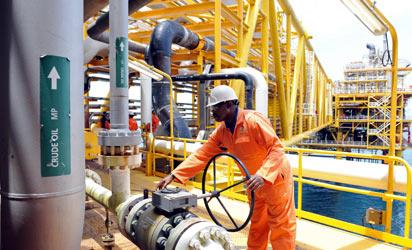
Oil Installation

By Ediri Ejoh
THE inability of the country’s natural resources to be adequately harnessed for socio-economic growth has been attributed to the continued believe by government that raw mineral resources are primarily meant to generate foreign exchange earnings. This assertion was made last week by Prof. Wumi Iledare, an internationally renowned petroleum economist, at the Nigerian Mining and Geosciences Society, NMGS, Annual Lecture, held at the Nigerian Institute of International Affairs, Lagos.
Iledare, in a presentation titled; ‘‘Roles of Solid Mineral to National Development,” discussed the strategic option available in growing the solid mineral industry as a driver of the economy. He also highlighted the challenges facing the mineral resources sector, and cautioned that the country’s policy should not be driven solely for foreign exchange earnings.
The University don also argued that no economy can survive when all the resources it needed to produce locally are exported, and urged the government to focus on ensuring that the raw materials are also utilised and consumed locally. He further noted that other major commercial mineral resources available across the country’s landscape have not been fully developed in commercial quantity, because the Constitution vests the propriety right of all mineral resources in the country on the Federal Government.
According to him this right empowers the government to solely decide on which aspect of the resources to be developed at the expense of others. He said: “Nigeria needs to develop a strong rule of law which would help to accomplish the development of the solid minerals sector having being hit with the revenue decline and poor development owing to dependency on the oil and gas sector.”
Although the solid minerals industry in Nigeria is ranked among the top ten, he also warned that care must be taken to ensure that the prospect of value addition and developing of the mineral industry is not developed the same way as the oil and gas industry. Highlighting some of the challenges facing the growth of the country’s natural resources, the Professor said all the mineral resources can be developed in commercial quantity.
He however charged that priority must be given to few resources that can displace the oil and gas sector for effective growth, while warning the government to avoid the perception that foreign exchange earnings are attributes of growth and development.
According to him, “The expansion of the oil and gas sector has undermined other major minerals. Privatisation of the mineral industry most follows due process. The solid minerals must be developed because the country’s oil reserves are on the decline. It is high time to formulate policy to diversify the economy. The competition for oil and gas is growing in Africa; almost all the countries in the continent have discovered oil and gas. It is time to reposition Enugu State as coals city hub.”
He however urged the industry players to collaborate with the government to formulate the right policies, as there is a need to provide government with prerequisite human resources, training and intellectual structures needed to drive the industry. He called for the training of mining engineer, mineral processing engineer and other economic managers to sustain the industry growth, and urged government to develop the various infrastructures to cater for the mining sites and locations across the country.
He charged the government to ensure that the professionals within the solid minerals sector are properly appointed to head the sector, while the operators must ensure that they are adequately involved in the formulation of fiscal policies to drive the sector. He lamented that the existing fiscal regime is too harsh for investors to invest in the country, adding that such a regime must promote effectiveness, efficiency and stable fiscal terms to facilitate foreign direct investment.
“The administration of President Mohammadu Buhari must be committed to the passage of the 2007 Nigerian Mineral and Mining Act, which promotes the regulatory framework, favourable fiscal regime, health safety and a solid institutional framework. The extractive industry must be situated in such a manner as to ensure that it maximizes the welfare of the people and not the elites. The process for the issuance of certificate to the operators of the mineral resources must follow due competitive biddings and not discretionary means which characterised the oil and gas sector,” he said.
He further charged the present administration to effectively interpret its policy direction, noting that despite the growth recorded in the Gross Domestic Product, GDP, which makes Nigeria the biggest economy in West Africa; the country has only recorded about five percent growth, without a commensurate economic growth.
Disclaimer
Comments expressed here do not reflect the opinions of Vanguard newspapers or any employee thereof.