
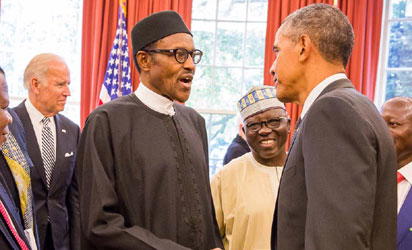
President Muhammadu Buhari and President of US Barack Obama during a meeting
By Rotimi Fasan
DAYS before President Muhammadu Buhari embarked on his official visit to America at the invitation of the US President, Barack Obama, many Nigerians appeared anxious. It was clear they could not be sure what would be the outcome of that visit. Their anxiety level had been raised by some commentators who could neither see nor be bothered by what the trip would achieve.
For many of these commentators, the president’s visit to the US was nothing but yet another opportunity for the Americans, especially their president, to issue strictures to Nigeria on how to tow the line drawn for us by America. For them, Buhari’s visit to America was a clever ploy by Obama to impose his pet project of gay rights protection on Nigeria.

President Muhammadu Buhari and President of US Barack Obama during a meeting
For many Nigerians already fired up by these commentators , the outcome of Buhari’s visit would be nothing other than to open the door wide for gays and lesbians to begin to look forward to that day when they too can say “I do” to those they are in love with.
These commentators therefore drew up a shopping list of items for the president, several of them being failed projects of the Jonathan presidency. At the top of this was an arms deal for the Nigerian military in its fight against Boko Haram.
In addition to opposing Obama on the gay right matter, Buhari was expected to return home with an arms deal and a few other things thrown in or his trip would be considered wasted.
As it has turned out, Buhari returned from the three days trip last week without securing an arms deal, and those who never thought he would survive what they thought would be the rigour of the trip to say nothing of securing any arms deal are already describing the trip in unfavourable terms. What even appears to have got them really riled up is Buhari’s plan, declared during the US trip, to bring members of the Jonathan administration found to have been corrupt to justice.
After six years of the Goodluck Jonathan administration, time during which the president appeared to have commanded little or no respect from Nigerians to say nothing of the international community, it is understandable why many of his supporters would think Nigerian leaders are condemned to second class status.
America looks out very well for its interest and perhaps only those who share these interests or believe in the possibility of their achievement are seen as America’s friends. But America also knows those deserving of their respect. They certainly didn’t think Goodluck Jonathan belonged in that class. And this was not simply a consequence of America’s usual arrogance. It has more to do with the near collapse of authority, moral or political, that characterised the Jonathan presidency.
Jonathan more or less ceded authority to his subordinates who promoted corruption to a level that could not have inspired confidence in him or his administration. Like many Nigerians, serious countries couldn’t wait to see his government go.
When those commentators in love with the former president took on the thankless job of instructing Buhari on what to say or not to say to Obama, they mistook him for the most part for Jonathan. In criticising the purpose and outcome of Buhari’s US trip, his critics are bent on showing that he is not different from, perhaps even worse than, Goodluck Jonathan.
Thus, they forget that two months is not the same thing as six years and criticise him for being too slow. Perhaps, Buhari is indeed slow but it may be too early in the day to come to such conclusion. He, however, is deliberate, he appears to know where he is headed.
Many thought that Buhari ought to “hit the ground running” but the man says the rot left for him by Jonathan is such that he would have to look very well before leaping. This is sensible enough. Even when it may be contestable, Nigerians will know for sure when Buhari becomes too slow for their liking. For now, he should be given room to operate for if nothing else his US trip shows that America has respect for him and expect him to do much. Of course, they refused to sell him arms but he was also able to make clear that gay rights talk was not yet on the priority list of his administration. On either side what was obvious was mutual respect and dignity. There was no recrimination, or any sense that one person lorded it over the other.
The main reason America is refusing to sell arms to Nigeria is because of alleged violation of human rights. A Leahy Act forbids sales of American arms to countries accused of such violations.
However foolish this may sound given the atrocities being perpetrated by insurgents in the North-east, the real point at issue is that Nigerians must read between the lines to know why America would not sell arms to us. Corruption was a major issue, and even the administration’s military commanders could not be trusted to be fighting insurgency wholeheartedly. If anything, many members of that administration were beginning to look like war profiteers. They were very well fishing in the troubled waters of insurgency.
It got to a point nobody could trust them. Even the edge they gained over the insurgents in the last days of the Jonathan administration looked contrived and left room for suspicion. What were they doing in the previous years, many wanted to know? By refusing to sell arms to Buhari, the Americans, it would seem, are just being cautious.
They need to be sure he won’t go the way of his predecessor. This is not the era of handouts, when our leaders go abroad to be treated like younger siblings or children of foreign leaders. Buhari must win the confidence of those he wants to work with. He must earn his stripes and must be prepared to reject what he does not see as central to Nigeria’s interest. His US trip has definitely earned him and, by extension, Nigeria some respect. All Buhari needs now is to build on the respectable outcome of his visit to America.
Disclaimer
Comments expressed here do not reflect the opinions of Vanguard newspapers or any employee thereof.