
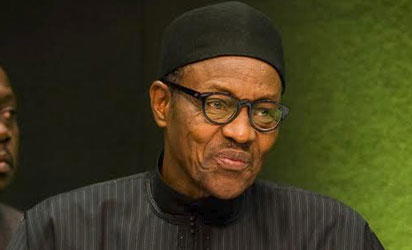
President Muhammadu Buhari chairs the meeting of the Peace and Security Council at the 25th AU Summit in Johannesburg on Saturday
By Sunny Ikhioya
THE moment we become fixated with our past, our ability to move forward positively is handicapped. Fixation with the past; that has been the Achilles heels of successive Nigerian governments. It began with the military coup plotters of the ’60s up until the Sani Abacha regime. They begin by reeling out the so called rot in the system caused by the outgoing (overthrown) regime and by the time they have stayed two, three, four years, the situation remains the same until another coup takes place, a new government takes over and the whole process is recycled again.

MUHAMMADU BUHARI
Space will not allow me to chronicle the details in this piece but for those interested, they can check out our historical archives for speeches of military coup plotters each time they took over the reins of governance right from the Chukwuma Nzeogwu to the Sani Abacha era. Unfortunately, our civilian leaders have not been able to extricate themselves from this blame culture.
They claim the rot in the system has been there for several decades, therefore the people should allow them time to settle down and by the time they are leaving after four to eight years, they are still settling down, that is why we have not been able to fix electricity and the rot in the petroleum sector.
When he assumed office in 1999, so much was expected of President Olusegun Obasanjo, all the failures of government were heaped on past military regimes and the whole country united to give him time to fix the situation, by the time he left in 2007, even the condition of the road leading to his Otta farm residence was worse than when he assumed leadership of the nation’s affairs for the second time in 1999.
By the time he was handing over power to Umar Yar ‘Adua in 2007, the condition of power was in a comatose state. Time did not allow us to really assess Yar’ Adua because of his health status but it is a known fact that he dismantled the structures Obasanjo had put in place in the power sector within a year of his taking over.
Goodluck Jonathan took over and started the rebuilding process, again, the people were told to be patient and by the time he was leaving, the situation of things did not changed much. We must begin to discourage the practice of asking for patience whenever a new government assumes office, patience has become an escape valve instead of the virtue it is supposed to be.
President Goodluck Jonathan once said that you do not need more than four years to make an impact in governance if you are a good leader and I very much agree with him. If we adopt the right approach, our challenges can be over in four years time. It does not matter how deep the rot is or how long the decay, what is important is to start immediately with a programme of recovery and stay focused on that path.
When we are fixated with the past, we give room for excuses and excuses do not get projects done, that is why we cannot wait. I will not like this government to go through that route again; while the various agencies responsible for compliance, enforcement and prosecution are busy bringing those who have committed criminal offenses against the State to justice, the government must concentrate on moving forward.
What I propose here is not new; it has been done in other parts of the world with considerable success. In fact, I picked the title of this piece from the twitter handle of the Wharton Business School. Several leading professors of the institute collaborated to research on how the Chilean government recovered and rebounded from the catastrophe that befell the country as a result of a devastating earth quake.
A quote from their report goes thus: “Although he was urged by members of his cabinet to set aside his plans for Chile’s economic recovery, President Sebastian Pinera insisted that his government stay focused on the long term goals while working to recover from the earth quake. The strategy worked; by the end of 2011, with restoration goals on track, annual GDP growth had increased to 5.8 percent, and by early 2013 unemployment had dropped from 9.0 to 6.0 percent.
The president insisted that the country’s restoration would proceed apace but also go well beyond a return to what existed prior to the quake…….the government adopted a metric based strategy, public ministries applied dozens of specific metrics to both track and administer their rebuilding initiatives for housing, education, health, construction and transportation.
Tracking goals in detail allowed for proactive intervention when specific timetables were not being reached, focusing leadership attention on underperforming areas. The government compiled detailed statistics……..President Pinera made a public commitment to restore everything within four years, asserting the importance of determination, speed, and readiness to cut through slow bureaucratic processes”.
Are we seeing the possibilities for Nigeria here? Let me quote the president of Chile again: “many people thought that it was absolutely impossible and therefore we put together this emergency plan to move very fast. This is what we are going to do, this is the timetable and this is the amount of resources that we need to fund it”. The key was to establish a programme, a plan.
It is not beyond the President Muhammadu Buhari’s administration to achieve the same result if we adopt the model of Chile as a guide. Let us free ourselves from the ghosts of the past.
Disclaimer
Comments expressed here do not reflect the opinions of Vanguard newspapers or any employee thereof.