
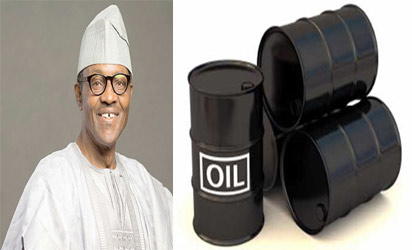
Buhari-oil
By Sebastine Obasi
When President Muhammadu Buhari, indicated that his administration will probe the $20 billion allegedly missing from the coffers of the government-owned, Nigerian National Petroleum Corporation, NNPC, he appeared to have spoken the minds of many Nigerians.

President Buhari
His resolve for the probe stemmed from the allegation by the immediate past governor of the Central Bank of Nigeria, CBN, Sanusi Lamido Sanusi, who said that about $20 billion made from the sale of Nigeria’s crude oil by the NNPC could not be accounted for.
Former President Goodluck Jonathan had sacked Sanusi after being found guilty of misappropriation of CBN funds by the …, but which many misinterpreted to be on account of the missing $20billion. The former bank chief was later crowned the Emir of Kano after the death of Ado Bayero, the former emir.
Barely three weeks after his inauguration as President, Buhari had made real his promise to probe the NNPC believed by Nigerians to be involved in opaque activities. Their belief is not out of place.
Comatose refineries
Despite being an oil producing nation, Nigeria still imports petroleum products, thus necessitating marketers to always hold the citizens to ransom through artificial scarcity and arbitrary price increase. Also, the nation’s four refineries with combined installed capacity of 445,000 barrels per day are not fully functional.
However, it must be pointed out that the comatose state of the refineries and the unpatriotic acts of the marketers preceded the government of the immediate past President Goodluck Jonathan. Right from the administration of late General Sani Abacha, no meaningful turn around maintenance, TAM, had been carried out in any of the refineries; thus leaving Nigerians at the mercy of marketers, most of whom are cronies of government officials.
Getting to the root of corruption
As welcome as the NNPC probe is, stakeholders encourage Buhari to go the whole hog of scrutinising the Corporation way back to the General Ibrahim Babangida years in order to achieve meaningful results; except he wants to indulge in a witch-hunt of only the Jonathan’s administration.
This is because many billions of dollars were also misappropriated during the past regimes leading to the Jonathan’s administration, which cannot be swept under the carpets, if Buhari’s fight against corruption is to be believed. Reacting to the development, the World Bank Chief Economist for Africa, Mr. Francisco Ferreira, said that looking into financial records of the country, especially allegation of corruption at the NNPC, would check impunity and build public institutions in the future.
He said: “One norm that has to change is the norm of impunity. I am from Brazil myself, so I am also used to a country where people could be corrupt and escape justice. That keeps the people to keep doing it.
“The current stand of the government to look into what happened in the past hopefully will have consequences for the future. And those consequences will be that institutions will be stronger; norms will be cleaner, and people will not have to steal millions of dollars from the Nigerian National Petroleum Corporation.
“People have alleged in the past that there had been major corruption scandals there. If that stops, then that will have very high returns in terms of the money staying around to be spent on education, health, roads and power that the poor people across the country need. So, my sense is that it will be good to promote cleanliness in politics.”
Also reacting, the Director-General, Lagos Chamber of Commerce and Industry, LCCI, Mr. Muda Yusuf, said the Buhari administration has a lot of cleansing to do in the NNPC. He said, “It is important that we do away with this regime of fuel subsidy payments. To prevent the economy from further haemorrhage, subsidy should be discontinued with, and the savings used to provide critical infrastructure.”
The LCCI DG suggested that revenue-yielding government agencies should be restrained from spending without approvals, whatever they generate. He also called for the amendment of the Fiscal Responsibility Act, as a way to check extra budgetary disbursements by government agencies.
For Mr. Obiora Akabogu, a Lagos-based lawyer, the probe is in the right direction. According to him, “The exercise is timely. For a long time, NNPC’s account has been in the dark and the Corporation has been a drain pipe to rip off Nigerians. This monumental fraud would have been swept under the carpet but for the former CBN Governor Lamido Sanusi who blew the whistle.
Akabogu however, accused the immediate past National Assembly of compromising on its oversight functions by giving the NNPC a clean bill of health and urged the Buhari administration to scrutinise the NNPC.
According to him, taking such a measure will serve as a deterrent. “I believe that economic rejuvenation of Nigeria should start with proper sanitisation of NNPC. It should no longer be business as usual. There should be no timeline for combating corruption,” he added.
Baring his mind on the NNPC probe, the Director, Centre for Social Justice, Mr. Eze Onyekpere, said: “It is a welcome development that President Buhari will probe the purported missing $20 billion. This will help to arrive at the veracity, truth or otherwise of the allegation, expose and punish the culprits, as well as restore public confidence in the oil and gas industry.
“What the sector needs is more than a probe of the missing $20 billion and the CSJ is calling for a probe of the entire NNPC management since the return to civil rule in 1999. There are no corresponding developments and disbursements to revenue accrued to the country in the last 16 years.
“Beyond the probe, the CSJ calls for a fundamental restructuring that will separate the regulator from being an active player, introduce private sector efficiency and pave the way for investors to finance long-term transactions and projects in the oil and gas industry.
“It is a positive process of liberalisation that will create opportunities for Nigerians and their partners to be in a win-win situation and this will remove the constraints on Nigeria’s development.”
While the probe may be a right step in the right direction, it is pertinent to mention that Nigerians are looking forward to a country where institutions are strengthened to function effectively for the good of every citizen.”
Against this backdrop, selective probing of the NNPC during the Jonathan’s regime alone is tantamount to witch-hunting, and detracts from the underlying fact to strengthen corporate governance in the petroleum industry upon which the Nigerian economy rests.
Disclaimer
Comments expressed here do not reflect the opinions of Vanguard newspapers or any employee thereof.