
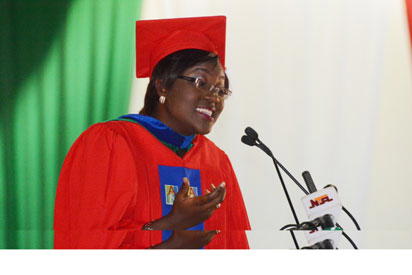
Marvellous Imabeh
By Ebele Orakpo
Community service is one of the programmes that set the American University of Nigeria (AUN) apart from other institutions of higher learning in Nigeria. In a 2013 interview with Vanguard, AUN President, Dr. Margee Ensign had said that as an American-style university, every student is required to work in one of the community development projects. “Community service (CS) is a graduation requirement for all students regardless of their major. We are a university that teaches students to understand Nigeria’s challenges.”

Marvellous Imabeh
During CS, students experience first-hand the challenges facing the country and proffer solutions. And so at the last Commencement ceremony, the Class Valedictorian/ Overall best graduating student, Ms Hephzber Ifunanya Obiora and Class Speaker, Ms. Marvellous Imabeh in a chat with journalists, spoke glowingly on how AUN has impacted them, especially the CS programme, and called for its inclusion in Nigerian university curriculum.
Community service is voluntary work intended to help people in a particular area. So AUN students are engaged in various CS projects such as STudents Empowered through Language, Literacy and ARithmetic (STELLAR) project, where they provide critical assistance to primary school children in Adamawa State by conducting after-school classes, writing books and translating same to local languages, coaching students for external exams etc.
Learning Resources Literacy project which targets teachers; Adamawa Peacemakers Initiative, established to foster peace and harmony in the region; ICT Training to various groups; Women Empowerment Initiative and Sustainability Initiative which aims to spur local economic development by providing hands-on training for local people while at the same time protecting and enhancing the environment.
Recounting her experiences at the AUN, Marvellous Imabeh said she was grateful for the location of the university. “I am grateful that AUN was not located in Abuja or Lagos. It is located in Yola where you get to see that you are privileged among other people. People would say they would give back to society when they have millions. But here, with the little you have, you start to impact people’s lives.
“Having to go for community service among poor people, you now begin to think: how do I give back to society? What do I do even when I have not finished school yet? So, everything is just, how do I give back and how do I impact?
“I suggest Nigerian universities borrow a leaf from AUN. Initially, when I came to the school, I didn’t understand why I had to do community service. But over time, when I had to go out to see people who were grateful for the little they had, compared to where maybe if they seize light for 30 seconds, you are saying ‘oh my God’, and you see people who’ve not had light for three weeks, you begin to see something that you should be grateful for. You go back and know that you are not living for yourself. You are living for a larger cause; you are sent into this world for a larger cause.”
Shun tribalism:

Hephzber Obiora.
Hephzber Obiora who received many awards including cash awards, advised young people to shun tribalism and be determined because that is the key to success. “My advice is to let tribalism go. If you work hard for something and you deserve it, you will get it. Do not say, this is the North, I as an Igbo cannot succeed. Everything has been done fairly and justly without recourse to tribalism. So, I am really happy and I say away with tribalism.
Determination:
“I have always believed that nothing can stop a man that is determined. So, I believe that no matter what is happening, in spite of the insecurity, it is God that keeps life. If you are determined to succeed, wherever you are in the country or in the world, you will definitely succeed.”
Choose courses based on your passion:
Obiora, past Honours Society president said AUN gave her the very best. “After sitting for JAMB, if you took Arts or Science, they restrict you to what you have taken. That is totally wrong. The American system gives you the chance at any given time in your life. In secondary school, I was forced into the Sciences because it is only in the Sciences that you had competitions. But I knew I loved Arts. If I had gone to Babcock University, they would have kept me in science. Although I would have made it in science but that is not where my strength is.
AUN gave me chance to change my major to English and Literature. I came here with the intention to do Information Systems because I like the name. But along the line I realised that programming is not actually my stuff. I changed to Business. I realised that this is good but when I am in my classes, I feel like writing poems instead of reading books on mathematical computation.
It was at that point I decided to switch over to English and Literature. Since then, I have been happy. I have found my rhythm. Today, there is no question in English Language or Literature that I cannot answer. I am so sure about it. “The professors teach you so much until you discover yourself, your talent, what you are really good at. In that case, you can conquer the world.”
Obiora said she hopes to write books based on Nigerian history.
“Nigerians don’t know what exactly Nnamdi Azikiwe did and who Aguiyi-Ironsi is. But then, we all claim to be Nigerians, so I will write stories based on Nigerian history. I hope that people will read them and learn more about this country.”
Imabeh said AUN gave her a chance to explore. “You don’t have that in a regular Nigerian university where you are expected to follow a set of rules in doing your course. But here, you have professors who are not too strict, who unlike most Nigerian professors allow you to explore, make your mistakes and they pick you up; you have friends who are not looking at how rich or poor you are. There is this wholeness and oneness mixed.”
Disclaimer
Comments expressed here do not reflect the opinions of Vanguard newspapers or any employee thereof.