
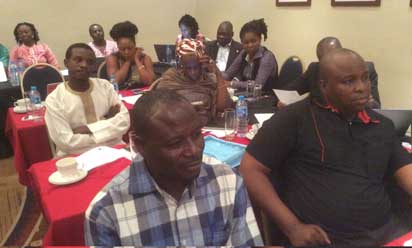
•Participants at the United Nations Development Programme, UNDP, in Lagos
By Emmanuel Aziken, Political Editor
Two months after the relatively successful general elections, the United Nations Development Programme, UNDP penultimate week, convened a review of the media coverage and performance before and during the elections.
The two-day review in Lagos on June 9 and 10 was essentially to appraise media performance with a view towards achieving a better performance by all election stakeholders in future elections.
The conference by the UNDP through the Democratic Governance for Development (DGDII), a project of the UNDP, drew participation from the media, media support groups, the Independent National Electoral Commission which was represented by the Resident Electoral Commissioner, REC, in Lagos State, Mr. Akin Orebiyi. Also present were media unions, media regulatory agencies, media support groups; men and women from the academia, advocates of development communication; gender advocates; international development partners among other stakeholders.
Among the issues that were raised during the presentations and panel discussions the Electoral Management System and Democratic Consolidation in Nigeria; Voter Education and Media Coverage of the 2015 Elections: an Assessment, the Nigerian Media Code of Election Coverage and other legal/professional frameworks; Capacity Building Initiatives: Relevance and Results; Online and Social Media; what value added to the integrity of the elections and the Media, Elections and Democratic Consolidation in Nigeria: Roadmap towards 2019.

•Participants at the United Nations Development Programme, UNDP, in Lagos
Mr. Nick Dazang, the head of publicity at INEC in a paper presented on his behalf by the head of publicity in Lagos, Mr. Femi Akinbiyi, spoke of the efforts of INEC in creating awareness among voters through among others means including “the institution of the National Interagency Committee on Voter Education and Publicity (NICVEP); a Communication Policy; a Gender Policy; and Summits for Youths and Persons Living With Disabilities.”
Mr. Lanre Arogundade a development communication expert also spoke just as Mr. Edeetan Ojo, executive director, Media Rights Agenda, ERA presented a paper titled “The Media, Elections and Democratic Consolidation in Nigeria: Roadmap Towards 2019.”
In it, he affirmed that the current government should be held accountable to its promise of “change” and its responsibility for good governance, that preparations towards building on the successes of the 2015 elections should commence and that the shortcomings of the media during the last elections be adequately addressed.
Emmanuel Aziken, Vanguard’s Political Editor, on his part spoke on voter education and media coverage and gave a narrative of his medium’s efforts in boosting awareness among voters in the process of voting. He especially highlighted how Vanguard brought created much awareness on the use of the card reader among the reading public.
He nevertheless faulted the distant relationship between the Election Management Body, EMB and many journalists especially in the area of voter education.
Following the observations and other presentations, the participants in a communiqué issued at the end of the two-day review, recommended thus:
- Government should sustain the gains of the 2015 elections by ensuring the appointment of core electoral staff and the next leadership is based on proven competence and integrity.
- Key INEC technical staff should be retained to provide institutional memory.
- INEC should continually update the Voter Register and PVC production/distribution to avoid 11th hour rush.
- Electoral reform efforts should include the strengthening of INEC’s operational control over security during elections, including the use of surveillance cameras in collation centres.
- INEC should digitize the collation of election results and improve on its logistics management and contingency planning ahead of future elections.
- INEC should decentralize and improve all its information and communication structures for better outreach.
Media
- Publicly funded broadcasters should be established in a manner which effectively guarantees their independence from political or other partisan influences, especially in editorial matters.
- All state-owned broadcasting stations should be removed from the direct control of the Minister of Information (at the Federal level) or the Commissioners for Information (at the State level).
- Existing laws establishing state-owned media should be abrogated and replaced with new laws which reflect the principles of broadcasting independence.
- Media practitioners should develop their capacity to understand existing processes and procedures relating to elections to enable improved reportage of the electoral process.
- The Media should engage in investigative reportage of parties/candidates/issues to support informed decision-making by the electorate.
- The Media should provide equal access to all political parties/candidates as well as underrepresented groups including women, youth and people with disabilities.
- Media practitioners should advocate for a Code of Conduct for Media Owners which would include mechanisms to ensure that media owners do not interfere in editorial matters.
- The media should collectively address the challenge of ownership in the editorial content of privately owned media outlets, especially in the light of the current environment where a large number of media organizations are owned by politicians or business persons with clear political interests and affiliations.
- Regulatory authorities should properly define and monitor the structure, ownership and purpose of community radios.
- Legal redress should be encouraged for any infractions by offline, online and social media.
- Civil society should join efforts to counter hate speech online and on social media.
Voter Education
- Better funding of voter education efforts should be secured by all stakeholders.
- Voter education should begin early; deliberate efforts should be made to target Nigerians in the rural areas.
- INEC, political parties/candidates, security agencies, CSOs and other relevant institutions should be collectively involved in voters’ education.
Regulators
- Media regulatory institutions should review extant codes to provide stiffer penalties and sanctions for violations of regulations.
- It is recommended that an Independent Fund for media development be set up.
Academia
- The Academia should conduct researches on media and elections and develop educational material on political communication.
Political Parties
- Political parties should run issue- based campaigns, effectively contribute to voters’ education and develop media engagement skills/strategies in order to reach the grassroots.
- Political parties should make deliberate efforts to include underrepresented groups as party candidates.
Disclaimer
Comments expressed here do not reflect the opinions of Vanguard newspapers or any employee thereof.