
Xenophobic Attack
By Rotimi Fasan
JUST when the number of days he has left in Abuja could be counted off one’s fingers or reeled off without much thought, President Goodluck Jonathan finally did what any leader who is in control of his turf does: takes the hard decisions. He ordered the suspension of the permanent secretary in the Foreign Affairs Ministry.
The PS, Danjuma Sheni, allegedly recalled the Nigeria’s High Commissioner to South Africa, or caused to be released statement to the effect that President Jonathan had recalled the country’s High Commissioner to South Africa, without clearing from the president. It is a little hazy what actually transpired. What is known from the entire episode is that Ambassador Sheni was in the centre of what is now said to be the unauthorized recall of Nigeria’s High commissioner to South Africa following the recent xenophobic attacks on Nigerians and other African immigrants in South Africa.
In the wake of these horrendous attacks, images emerged of how nationals from other parts of Africa, their property and businesses, were made targets of vicious hate attacks, leaving many to wonder what could justify such treatment. Many countries supported and worked hard for the liberation of South Africa from apartheid rule.


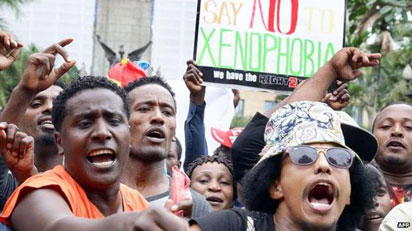
People take cover from a stun grenade and tear gas after a skirmish between locals and foreign nationals as thousands of people take part in the “peace march” against xenophobia in Durban, South Africa, on April 16, 2015. South African President Jacob Zuma on April 16 appealed for the end of attacks on immigrants as a wave of violence that has left at least six people dead threatened to spread across the country. In the past two weeks, shops and homes owned by Somalis, Ethiopians, Malawians and other immigrants in Durban and surrounding townships have been targeted, forcing families to flee to camps protected by armed guards. AFP PHOTO
Nigeria for one was declared a frontline state by the Murtala Mohammed regime, as a sign of its total commitment to the liberation struggles in South Africa. Nigeria’s oil revenue went into fighting apartheid and many young South Africans had their higher educational training in Nigeria on Nigeria’s bill. It was therefore with righteous anger that Nigerians called for reprisal action from Nigeria against South Africa that has major business interests in the country.
In spite of these calls there was no evidence of Nigerian casualties. Even now, there haven’t been any reported cases of deaths. Yet the images of people being kicked around, thrown on the floor as their businesses were set alight were enough to fuel real anger.
Given its usual lethargy in responding to such cases or coming to the rescue of Nigerians in circumstances like these, Nigerians were quick to call on Abuja to evacuate Nigerians in South Africa even as they wanted the government to respond vigorously to the outrage from South Africa. It didn’t sound strange, therefore, when news went out that Nigeria had recalled her High Commissioner in South Africa.
Perhaps, it was the response from the South African government that Nigeria overreacted to the attacks by recalling her High Commissioner, or the realisation that only a few Nigerians were indeed affected in the attacks that got Abuja reflecting again. But it was soon being bruited that Nigeria had not recalled her High Commissioner. Some other reports had it that the Nigerian High Commissioner had truly been recalled.
The report went back and forth until the presidency, through Reuben Abati, the presidential spokesperson, finally weighed in with the information that President Goodluck Jonathan knew nothing of the purported recall of our High Commissioner. But before this clarification which took a couple of days in coming, the embarrassing confusion of a government and its Foreign Ministry that are working at cross purposes had been allowed to linger for too long.
It was the second time in as many months since the Jonathan Administration would be thrown into such embarrassing cul-de-sac. Shortly before the presidential election in March, Nigeria found herself in a dirty diplomatic spat with Morocco over a purported phone exchange between President Jonathan and the Moroccan monarch. While Morocco said there was no phone discussion between both leaders and all but called Jonathan a liar, Nigerian diplomats insisted there was a phone call. These went on for days before Reuben Abati confirmed no such discussion took place between President Jonathan and his Moroccan counterpart.
What both diplomatic incidents showed is the soft underbelly of the Jonathan Administration, the very problem many Nigerians and outsiders have observed about the Administration’s incoherence and the fact that there are simply too many power centres within the Jonathan presidency. Jonathan had allowed himself to be a victim of too many of his subordinates who probably have such little respect for his leadership ability that they erode his authority and take upon themselves tasks clearly meant for the president. Certain female ministers in the outgoing government were so deluded by their sense of importance that they clearly arrogated to themselves power they do not have. They took decisions without recourse to the presidency and were not in the least embarrassed about this.
The Pricewater Coopers report on the Nigerian National Petroleum Corporation shows some instances of this brazen and unauthorised use of power. The PWC investigation that was informed by allegations of corruption in the activities of the NNPC and the alleged disappearance of billions of unremitted oil fund was stalled by failure to release vital information by NNPC officials.
Thus, what should have been and was touted as a forensic audit of the NNPC is now revealed to be a watered down version of the real thing, no thanks to the stonewalling tactics of NNPC officials. This latest incident is a sad reminder of how the president’s men and women have inserted themselves between the president and Nigerians, acting in a manner that is at the very least disrespectful to the authority of the president.
Yet, this kind of interference in presidential responsibility, of the disconnect between a leader and his minders, can happen with any leader not alert to what his subordinates might be up to. We’ve already seen it at work in the supposed order of President-elect, Mohammadu Buhari, barring the Africa Independent Television from covering the activities of the president-elect. Buhari has since issued a statement denying making such an order. He attributed the order to his ‘overzealous’ minders. This cannot be put down simply to a blame-shifting game. Some of these minders do very often cry more than the bereaved and only a perceptive leader can be alert to their more devious ways at appropriating authority they do not have.
Even leaders of the Peoples Democratic Party a few days ago called on minders of President Jonathan to desist from peddling presidential influence in manner that could be injurious to the unity of their party. Which all goes to show the danger facing a leader who leans too heavily on the wisdom of subordinates.
From the beginning of his coming President Jonathan was hardly his own man. It is a regrettable that on the eve of his departure he is still hostage to the same forces.
Disclaimer
Comments expressed here do not reflect the opinions of Vanguard newspapers or any employee thereof.