
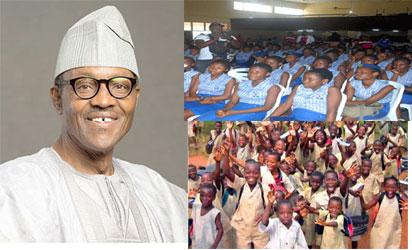
By Dayo Adesulu
Bothered by the deplorable state of our education sector, stakeholders are calling on the incoming administration of Mohammadu Buhari, to choose one, among primary, secondary and tertiary education and adequately fund it, while others should be left in the hands of private investors to strengthen. This, according to an expert, will allow the government with its limited resources to concentrate fully on a single aspect to enable it give the best to our teeming population of children.

Chairman, Board of Governors, Olashore International School, Iloko, Prince Abimbola Olashore during a forum with journalists in Lagos urged government to fund primary education to the age of ten or eleven to give them a solid base. He added that Awolowo brought free education because he wanted everyone to a have the minimum level of education.
According to him, the incoming government of Muhammadu Buhari should focus on primary education and ensure it is funded to the best. ‘’If government can fund primary education to the age of ten or eleven by giving them a solid base, the better for the country,’’ he said. The government, he noted can leave secondary and tertiary education for other private hands to handle.
Whether education is set up by government or by individuals, the most important thing, Olashore pointed out, is the sustainability of what you start. He stated, if government says it wants to provide free education for all, the question to ask is: what is the quality of education it wants to provide and how does it fund it?
In the wake of the development, he enjoins the federal government not to close down the existing federal schools, adding the new will complement the existing ones. His words: “If government says it will operate free education from primary to university level, I will doubt it because, I don’t think government has the resources to adequately fund it. The cost of getting quality secondary and tertiary education is heavy and capital intensive for government alone to fund.
“If you say you have a university that produces engineers and they cannot compete with their counterpart world over, what’s the use? If the facilities are not there in the university, you cannot produce a sound graduate in any field of study.’’ Olashore who urged the in coming administration to allow private sector invest in both secondary and tertiary education, maintained that the initiative allows government conveniently handle primary education of its citizenry.
He thus lamented that the existing regulatory policy makes it difficult for private sector to invest in education, stressing that the law regulating education in the country should be looked into. ‘’When you approach the regulatory body for establishment of a university, they tell you that before you can start, you must get hundred acres of land. That demand alone is a discouragement to investors in education.”
He advised that investors should be allowed to establish schools based on their philosophy on education, arguing that where an investor might just have vision for a Law school or Accounting school and perform optimally, others may be interested in only Medical school, as such, the regulatory body denying such person, will kill the dream and philosophy for that area of education.
He urged the government to encourage persons and never make it compulsory for investors to include other courses of study. “If such investors are allowed, it will no longer be required to acquire hundred acres of land before starting a university which will make it easy to invest in.” Considering the density of Nigeria’s population, Olashore averred that the country should have about five to ten thousand universities, adding that not all universities must have 40,000 student capacity.
“Some universities can just focus on just 1,000 students and ensure that the facilities are in place to give the best output to meet the minimum standard. That was why I said that the philosophy of those in charge of education is really important before we can fix the education sector. If the philosophy is sound, anyone can come and build on it to get the desired result.”
Olashore who said he would be very disappointed if the incoming government calls for education summit immediately he assumes power, noted that holding a summit means that the person in charge does not know what to do, hence he is inviting experts. He said: “When Buhari gets there May 29, he should not be calling for education summit by June.
For over 12 years Mohammadu Buhari has wanted to be president, he must know what he wants to do in the education sector by now and not to call for education summit. Before now, he should have called all the experts and listened to their suggestion that will help him hit the ground running from May 29.”
Disclaimer
Comments expressed here do not reflect the opinions of Vanguard newspapers or any employee thereof.