
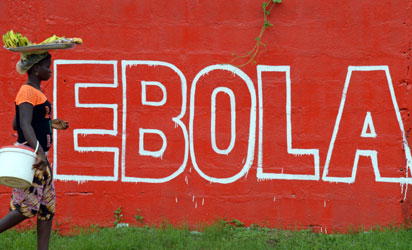
File: A seller of bananas walks past a slogan painted on a wall reading “Ebola” in Monrovia on August 31, 2014. Liberia on August 30, 2014 said it would deny permission for any crew to disembark from ships at the country’s four seaports until the Ebola epidemic ravaging west Africa was under control. AFP PHOTO
By Sola Ogundipe & Gabriel Olawale
The campaign to eliminate the Ebola virus marked a significant milestone on Saturday 9 of May, as the World Health Organisation, WHO, declared Liberia free of the Ebola disease.
At the time the announcement came, 42 days after the safe burial of the last confirmed Liberian victim of the Ebola, a period equal to twice the virus’ incubation period, Liberia was the first of the three worst affected countries to be rid of Ebola.
To date, Liberia recorded the most deaths with 4,716, followed by Sierra Leone with 3,903 and Guinea where 2,386 have died.
The success which was described by WHO as a “monumental achievement for a country that reported the highest number of deaths in the largest, longest, and most complex outbreak since Ebola first emerged in 1976.”
“At the peak of transmission, which occurred during August and September 2014, the country was reporting from 300 to 400 new cases every week. During those two months, the capital city Monrovia was the setting for some of the most tragic scenes from West Africa’s outbreak: gates locked at overflowing treatment centres, patients dying on the hospital grounds, and bodies that were sometimes not collected for days.
“Flights were cancelled. Fuel and food ran low. Schools, businesses, borders, markets, and most health facilities were closed. Fear and uncertainty about the future, for families, communities, and the country and its economy, dominated the national mood.
“It is a tribute to the government and people of Liberia that determination to defeat Ebola never wavered, courage never faltered. Doctors and nurses continued to treat patients, even when supplies of personal protective equipment and training in its safe use were inadequate. Altogether, 375 health workers were infected and 189 lost their lives.
Local volunteers, who worked in treatment centres, on burial teams, or as ambulance drivers, were driven by a sense of community responsibility and patriotic duty to end Ebola and bring hope back to the country’s people. As the number of cases grew exponentially, international assistance began to pour in. All these efforts helped push the number of cases down to zero.
The last case was a woman in the greater Monrovia area who developed symptoms on 20 March and died on 27 March. While WHO is confident that Liberia has interrupted transmission, outbreaks persist in neighbouring Guinea and Sierra Leone, creating a high risk that infected people may cross into Liberia over the region’s exceptionally porous borders.”
Liberia’s President, Ellen Johnson Sirleaf, remain cautious however. “Let us celebrate, but stay mindful and vigilant,” she stated.
While praising the international community’s help in getting Liberia to zero cases, Johnson Sirleaf said: “This Ebola outbreak is a scar on the conscience of the world. For some the pain and grief will take a generation to heal,” she said. “Therefore, let today’s announcement be a call to arms that we will build a better world for those Ebola could not reach … It is the least the memories of our dearly departed deserve.”
Disclaimer
Comments expressed here do not reflect the opinions of Vanguard newspapers or any employee thereof.