
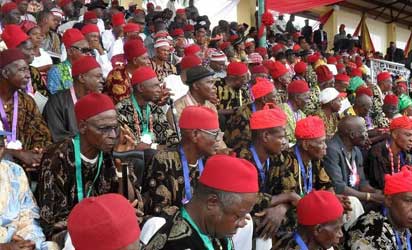
Igbo Chiefs
By Obi Nwakanma
Zoning to unzone” the words of the legendary Nigerian politician and wordsmith, Kingsley Ozuomba Mbadiwe continues to offer useful political metaphor in these times. But what those words suggest was that zoning political offices at that time reflected the stage of Nigerian politics which was still fragmented by ethnic differences.
It was needed until such a time when national cohesion would make such a venture unnecessary. We would then focus on the emergence of worthy and competent leadership at the national stage. Zoning thus was principally to lay the grounds towards a more meritocratic future. Well, that future did not arrive. Using the same old NPN formula, the PDP inserted the zoning principle in its policies, and thus, seems to have perpetuated zoning as a condition of Nigerian politics.
Zoning the most sensitive political offices in the land is absolutely problematic; however I understand the need to gesture towards Nigeria’s plurality, and the use of that framework to circulate national political privilege and representation. But I think it is about time that we reconsidered its use in filling political office. There is no better time than now with the so-called SE-SS regional bloc voting enmasse for the PDP in the national elections. As a result, these zones do not have any politician of weight in the APC to occupy potentially zoned positions in the National Assembly. This has generated a lot of hand-wringing in some quarters and even a little gloating in some other quarters.
Dr. Junaid Muhammed, not ever shy on these matters is now on record to say, the East should be served their just deserts, and be not included in the APC’s legislative leadership since they voted overwhelmingly for the PDP.

FILE PHOTO: President-elect, General Muhammadu Buhari, (middle) flanked by APC National Chairman, All Progressive Congress (APC), Chief John Odigie Oyegun, APC Chieftain and former Goverinor, Chief Ogbonnaya Ono, Eze Ndi Igbo Suleja, Amb (Dr.) Igwe Collins Chibueze Okoli, Uche Eginti Eze Udo, President General Igbo delegates Assembly (IDA) of the19 Northern States, Chief Damian Sunny Inyamah and others at the APC Presidential Campaign office in Abuja. PHOTO; SUNDAY AGHAEZE
I think I agree with Junaid Muhammed. Because the Igbo mostly in the South-East and South-South made their political choices, they are obligated to pursue those choices in the parliament of the land in the opposing bench. They could lead a formidable PDP opposition in the National Assembly, and offer robust alternatives, scrutiny, and insight to legislative governance. It is a great opportunity for the Igbo especially in this legislative cycle to place in context, the quality of their national visions on the other side of the whip, if they have such an alternative vision. A great Igbo politician should emerge as the leader of National opposition in the National Assembly, and as minority whip, lead the charge for a great legislative agenda. The APC does not have overwhelming majority in parliament. They will need the PDP to pass bills. They will have to trade horses, negotiate, seek compromise, cut parliamentary deals, and share bacons.
The Igbo might gain much more in opposition than at the center of legislative leadership. It is clear that what is important to the South-Eastern and South-South electorate must be pushed, and even where they are in opposition, not ignored even by the government in power. The Igbo do not need to be Senate President or Speaker of the House of Representatives to get their due from the in-coming administration. The Igbo do not need such positions to assert their national influence or establish their capacity. All they need is to establish a clear voice in the in-coming Assembly.
As the Igbo themselves say, “before there was rice on the menu, no one resorted to eating goat droppings.” There was such a time when Nigerians did not even have a single right to vote people of their choice. Today they do. Voting people of their choice has democratic outcomes, and the Igbo are not, and should not be afraid to live with the choices they make in a democracy. No Nigerian should therefore worry about whether Igbo occupies a position in the National Assembly or not; what should worry Nigerians is whether Igbo and other Nigerians are treated fairly in the distribution of resources that should be available to every citizen under the in-coming administration. Opposition does not mean, and should not mean political neglect. No federal program can, or should be denied the South-East or South-South because they did not vote Buhari, who on May 29, will swear to treat all parts of the federation, irrespective of religion, conscience, gender, or status equally in line with the constitution of the Republic.
To marginalize political opposition will certainly lead to problems which the in-coming administration will only do too well to avoid. In any case, in the last sixteen years, the Igbo have been Senate President; Deputy Senate President; Majority leader in the HOR, and all such. These positions may indeed have benefited the individual occupants, there is no doubt, but in what ways did it benefit the Igbo people generally? That is the question. These positions did not change the political fortunes of the Igbo of South-Eastern Nigeria. I doubt that David Mark’s job as President of the Nigerian senate benefited the Idoma, his ethnic group in the Middle belt of Nigeria, or even his state, Benue, in any distinct material or political way. It did not add more juice to Benue’s federal allocation. It did give Mr. Bonaventure Mark some personal leverage and power, no doubt; a little operating room; some leeway to do small favors, like giving jobs, a little contract here and there, to political friends and family, but it did not create a radical shift in the well-being of the Idoma in general. A formidable opposition should engage the governing party on questions of power, and the policies that might serve a wider public good.
This is what Nigerians must expect: an engagement by a PDP in opposition that should arise to either counter or deconstruct an APC ideological position and deepen the national dialogue. Remarkably, the APC and the PDP do not share any profound ideological differences, but perhaps, here is the time to begin to iron out, and thresh through the mill, a clear ideological difference in the party politics of the nation.
Here is PDP’s chance to prove to Nigerians that it should be returned to power in 2019 by creating a formidable political opposition. Here is also the Igbo chance to lead that opposition and shape the political debates leading towards 2019, and perhaps, situate the possibility of an Igbo aspirant to the presidency. Being in opposition, therefore might turn out to be a greater advantage, than a disadvantage.
In any case, the Igbo have been in opposition since May 1967 against the current political coalition that has just secured electoral victory. Mobilizing and leading a different coalition, the Igbo, as they are often wont, can transform political opposition into a vital democratic alternative by giving it sex appeal. But more vital than leading legislative opposition in this cycle, is that it is about time that the economic, cultural and political leadership of the South-East came together to design, chart and implement a new course towards the trilateral renaissance of Eastern Nigeria. That is the most urgent political imperative of our time. A weak East is no use to Nigeria.
Disclaimer
Comments expressed here do not reflect the opinions of Vanguard newspapers or any employee thereof.