
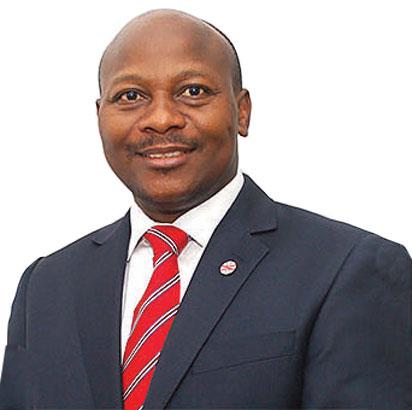
Rasheed-Olaoluw-MD-BoI
By Franklin Alli
Mr. Rasheed Olaoluwa took over as the Managing Director /Chief Executive Officer of the Bank of Industry (BoI) one year ago. He spoke with Vanguard on the milestones recorded by the bank since he assumed office. He also bore his mind on issues relating to the sustenance of the Nigeria Industrial Revolution Plan (NIRP); bid by the Bureau of Public Enterprises to privatise BoI, among other issues.
Manufacturer Association of Nigeria and NACCIMA have always complained of policy somersaults by the government. How are we sure there won’t be a sudden change in policy after May 29?

Rasheed-Olaoluwa,-BOI-MD
We believe that in terms of the current industrial policy, there are several good elements that will continue to resonate with the Nigerian private sector because many of them have been discussed at forums like the Nigeria Economic Summit Group, NESG, and so on and so forth.
So in terms of the Nigeria Industrial Development Plan, NIRP, I believe the policy is sustainable and it is not likely to suffer policy reversal.
Remember when I was talking about the NIRP, I also alluded to the fact that NIRP itself was based on a report issued by the Economic Commission for Africa. So it is really a report that says we have three types of natural resources, agricultural resources, solid minerals and oil and gas.
And how can we implement programmes that will ensure domestic value addition. I believe that the incoming administration will also find that this policy makes sense.
Could we have details of your non performing loans?
In terms of Non-Performing Loans, NPL, our NPL was relatively high in the past .However, we have embarked on a number of initiatives to manage the NPL downwards including loan recovery. Some loans that were not properly monitored, those loans have been monitored; we have engaged the customers and the payments have commenced. The summary is that today, at the Bank of Industry, our NPL is less than five percent.
Let me put this in perspective, as I always tell my colleagues, the development bank in Brazil their NPL is 2.2 percent; the development bank in South Africa, their NPL is 16.8 percent; in Nigeria among the commercial banks the average NPL in the industry is between 6 and 7 percent. So you can now situate that less than 5 percent as NPL, BoI ratio is not bad.
Last year, we recovered N2.9 billion bad debts from our customers and also blacklisted 22 other companies for loan defaults. The N2.9 billion was recovered through the efforts of our loan recovery team, the Economic and Financial Crimes Commission, EFCC and the courts.
It is the duty of the bank to lend money to companies in the large and small business sectors and to get the money back with single digit interest rate, but if the borrowed funds are not paid back it will affect onward lending to other entrepreneurs. Development finance loans are not national cake. We expect customers to pay back.
What are the challenges of SMEs?
If we want to talk about the challenges of SMEs, we won’t leave here today. The mandate of BoI is not really to try and tackle all these challenges because we are not a government; we are just a development finance bank. However, because we are a member of important government agencies and forums, we make our contributions known at those forums.
When the federal government launched the SMEs Council, BoI is a member. I attended the meeting which was chaired by the Vice President Namadi Sambo. The Presidents of NACCIMA, MAN; NASME and NASSI are members. So, these problems are being discussed at the Council, to explore solutions to them.
Do you provide technical advice and business support services to SMEs?
That was why we appointed 122 Business Development Service Providers (BDSPs) late last year. They were set up not just to provide business plans for SMEs; they are also to give those technical supports and advice in terms of several aspect of their business. We are trying to create an eco-system that can support our SMEs throughout the country to facilitate their access to the loans. The BDSPs are located across the country as well as in each of the six geo political zones.
Some of the providers are 3T Consulting Nigeria Limited; Adebola Sobanjo Company Ltd and IBFC Alliance Ltd; BoI- Investment and Trust Company Limited; BCG Associate, Fortis Academy Ltd and Nigerian Youths Chamber of Commerce. Others include World Hope Resources; Road Master Link; Koinonia Ventures Limited; African Consult Limited; Corporate Consulting Limited, Kano, etc.
How do you monitor the Business Development Service Provider?
What we have agreed with our Executive Director, SMEs is that those token fees, we will publish them. So that if an SME is applying for a N40 million loan, what he should pay the BDSP is N25, 000; if any BDSP is asking for more than that, we can blacklist the company. They signed an agreement with us and there are performance benchmarks. We have agreed upon how these things should happen and if they violate it, we can easily delist any of them.
Does BoI patronise local entrepreneurs?
The answer is absolutely yes! See all these lovely shirts we are all wearing, they are produced by our SMEs. We didn’t import them and if you actually want, we can introduce you to some of our SMEs customers. So even when we buy furniture for our offices, we buy from local SMEs –people like Sokoa chair, we like to patronize them. Even Innoson Vehicle Manufacturing Company Limited. Innoson produces made in Nigerian cars plus after sales service.
We buy pickup trucks and staff buses too from Innoson to support and encourage local patronage. Also, our partnership with the National Automotive Council, NAC, enables us to support companies who are now going to set up workshops to really do diagnostics analysis of vehicles and all that. Many of them are being set up and we hope that Innoson can also take advantage of this.
Why do you have branches in 14 out of the 36 states in the federation?
This is a very important point. We have signed MoU with 17 states. We almost signed the 18th one this week that just ended but it has been postponed again. Our experience is that when we signed MoU, it is state-matching fund. Matching fund means BoI brings 50 percent, the state government brings 50 percent. So if the loan goes bad, we suffer a loss up to 50 percent. The states government sometimes, they want to get BoI to do a kind of loans that ordinarily we won’t accept.
So what we do in that case is we have provisos in the agreement that allows the states to fund such loans from only their own portion and that gives us sufficient protection. On expansion of BoI to other states, well, Rome was not built in a day. So what we are trying to do is to do it gradually because there are cost implications. Before now we are represented in each of the geopolitical zones plus Lagos. So what the board approves for us is to have a second location in each of the geopolitical zones.
We have six geopolitical zones in the country that means six locations. The Osun state government recently came here and said we have an office just bring staff. We couldn’t resist it and as Waheed Olagunju mentioned, Cross River state has also come here and tell us we have three options come and choose out of the three locations and tell us which one you want. So it is a matter of developmental interest that each state manifest.
We will go to as many states as possible overtime as much as our resources allow and as much as states want to support us to be able to set up the offices.
What advice would you give to the incoming government?
I think I have said some of these things already. For me it is important that we begin to run Nigeria like we are now an important company in the international economic environment. We are no longer an African economy. When you become number 21 and never watch your back; there is what we call strategic national interest.
We need to define what is strategic in our national interest and to protect those interests at all cost because there are countries that will deliberately take steps to undermine Nigeria’s interests. People always complain about imports from Asia; they are all national interests; what are you doing to pursue yours. For me that is very important.
And the other thing is the fact that as everybody has seen in the last election, accountability is being brought to the fore and their consequences is also coming to the fore and this can permeates to all aspect of national life. At BoI, our staff knows that there are consequences for bad behaviours and for good behaviours. If you behave well, this is what is going to happen; if you behave badly this is what is going to happen.
I think that is how nations grow. If 200 people gather at Murtala Mohammed Airport, going to London, you see rowdiness but the same people, six hours later, arrived at Heathrow Airport, they behave orderly- the same people- why? It is because they are now in a different environment where there are consequences. So government should make sure they let people know that there are consequences for their actions.
Are you working with the Raw Materials Research and Development Council to support clusters?
Yes, I have had meeting with the Director General and we have tried to identify all the clusters. We have mandated our regional heads and state officers to identify the clusters and we will build products around them. A director once shared with me how they set up SMEs rating agency in India and also the Small Industries development Bank of India.
Now they have over 1,000 clusters in India. So we are going to work with these institutions so that we can learn best practices to implement here in Nigeria. The rest of the world is moving and we don’t want to be left behind.
Has your bank done thorough risks assessments in the Solid minerals; what do you identify as the risks in the sector?
Thank you so much. I agree with you clearly from a risk management perspective artisan mining is not the way forward. I am aware that there was a law that was passed in 2007, the Solid Minerals and Mining Act of 2007. That law is world class. What we now need to do is to implement the policy regime around solid minerals. And luckily, the Mining Act has provision for small scale mining leases; so even if it is just one local government, you can get a small scale mining lease;
you can go and do your own exploration and all that. I think what is missing in our solid mineral space in Nigeria, is that as a country, we have not develop a comprehensive and detailed geological data. So my advice to the incoming administration is that the government should fund a detailed geological data for Nigeria. Geological data is what will tell you that in this location we have so and so quantity of solid mineral, etc.
Once we have done that, we can now go ahead and conduct international bid the same way we did to GSM companies. They will come and bid, bring the money and develop the industry. Botswana earns over $3 billion annually from gold mining. The same way Nigeria earns more than 90 percent of our foreign exchange from crude oil, is how Zambia earns more than 90 percent of their foreign exchange from copper. So solid minerals are big businesses but we need to make sure we do the right thing.
Are you really where you are in terms of recapitalization?
Today BoI’s authorized capital is N250 billion, of which paid up capital is N146 billion. You are aware that government has been taking steps to priavtise BoI. In fact, just two days ago at BPE, they opened a financial bid for the appointment of advisers. So, going, not gone yet, there is a process that is ongoing. What is the exact strategy to priavtise the bank in terms of what percentage is sold we don’t know.
All we know is that it is going to be partial privatisation. We do not know what the position of the incoming administration is going to be. These are the things going on. But beyond recapitalization; our capital has always come from government. We want to take step to make sure we look for funding from other sources. This is why we are now doing rating.
What is your take on the SMEs Development Bank?
It has been launched. I don’t think they have any office yet and I am not aware of any MD appointment. Again, we keep our fingers crossed.
Disclaimer
Comments expressed here do not reflect the opinions of Vanguard newspapers or any employee thereof.