
BY LAJU IREN
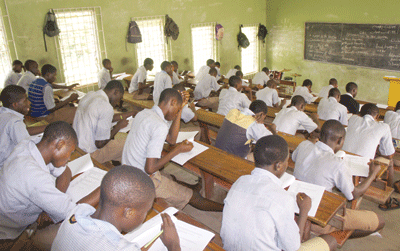
2015 is a sensitive year for Nigeria and for education on a global scale. On one hand are the nation’s 2015 elections and on the other, is the Education For All, EFA, goal set by the United Nations. Elections are underway today to select new governors for most of the states in the Federation. Many Nigerians hope this will be a successful venture, but as far as the EFA 2015 goal is concerned, all hope seems lost for Nigeria.
The nation has the highest number of Out of School Children in the world—10.5 million. So even before 2015, many had doubted that the country would be able to meet the deadline. In fact a 2014 report by the United Nations Educational Scientific and Cultural Organisation, UNESCO, said it would take more than 70 years before all children will have access to primary education. The report indicated that the greatest problems are in sub-Sahara Africa, with particular weaknesses in parts of West Africa.
Former Minister of Education, Prof. Ruqayyatu Rufai had also during her tenure confirmed that the nation would not meet the mark. Basic education, which is on the concurrent list of the budget, is the primary responsibility of the state and local governments. It is no wonder then that stakeholders in the sector are calling on the upcoming governors in the different states to make education a priority.
National Coordinator of the Education Rights Campaign, ERC, Hassan Soweto told Saturday School Life, SSL, that being Chief Executive Officers of the States and custodians of budgets, and for having direct responsibility for a considerable portion of the public education sector, State governors are a big determinant of the fortunes of education. He said: “Whatever is the policy directive of the Federal Government, if the States are not supportive, it would fail.
An example is the Universal Basic Education scheme which is presently floundering as a result of corruption but also inability of some States to access the funds. The twin cases of Benue and Kogi States where the respective governors are owing teachers months of salary arrears are further examples of how anti-worker and anti-education State governors can contribute to the failure of education sector.”
Prof. Mohammed Ibrahim, President of the Mathematics Association of Nigeria, MAN also spoke to SSL. His words: “If you look at the role of the state government in teaching and learning, most states have not been performing as expected. The first nine years of basic education are to be handled by the State Universal Basic Education Board, SUBEB. In the past, the Ministry of Education was responsible for education at all levels, but it is not so anymore. Many state governors have not been giving SUBEB their full support. But Governors must understand that there is no meaningful development without education. And the state is responsible for education at the foundational level. It’s just like if you’re constructing a building, if the foundation is not sound then there is no way the building will be strong. Education should be a priority for State Governors and any aspirant that will not encourage it is not worth a vote.”
Speaking further, Ibrahim said: “In 1962, anyone who went to primary school could do anything with his life. In those days, everyone went to public. In fact today, nearly everyone in our generation who is someone in society attended public schools.
As it is, there are some teachers in state schools that have not been paid for months. Governors need to encourage teachers. Also, they should make it a point of duty to make the first nine years of schooling free as this is necessary to eradicate illiteracy.”
The Chairman of the Nigeria Union of Teachers, Mr. .Michael Alogba also said that the Governor of a state could be instrumental in making or marring education in his state. His words: “Without mincing words, I must say that the Governor is the Chief Executive Officer of his state. It is his job to allocate resources which will in turn impact on free education, educational activities and a better outing for students in the qualifying examinations. The cost of education is capital intensive; it will therefore take a determined governor to see the realization of this gigantic objective in his state. Any governor stepping in must prioritize his electoral objectives with education at the forefront because it is the key to development. He must allocate better resources, ensure that teachers do not have any reason to strike and expose children to Information and Communication Technologies, ICT. It takes a lot of commitment to this in the face of other pressing issues. But education is on the concurrent list and within the purview of the state governors.”
Disclaimer
Comments expressed here do not reflect the opinions of Vanguard newspapers or any employee thereof.