
ANALOGUE TO DIGITAL TRANSMISSION
By Prince Osuagwu
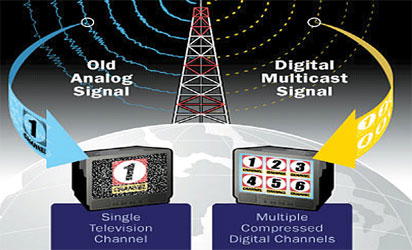
In about two months away, Nigeria is expected to join many other broadcasting economies of the world that are operating exclusively in the digital transmission space. The country actually has no choice in this, because June 17, 2015 is the deadline, world body and global telecoms regulation arm of the United Nations, the international Telecommunications Union, ITU, set for every country operating in the analogue frequency to migrate to the digital.

ANALOGUE TO DIGITAL TRANSMISSION
Although, the country, in trying to be proactive to this deadline, had set belated deadlines for herself and failed to meet up a couple of government charged with the responsibility of actualizing the migration, the Nigerian Broadcasting Commission, NBC, says there is no reason to panic.
However, the challenge of inadequate funding complained by the commission itself and low awareness of the whole fold increase in broadband penetration in the country by 2018, the federal government saw the 700megahertz band, which has been internationally adjudged very useful in deploying high-speed Internet services, as a Digital Dividend Spectrum.
According to the GSM Association, GSMA, if the transition is properly and timely executed, it is expected that the sale of analogue frequencies vacated by the broadcasters could rake in over $2 billion for the government.
Apparently bent on laying claim to that huge fund, the Nigerian Communications Commission, NCC had on two occasions in the past slated sales of these spectrums and on those two occasions failed to carry out the licensing rounds.
The reason, according to NCC, was that the spectrums were still locked, in use by broadcasters. A very reliable source at the commission told Hi-Tech that “as at today, none of these frequencies has been released despite the fact that we are on the eve of migration to digital broadcasting. Besides, we are not sure yet whether any of these broadcast media is ready for digital transmission,”
The source also hinted that for the country to increase broadband penetration from its current eight per cent to 30 per cent by 2018, in line with the Federal Government’s target, there would be need for adequate spectrum to deploy broadband services including the Long Term Evolution (LTE). Earlier, in February 2014, the regulator auctioned the 2.3 Ghz spectrum band to a national player, which is expected to commence commercial service soon.
The ministry of Communications Technology has also come to the defence of the NCC on the licensing issue. A top Director at the ministry told Hi-Tech that “NCC wants to get it right. Recall that in 2001 after the Digital Mobile Licence (DML) auction, Communication Investment Limited (CIL), one of the winners, did not pay for the licence because the frequency allocated to CIL was believed to be encumbered and it lost the licence and the deposit for same”.
According to the source, “so, the NCC wants to clear any foreseeable bottlenecks before such a major licence round” President, Association of Telecoms Companies of Nigeria (ATCON), Mr. Lanre Ajayi, said that if the NCC does not have the frequencies, it would be difficult to assign what it doesn’t have, adding “it will be an advantage for the country if these spectrum bands are released by the appropriate authority for NCC to allocate to would-be applicants.”
Surprisingly, NCC had before now held several consultative stakeholders fora on the best way to allocate the spectrum bands but on reminder that these spectrums were yet to be free, the commission said it was in its usual proactive manner, ahead of the expected release of the spectrums. However, the GSMA’s Digital Dividend Toolkit, a study which offers one-stop access to the latest policies, perspectives and best practices in managing the crucial issue of the Digital Dividend, had forewarned that “the process of clearing and awarding the 700MHz and 800MHz bands to achieve the Digital Dividend is not always straightforward.
Regulators and government bodies can face a range of obstacles, from how to justify the release of the spectrum for mobile broadband, to how to clear and possibly compensate incumbent users, and how to protect neighbouring spectrum users”
Process of spectrum handover
Already, stakeholders are waiting patiently for the digital dividend to be released by the necessary authority since frequency allocation in Nigeria has processes. For instance, if the 700 Mhz frequencies are taken over from the broadcast media by the National Broadcasting Commission (NBC), they are handed over to the National Frequency Management Commission (NFMC), which is the custodian of all frequencies in Nigeria. The commission is under the authority of the Ministry of Communications Technology.
The NFMC then decides what slots it gives out to the NCC for allocation accordingly. The NCC is expected to discharge that f unction with appropriate guidelines according to global best practices, especially as stipulated by the ITU. An industry analyst, Mr Akin Akinbo, said that the interest for the 700Mhz, particularly from operators. “The Federal Government of Nigeria has declared year 2015 as the broadband year and for mobile operators, the most technically-advanced technology for broadband offering is the Long Term Evolution”.
Disclaimer
Comments expressed here do not reflect the opinions of Vanguard newspapers or any employee thereof.