
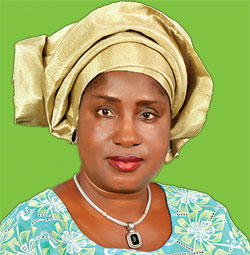
Olayinka Abdul
Morenike Taire
Another election year, another round of politicking and another spate of issues- none of them to do with the reasons why the fairer sex remains the small players on the Nigerian political scene.
The Nigerian First Lady Dame Patience Jonathan has announced on the campaign trail her disdain for the rumour that the rival APC candidature’s plan to dismantle the office of the First Lady if given a chance to preside over the affairs of the nation, come May 2015, saying women would not go back to the kitchen. The APC, in their turn, have inaugurated of the All Progressives Congress Women Presidential Campaign Initiative a vehicle with which to reach out to their female electorate.

Olayinka Abdul
And then, there is civil society, which continues to grumble about the lack of female participation in politics and government. Endless seminars and propositions on how to include more women in decision making roles in government have resulted in little change. The role of women in Nigerian politics appears to be set in stone, with the ladies at forefront of fanfare, entertainment and sharing of aso ebi, thereby bringing glamour and glitz to political events.
Many women have gone, seen and been conquered. There are those who complain that women do not have the make up to participate fully in politics not only because of their biology- which requires them to bear children as well as care for them- but also because of their cultural roles in society.
According to a woman who has dabbled into politics, been burnt, has recoiled into her shell and now wishes to be anonymous- “even in today’s modern world, there are few Nigerian men who would understand if they got back home to find their meal not ready because their wife had to attend a political meeting”.
According to her, a certain south west state which favoured a lot of women in their cabinet also recorded an unprecedented number of broken homes in that particular 4-year period, pointing to the fact that politics is not favourable to good housekeeping.
“Imagine that a woman dresses up at 10pm and tells her husband she is going for a political meeting to be back in the morning”, she further stresses. “How many men would agree to such an arrangement? A typical man would not believe that nothing is going on and would rather believe she will be spending a part of the night in the arms of a political godfather.”
There are few exceptions. Not so for sole female presidential candidate in the upcoming Nigerian general elections, professor Oluremi Sonaiya, a university don who abandoned life on campus to join the KOWA party in 2010. A mother of two children and a grandmother, Remi Sonaiya can count on the support of her family. Her husband, who is also a university professor, is her biggest fan and does not care who knows it.
In Lagos, for instance, this role sharing between the sexes has reached an advanced stage, as it has become more or less the rule for all deputy governors to be women. These women never run for office of the governor after eight years as they are constitutionally allowed to do, but would rather step down after their tenures for another woman to step up.


Funmilayo Adeyinka
This trend precedes even the current civilian dispensation and has been the case since 1990, when Lateefa Okunnu was deputy governor, with the sticky exceptions of Femi Pedro, who became deputy governor by default. Other states have joined the trend, notably Ekiti under Fayemi, where the Deputy Governor, Mrs Funmilayo Adeyinka was promptly replaced by another woman, Dr. Modupe Adelabu, a professor of Education.
Already, as the campaigns come to a crescendo, Lagos’ main contenders are already women- Alhaja Safurat Abdulkarim, running mate to the late Funso Williams; and the serving Secretary to the Lagos State Government (SSG), Dr Idiat Oluranti Adebule.
This might be seen as tokenism, and some might see women as being weak and unambitious, but this is not necessarily the case. It might well be that women’s social conditioning has helped them to develop quality quite different and complementary to men’s, making them more suitable for certain roles in the division of political labour. Such qualities might include but are not limited to flair, sense of style, diplomacy, multitasking and a variety of others.
Not only is it generally believed that women are more reliable, honest, diplomatic and much better managers to boot; until rather recently, it was also widely believed that women are less corrupt and are less likely to misappropriate public funds. In addition, they are believed to be less aggressive, unduly ambitious and are more likely to be grateful for positions given to them.
This might have been the motivation in Ogun State, where incumbent governor Ibikunle Amosun has made a switch from his first term deputy governor, Segun Adesegun, who has ended up switching camps and running against him, to 54-year-old Yetunde Abosede Onanuga, a senior civil servant in Lagos State.


Orelope-Adefulire
Unlike her predecessor, the lady deputy governor in waiting has not been able to hide her indebtedness. Speaking with journalists during her announcement last month in Abeokuta, she said she was pleased as she had been nursing an ambition to become deputy governor.
Indisposed Taraba State governor who had a plane crash that almost proved lethal as well as his supporters, may have wished he had a female deputy rather than Alhaji Sanni Danladi, who thrived to take his constitutionally recognized place at the helm of the state’s affairs rather than have an indisposed governor. That is because women are usually more faithful, loyal and peace loving.
In whatever roles however, it remains to be proved- as is widely believed- that women are better administrators than men.
Disclaimer
Comments expressed here do not reflect the opinions of Vanguard newspapers or any employee thereof.