
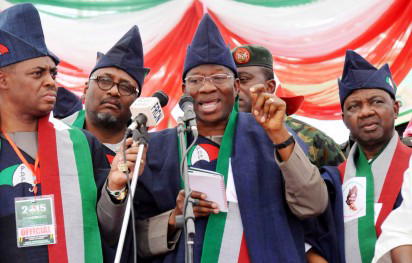
Jonathan
PDP: From The Beginning
By Henry Umoru
Following the setting up of the Independent National Electoral Commission, INEC in 1998 by the then Head of State, General Abdulsami Abubabar and the appointment of late Justice Ephraim Akpata as the Chairman, federal Government’s announcement that democratic elections would be held the following year, ending 16 years of military rule in the second republic, the doors for political activities were opened for politicians with euphoria.
Politicians, associates and stakeholders then began to meet to plan the formation of political parties that would present candidates for the 1999 Presidential and general elections. As a prelude to the formation of what is now called the Peoples Democratic Party, PDP, there was a meeting of the G4 in the Kaduna house of former Governor of Central Bank of Nigeria, CBN, Mallam Adamu Ciroma. With him at the meeting were Late Abubakar Rimi; Alhaji Sule Lamido and former Minister of Information, Professor Jerry Gana in attendance. Late Chief Solomon Lar joined and later became a meeting of the G-5.
The issue was the need to put in place a party that would form the government and the need to intimate other Nigerians of their plans which then led to the expansion of G5 to G18 and they reached out to former Vice President Alex Ekwueme. The meeting later took place at the Sheraton Hotels and Towers, Abuja with Professor Jerry Gana; Late Abubakar Rimi; former governor of Kaduna State, Alhaji Lawal Kaita; the Second Republic governor of the old Plateau State, Late Chief Solomon Lar; Late Chief Bola Ige; Chief Jim Nwobodo; Chief Richard Akinjide; Alhaji Sule Lamido; Dr. Iyorchia Ayu; Air Commodore Dan Suleiman; Chief Don Etiebet; Alabo Graham- Douglas, among others in attendance. Dr. Ekwueme became the Chairman with Jerry Gana as the Secretary.
Following plans by late General Sanni Abacha to metamorphose from Military head of State to Civilian President with groups calling on him to come out, the G18 put in place a very stiff opposition against the late military junta. G18 then wrote a very strong letter to Abacha, criticising him and kicking against his moves, saying that he could not be a civilian president and when the letter was to be published, one of the G18 members withdrew, thereby bringing the number to G17.
With the expansion of membership from G18 to G34 later, it became imperative to shift the venue of the meeting from Sheraton room 641 to a large office in Wuse 2 which is the present day office of the Peoples Democratic Institute, PDI and that formed the first Headquarters of the PDP following its registration in 1998. Now, their office is at Wadata Plaza, Wuse Zone 5. It will move later to its permanent office at the Central Business Area when completed.
Soon after its registration, there was a problem which led to the breakaway of some core Yoruba members like late Chief Ige. They left PDP to form the Alliance for Democracy, AD while some very powerful personalities like Late Dr. Olusola Saraki, Chief Emmanuel Iwuanyanwu, among others formed the All Peoples Party, APP. For the 1999 elections, Chief Akpata’s INEC registered the PDP, AD and the APP as political parties as the parties met the legal requirement with active offices in 24 out of 36 states.
With its coming on board, the PDP had broad membership drawn from traditional chiefs, academics, businessmen, retired military officers, especially popular with the army, as some retired senior officers later joined, including Olusegun Obasanjo, a former military leader of Nigeria (1976–79). He joined the party soon after its inception.
In the 1999 elections the PDP won a majority of seats in the legislature and Obasanjo was elected president. In the 2003 elections, the party secured 59 percent of the Chairmanship and Counselorship seats in 774 local government areas in the country. The PDP then won 21 out of the 36 governorship seats. They had 59 out of the 109 senate seats and 206 out of the 348 in the House of Representatives. The party maintained a legislative majority and Obasanjo was reelected president.

The PDP had an unofficial policy of rotating the presidency between candidates from the predominantly Christian south and the predominantly Muslim north. In 2007 the party’s candidate was late Umaru Musa Yar’Adua, a Muslim and the governor of the northern state of Katsina with his Vice presidential candidate as Goodluck Jonathan, a Christian and the then governor of Bayelsa state. Yar’Adua was declared the winner of the 2007 presidential election, even as international observers strongly condemned the election as being marred by voting irregularities and fraud which the late president attested to.
In 2010 power shifted to Jonathan, who assumed the role of acting president in February after Yar’Adua fell ill; he was subsequently sworn in as the President following Yar’Adua’s death in May, 2010. Jonathan’s announcement in September about his intention to run in the 2011 presidential election generated much controversy leading into the PDP’s presidential primaries, held in January 2011.
Following Jonathan’s readiness to contest the 2011 Presidential election, there was the emergence of the Mallam Adamu Ciroma led Northern Political Leaders’ Forum, NPLF, a group that was vehemently opposed to Jonathan’s Presidential ambition and at the end of the day, former Vice President Atiku Abubakar emerged the consensus candidate for the north to face Jonathan at the primaries. Jonathan defeated Atiku Abubakar. All is now history.
Jonathan was victorious in the country’s 2011 presidential election, which was deemed largely free and fair by international observers.
PDP’s PAST NATIONAL CHAIRMEN
With his role in the formation of the PDP at its embryonic stage, former Vice President Alex Ekwueme became the first protem national chairman, the position he held for about three months following which he stepped down for his Presidential ambition on the platform of the party.


Alex Ekwueme (centre)
After him was Chief Solomon Lar, the Second Republic governor of the old Plateau State. Lar conducted the first national convention of the party in Jos where Gen. Olusegun Obasanjo rtd defeated Ekwueme to fly the party’s presidential ticket in the 1999 election. He was in office as national chairman until November 1999 when Chief Barnabas Gemade became the national chairman, having defeated Chief Sunday Awoniyi to emerge the first elected national chairman of the party.
Gemade, served out his two year term, but his attempt to seek re-election in 2011 was stiffly resisted by Obasanjo who replaced him with Chief Audu Ogbeh.
Ogbeh who was elected for four years following the adoption of amendments to the party constitution allowing party officials to serve for four years, did not complete the term because he fell out with the then President as he became critical of Obasanjo’s administration.
Ogbeh who is now a Chieftain of the All Progressives Congress, APC was forced to resign as PDP National Chairman. He was replaced by Col. Ahmadu Ali, first in acting capacity and was subsequently elected at the national convention in 2005.
At the end of his tenure in 2008 and following the zoning of the office of national chairman to the Southeast, Prince Vincent Ogbulafor, who originally was a member of the opposition All Peoples Party, APP emerged as a consensus candidate.
Ogbulafor from Abia State was also forced to step down in May, 2010 and a replacement was found for him in the person of the pioneer National Secretary of the party, Dr. Okwesileze Nwodo who hails from Enugu State.
Amidst the intrigues that occurred, Nwodo was also forced to resign and the then Deputy National Chairman, Dr. Haliru Mohammed from Kebbi became the Acting National Chairman and following his appointment as Minister of Defence, the then National Secretary, Abubakar Kawu Baraje then became the Acting National Chairman.
Alhaji Kawu Baraje served as national chairman until the election of Dr. Bamanga Tukur in March 2012. Tukur continued from where Nwodo stopped in his re-engineering efforts. He pledged to sustain the e-registration project as part of his efforts to remove the party from the grips of the governors. Tukur quite unlike his predecessors also had the infamous reputation of severally quarreling with his National Working Committee, NWC members.
With the in – house quarrels, Tukur was forced to resign and former Governor of Bauchi State, Alhaji Adamu Muazu stepped in January, 2014.
PDP WILL RULE NIGERIA FOR 100 YEARS, BOAST PARTY MEN
Since 1999, the PDP has been in power administering the country, with its leaders boasting of ruling Nigeria for one hundred years. First it was the former National Chairman, Prince Vincent Ogbulafor who said the party would rule for sixty years, then the present National Chairman, Adamu Muazu and National Vice Chairman, North West, Ambassador Ibrahim Kazaure increased the years the PDP would rule to one hundred years.
HOW JONATHAN EMERGED AS PDP PRESIDENTIAL CANDIDATE
Prior to the formal declaration of President Goodluck Jonathan for his re- election bid, the National Executive Committee, NEC of the PDP at its 66th NEC meeting adopted him as the party’s sole Presidential candidate for February 14 Presidential election.
The party’s highest body explained that the move became imperative because no serious party would change a winning team, saying that President Jonathan has performed well with his transformation agenda.
As a preclude to the adoption of President Jonathan by NEC, Governor of Niger State and Chairman, Northern States Governors’ Forum, NSGF, Muazu Babangida Aliyu who spoke first and on behalf of all the PDP governors told NEC members that at the meeting of the governors at the Akwa Ibom Governor’s Lodge, Asokoro, the governors had unanimously endorsed President Jonathan as the party’s sole candidate for this year’s election without any dissenting voice.


President Jonathan
President Goodluck Jonathan who accepted the endorsement as the sole candidate by all the organs of the party, said that he was really humbled, overwhelmed and promised not to disappoint the PDP governors, the leaders, stakeholders and members of the party.
He said, “Let me really say that the events of yesterday, starting with BoT meeting last night, what just happened today, with the various motions adopting me as sole candidate of the party have really humbled me.
“Let me specially thank our governors that initiated that action, let me thank members of BoT, let me thank the senate president and members of the National Assembly, let me appreciate the PDP women for their position and the NEC. Adopting me as the sole candidate of the party has humbled. me; I am totally overwhelmed. Although House of Representatives started it, governors intervention was like an atomic bomb. I commend all departments of the NEC.
“I am so overwhelmed that I lack words to express myself. I leave it for another day. For today, for you to have that kind of confidence, I am extremely challenged. It means that whatever we had done in the past years, we’ll triple it. That is the only way Nigerians will appreciate it. I promise I will not disappoint you.”
With the arrangement, the party fenced out other aspirants as only one presidential form was said to have been printed because for the first time, the PDP gave a sitting president, the right of first refusal. Governor Sule Lamido who was rumoured to be interested in going for the position, however jettisoned the idea.
Even after the endorsement of Jonathan, there were efforts by son of Nigeria’s late prime minister, Alhaji Abubakar Tafawa Balewa, Dr Abdul Jelil to purchase expression of interest and nomination forms. He was frustrated as the doors were closed behind him.
He was later cajoled to step down which he did to allow for the President the sole presidential candidate of the PDP. Another Presidential aspirant , Mrs Zainab Duke- Abiola was also denied the opportunity of purchasing the forms to contest the Presidential election.
PDP NEW MANIFESTO
At the convention, the PDP approved a new manifesto to guide all the organs of the party. The 38- page manifesto which shall be for a period of four years from 2015 to 2019, would serve as a working document for the party and the government formed by the party, even as the party also approved its amended Constitution.
CAMPAIGNS
Ahead of the elections, the PDP decided to flag off its campaign rallies in Lagos, the APC State where the National leader, Asiwaju Bola Tinubu resides and since then it has been a very hectic exercise of criss- crossing the 36 states of the Federation and the Federal capital showcasing to Nigerians what it has done as a party, what it intends to do for Nigerians if voted today.
When the campaigns started, the party dissipated energy on Buhari and rarely addressed issues. Buhari’s certificates, his age, his health, his family, his past as a military dictator, among others reared their heads, the campaigns were more of abuses just as the Director, Media and Publicity, Chief Femi- Fani Kayode continually accused the presidential candidate of the APC of lying under oath and asked him to present himself to the nearest police station.
But as the campaign train of the PDP moved to other parts of the country like Kogi, Kaduna, Akure, Porthatcourt, Ibadan; Lafia; Osogbo; Katsina; Kano; Ilorin; Jalingo; Calabar; Benin; Uyo; Makurdi; Gusau; Bauchi; Abakaliki; Owerri; Abeokuta, Sokoto; Kebbi; Jos; Enugu; Abuja, President Jonathan and leaders of the party began to raise issues, began to tell Nigerians what it has done as a party and what it plans to do after the elections.
In other states, he called for peace among party leaders like in Ondo State when he urged the governor, Olusegun Mimiko, former National Legal Adviser of PDP, Chief Olusola Oke, business mogul, Jimoh Ibrahim to sheathe their swords and work in unison.
As PDP was still on with its Campaigns with two states and the FCT left, INEC Chairman, Professor Attahiru Jega on Saturday, February 7, 2015, Invoked the provisions of the following in the 1999 Constitution of the Federal Republic of Nigeria as amended: Section 76(2), Section 116(2), Section 132(2), Section178(2) and Section 25 of the Electoral Act 2010 as Amended, and announced the shifting of dates of the polls. The shift for a period of six weeks, came after weeks of anxiety, tension, despondency, allegation and counter allegation as well as INEC’s series of meetings with political stakeholders.
Jega who gave a plethora of reasons why the Commission had to change the dates, stressed that the postponement of the election then became imperative against the backdrop of the security situation in the country, just as he disclosed that the security agencies had said they could not guarantee the safety of INEC staff, election materials and the electorate, and that since the electoral body could not compromise the safety of its staff, the election had to be shifted. Although INEC appeared not ready the party in government pushed for the postponement.
Jega who explained that the poll shift would among other things, allow extra time for a newly constituted multinational force to secure the North-East, which was being ravaged by members of the Boko Haram sect.
According to the INEC boss, the Presidential and National Assembly elections earlier slated for Saturday, February 14, 2015, will now hold on Saturday, March 28, 2015 while the Governorship and State Houses of Assembly will hold on April 11, 2015. The shift of date gave room for PDP to campaign more especially as it appeared they faced gloomy day. They cried out over alleged imbalance in the distribution of Permanent Voters Card, PVCs and complained about the use of the Smart Card Readers ( SCRs).
Disclaimer
Comments expressed here do not reflect the opinions of Vanguard newspapers or any employee thereof.