
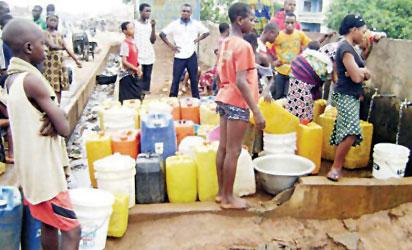
Lagos residents at a public water supply point
MARCH 22 was the World Water Day. It was the 22nd anniversary of the United Nations World Water Day.
The theme, Water and Sustainable Development, aptly captures travails of living in Nigeria, where the Water Day is celebrated with rehashed speeches, indicating poignant disregard for develop-ment handles water provides.
The connec-tions between water and sustainable development and their impacts on the lives of people across the world have drawn attention to the resource and its uses. Many countries have realised that without water, development, prosperity and successes are impossible.

Woman fetch water from a local pond, which is a source of drinking water. Photo by E. Staub, courtesy of the CDC and The Carter Center.
Among objectives the United Nations set for the World Water Day, are identifying policies, approaches and solutions to water uses and sustainable manners to achieve greater economic and social impacts. Relevant stakeholders in water and sustainable development should be engaged in charting more water and development linkages. For Nigeria, focus on water is critical to the attainment of the economic and social prosperity. Water is very essential to survival.
Sustainable development is impossible without water, which is crucial for energy, health, industrial, commercial and social engagements. Yet none of contestants for office is approaching the matter with any discernible manner. Issues of water and their implications are profound.
The lackadaisical approaches to water and sustainable development are difficult to understand against the background of the general improvements they can make on lives, and creating jobs across industries and various enterprises. Nigeria’s situation is worse: we do not have drinking water.
Water defines some countries. Water is so important that nations go to war over it. Egypt and Ethiopia cannot do without the Nile. Their agriculture, electricity, and water for other daily affairs, draw from the river they share with Burundi, Democratic Republic of the Congo, Eritrea, Kenya, Rwanda, Sudan, South Sudan, Tanzania, and Uganda.
The 6,650-km Nile, the longest river in the world, serves over 450 million people with more than 200 million of them depending directly on it for their food and water security. The linkages from the uses of the Nile affect both economic and social lives of their peoples. Agreements on the uses of the Nile date back to 1902.
The larger national picture is of urban areas without safe drinking water sources. The hazards from such living, which is worse in rural Nigeria, are ominous and hamper sustainable development.
Lamentations about the poor state of our energy and water infrastructure should stop. Government budgets for the sectors are so low that it is obvious they cannot solve the problems. Sustainable solutions to Nigeria’s water and development crises lie in more robust and sustainable partnerships with the private sector, and users, with emphases on more efficient uses of this valuable resource.
Disclaimer
Comments expressed here do not reflect the opinions of Vanguard newspapers or any employee thereof.