
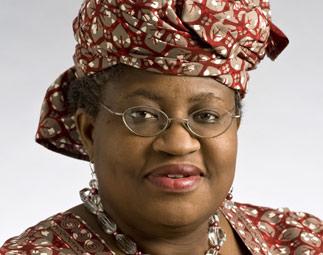
Okonjo-Iweala: Begs for time
by Morenike Taire
As global pop idol Beyonce said in her song: who runs the world- girls, the world appears to be in a frenzy over female participation in public life, and Nigeria has been no different. It’s been said, in fact, that Nigeria at present is being run by women.

Mrs Johnson
As the present administration draws to a close, a lot has been made of its fulfillment of the campaign promise, in 2011, to accommodate women into almost 35% of the ministerial slots, beating even the Obasanjo administration which actually gets the credit for starting the inclusion trend. In addition, it assigned them to some of the most critical ministries to the economy.
There are however two questions being asked: how much have these women fared in the improvement of the living conditions of the Nigerian woman and how much have they fared in showing women to be more transparent/ better administrators, as the myth goes?
They came…
Though the administration was inclusive at the beginning, a good number of the originally deployed women were unceremoniously sacked, including Ms Amal Pepple, who is from Rivers State and is believed to have lost her job for being unable to read the President’s mood on the crisis in the state. Although Pepple was not nominated by Governor Rotimi Amaechi, Pepple was said to have shown too much concern for her state, causing the presidency to be suspicious of her loyalty.
Amongst the casualties were erelu Olusola Obada who was Governor Olagunsoye Oyinlola’s number two in Osun; prof. Ruqayyatu Rufai (Education) and erstwhile Minister of Environment, Hadiza Mailafia, amongst others. Some of them were replaced by other women. Of the 8 most recently sworn-in ministers, only two are women (25%)
They saw…
Of those who were retained, some were in the eye of storms, while others recorded average performances, but at least have been able to hold on to their portfolios. Notable amongst the controversial was erstwhile Aviation minister Princess Stella Oduah-Ogiemwonyi, who was sacked in February 2014 for purchasing two BMW cars at a highly-inflated price. She tried to make a comeback purportedly with the help of some powerful Nigerians.
Minister of State for the Federal Capital Territory (FCT), Oloye Olajumoke Akinjide and Minister of Communication Technology of Nigeria, Omobola Johnson, have used their fathers’ contacts well. They have not changed the game, but at least have managed to stay out of any sustained controversy. Mrs. Johnson has been referred to in some quarters as “the perfect female minister”

Petroleum Minister, Alison-Madueke
They conquered…
To many Nigerians and the rest of the world, President Goodluck Jonathan is the one running the affairs of the country. But to former President Olusegun Obasanjo, there are five presidents in Nigeria. According to a controversial autobiography titled “My Watch” launched by the former Head of State, the four other presidents are first lady, Dame Patience Jonathan;
Minister of Petroleum, Madueke Allison- Diezani; former aviation minister, Stella Oduah and Finance Minister, Ngozi Okonjo-Iweala.
The survivors, though, are at the top of their game. Mrs. Okonjo Iwealla (Finance) was educated at the International School Ibadan and Harvard University, graduating magna cum laude with an A.B. in 1977, and earned her Ph.D. in regional economic development from the Massachusetts Institute of Technology (MIT) in 1981.
Her moment in the sun however came when she achieved through a buy-back option, a write-off of between N18 to N20 billion for Nigeria, with the Paris Club.
On January 1, 2012, the Nigerian government removed the fuel subsidy. That action triggered a nationwide riot which had Dr. Iweala in the cross-fire. She got the blame more than any other public servant for the removal of subsidy. It’s been downhill from there with regard to her public perception, but she is unrelenting. Arguably Nigeria’s most powerful woman, Diezani Alison-Madueke, has held three significant positions in the Nigerian federal government.

Okonjo-Iweala: Begs for time
She was appointed Transport Minister in July 2007. On 23 December 2008, she was named as Minister of Mines and Steel Development.
After Vice-President Goodluck Jonathan became acting President in February 2010, he dissolved the cabinet on 17 March 2010, and swore in a new cabinet on 6 April 2010 with Alison-Madueke as Minister for Petroleum Resources, making her the first woman to hold the position. She is also the first female President of OPEC, but the achievement that cannot be taken away from her is the signing into law of the Local Content bill.
Disclaimer
Comments expressed here do not reflect the opinions of Vanguard newspapers or any employee thereof.