
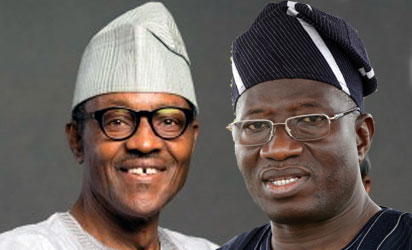
Buhari and Jonathan
By Tonie Iredia
The emergence of the All Progressive Congress (APC) cannot but be seen as a positive development in Nigeria’s political history that was hitherto replete with ineffectual political opposition. In the last one year, Nigerians have never seen a more robust opposition that gave the ruling party a run for its vast resources.

President Goodluck Jonathan and Gen. Muhammadu Buhari
The party should also be appreciated for the overwhelming awareness it brought to bear on the need for change in Nigeria. Of course, it is only a crazy nation that can continue to do the same thing while expecting different results. It is now left for the citizenry to insist that whoever comes to office on May 29, this year must effect fundamental changes to the rot in our democracy in the last 15 years. In other words, if President Jonathan returns to power, he needs to be told right way that what we want is real transformation. At the same time, if the APC takes over what we want is not a slogan but real change.
For example, in the executive arm of government, Nigerians desire strong societal institutions instead of strong chief executives. National institutions in particular should be made to perform their core mandate. The NYSC for instance has no business being turned partly into a para-military force; just as its harsh environment supposedly to build resilience is devoid of an orientation towards the main goal of national unity for which it was established.
Nigeria like every other civilized nation ought to have since done away with unwieldy bureaucracy. If it is unreasonable to have a large figure of 36 Ministers currently provided for in our constitution, it is worse that we have been having more than that figure since 1999. A serious government should push for a constitutional amendment that reduces the figure by no less 50% so that the nation can give priority to capital expenditure. Government should find courage to implement the Steve Oronsaye report which recommended the scrapping of duplicated institutions/functions. In the same vein, state governors should put a halt to their practice of appointing hundreds of 419 special advisers/assistants.
The police should be put into better use through proper funding. It should protect society and not just the ruling class. Accordingly, we should stop holding down a large number of policemen to guard related duties. The police should no longer be pressurized to be partisan; here, its posture in the defection of the House of Representative Speaker from one party to another is a good example. Only members of the House have roles to play in the selection and removal of their Speaker.
Law enforcement is a police duty and it should be equipped to do that well. If that is done the unnecessary involvement of the military in elections would not arise especially now that the Judiciary has so spoken. All security agencies should be mobilized to follow best practices in their duties. Modern facilities for security should be procured for intelligence gathering rather than the unending mundane stance which further punishes citizens through long queues caused by check points. Nigerians are waiting anxiously for when they will not be whipped off the roads for easy movements for wives of elected political leaders
The legislature in particular must change itself. First, its members should cease being the highest paid political office holders in the world. Indeed, the salaries of its members which are drawn from taxpayers’ money should no longer be a secret to the same taxpayers that the legislators claim to represent. The argument that seeks to draw a line between the salary of a legislator and his allowances is puerile because they have no right to fix any allowances for themselves as there is nothing wrong with Section 76 of our constitutions which provides that they “shall receive such salary and other allowances as the Revenue Mobilisation Allocation and Fiscal commission may determine” Also to stop are stories of fraudulent oversights by our legislators.
The senate in particular should play its proper role in assisting the nation to ascertain that only fit and proper persons are appointed to certain key offices. As a result, immature clearance should cease. As argued in this column two weeks back, a nominee permitted to take a bow and go is not cleared but exempted; yet the only mandate the senate has is to clear nominees. To exempt any nominee is certainly not part of the mandate. As for state legislators, it is time to depart from political rascality.
Legislators in states such as Rivers and Edo which ran two factions of one legislator owe posterity an explanation. In Ekiti, it is a matter for regret that in 2015, a state that lays claims to being among the most educated in the nation is where a few legislators are holding sway at the expense of the majority. It is hoped that those involved would see reason and return to sanity. We also hope that as from May 29, 2015 legislators in states like Adamawa, Imo and Enugu would decline to impeach deputy governors for materialistic considerations.
Nigerians earnestly desire an end to politicians using judges to win elections. We want an end to what happened in Adamawa state in particular where the judiciary used delay to help Governor Murtala Nyako to stay in office and later helped to remove him in an unimpressive impeachment arrangement. While our judiciary can do better, civil society groups can do much to help the nation develop. First, they need to speak out against unwholesome practices by political leaders especially our unending politicisation instead of governance.
Many of the groups who were authors of hate campaigns in the last electioneering period need a rethink. Traditional rulers constitute another group that must retrace their steps. Whereas the constitution encourages them to enjoy their respectable positions of fathers of the nation, many of them often serve as campaign managers of candidates while others are always engaged in endorsing candidates for cash. The Awujale of Ijebuland may have had his preferences but he spoke like an Oba. His Osun colleagues should note
Disclaimer
Comments expressed here do not reflect the opinions of Vanguard newspapers or any employee thereof.