
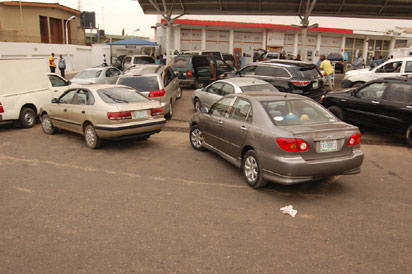
Fuel Scarcity at Ogba ijaiye Lagos.PHOTO;AKEEM SALAU
By Rotimi Fasan
IT’S just been a few weeks since the Nigerian government decided that the pump price of fuel should go down following dwindling oil prices in the international market.
The fall in fuel price did not happen immediately after the fall in the price of oil became obvious in the international market. It took months and hints of possible showdown with labour before government decided on any downward review of the price of oil.
Even at that the review did not reflect the actual percentage of fall in the international market.
From N97 per litre the pump price came down to N87 in Nigeria, even when many thought the new price could still do with more downward review. But used to not enjoying what they have in abundance, Nigerians were nonetheless grateful that there was a reduction in the domestic price of fuel at all.
This was the case even when that reduction did not translate to any reduction in the amount paid for services or commodities often subject to the vagaries of changes in fuel prices.
Cost of transportation remained the same, just as tariff on electricity seemed on the cusp of another increase. Food prices did not change in the least. Perhaps the only thing people could point to is that they paid N10 less in the amount needed to fuel their generators per litre.
But few weeks down the line, signs started showing that even the little gain that came to Nigerians by way of fall in the international price of fuel couldn’t be taken for granted. Long queues of vehicles for fuel emerged in different parts of the country just over a week ago.
This was reported in sections of the media. Speculations were rife that prices of fuel were about to fall. Some said the prices would rise.
The outcome of it was that fuel stations started shutting their gates to buyers in anticipation of what might happen. But last week, matters came to a head as long vehicular queues returned to fuel stations in Nigeria after a long while.
The reason so far given is that marketers are paying more to procure the product at the depots. Put differently, what Nigerians are being told is that the gains that they expected from the fall in oil prices in the international market has been wiped off by the even more precipitous fall in the value of the Naira.
Thus, what the people were given with the right hand has been taken from them with the left. In the voodoo economics of the experts in government, Nigeria is paying more on oil subsidy now than even when the price of oil in the international market was sky high.
Our national economy is crippled by voodoo logic for the simple reason that it manages to defy any kind of transparently meaningful explanation. Up until the prices of oil started falling in the international market, Nigerians paid high to fuel their vehicles and power other domestic products that use petrol.
The reason for this, we were told in simple language, was that oil prices are controlled internationally.
We could not expect to buy our fuel cheaper in Nigeria because the prices are determined by market forces internationally. What seemed to us to be high prices were being subsidised by government, the experts in government say.
Even when we could not feel convinced by these explanations, we had no option but to accept them and only fight back when matters boil over as they did during the January 2012 protests.
But after a sustained fall in oil prices over many months in the past year, it became obvious that the argument could no longer hold that Nigerians should continue to pay as high for petroleum as they did until the recent past. Even the revenue going into the Nigerian treasury from oil was at an all time low.
The spendthrifts who rigged their way into power as governors blamed their inability to pay workers for several months at a time on shortfall in their monthly allocation occasioned by belt-tightening measures imposed by Abuja following dwindling oil revenue.
Thus, all in all, the people in government were agreed that little was coming in from oil sales. Nigerians therefore asked for some reduction in what they pay to consume fuel if, indeed, everybody else around the world is paying less for it. How come there was no change in what they had to pay? they asked.
Grudgingly our leaders agreed to reduce the price of fuel. They took N10 off what we paid for fuel. This was not the best they could do as far as Nigerians were concerned. But Abuja felt it had done more than enough. And now, only weeks after the reduction, we are back to where we were as we are once more paying more per litre of fuel than we did even before government agreed to the recent reduction.
All through last week Nigerians paid in the region of N100 to N110 per litre for fuel. This was only possible where fuel could be got. Otherwise, the black market is again thriving in the illegal sale of fuel.
What is government doing about this? Nobody knows. Perhaps what we should be asking is what government has done to contribute to this agonising state of affairs. So far, the problem is being put at the doorstep of the government under whose watch the Naira has been devalued to the extent it is beginning to look like we are headed in the direction of those African economies whose currencies are worth less than the paper on which they are printed.
Value of foreign currencies like the US dollar, and especially the pound, has increased relative to the Naira than at any other time in our history.
As at last week, a dollar was being exchanged for about N220 in the black market. Our import-dependent economy is set to suffer more for this. The astonishing thing is that when things like this happen in other places, people and the economy have something to show for it.
There are gains to point at. But this is never the case when it comes to Nigeria. What is always clear is that we suffer the pains of currency devaluation and other economic disjunctions without ever enjoying the benefits.
And if on the other hand, prices of oil rise as we have had it for the best part of the Jonathan years, Nigerians still don’t have anything to show for this.
This may be an appropriate a time as any, therefore, to hold this government to account by deciding its fate in a manner it deserves even when the alternative would not necessarily be better considering the sharks supporting the candidacy of Mohammadu Buhari.
.
Disclaimer
Comments expressed here do not reflect the opinions of Vanguard newspapers or any employee thereof.