
FILE IMAGE
CLARA NWACHUKWU, SEBASTINE OBASI AND MICHAEL EBOH
Except urgent and immediate steps are taken, Nigeria’s quest to have sufficient refining capacity may not be achieved soon as being anticipated, because none of the fluid catalytic cracking, FCC units in all the refineries is working, investigation has shown.

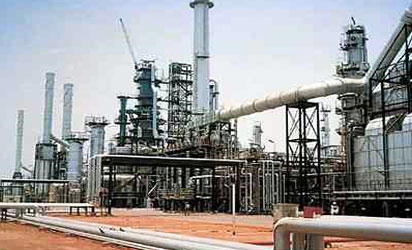
A refinery
The FCC is one of the most important conversion processes used in petroleum refining. It is widely used to convert the high-boiling, high-molecular weight hydrocarbon fractions of petroleum crude oils to more valuable gasoline (Premium Motor Spirit, PMS or petrol), olefinic gases, and other products.
Refining experts insist that without the FCC unit, it is impossible for the refineries to produce white products, such as petrol, liquefied petroleum gas, LPG or cooking gas, dual purpose kerosene, also used as domestic kerosene, and automotive gas oil or diesel. Rather the refineries will only be able to produce more of other types of low quality fuel like high or low pour fuel oil otherwise called black oil.
Operations at the refineries
At a time when Nigeria should fall back on domestic refining occasioned by the recent supply shortages in the market resulting from Naira devaluation, as marketers were unable to import, no succour came from the refineries.
Rather, due to very low capacity uitilisation, products lifting are being rationed for marketers depending on what each of the refineries is able to produce.
Operations reports exclusively obtained by Sweetcrude last week from sources in the Port Harcourt, Warri, and Kaduna refineries based on products evacuation by marketers showed that the refineries are still experiencing skeletal fuel production.
At the Port Harcourt Refining Company, PHRC, made up of two plants with combined capacity of 210,000 barrels per day, bpd, very minimal quantities of high quality fuel were being produced, as no marketer could load above 2 trucks per day for petrol. (Trucks are generally 33,000 litres). Diesel was supplied based on orders of not less than six months ago, while there was no loading of kerosene from the refinery.
From the Warri Refining and Petrochemical Company, WRPC, a 125,000bpd plant, each marketer got a maximum of four trucks daily. Like in the PHRC, diesel was loaded based on previous orders, and kerosene had not been loaded from the refinery in the last one month.
The situation is even worse in the Kaduna Refining and Petrochemical Company, KRPC, with a name plate of 110,000, the smallest of all the refineries. According to the operations’ report, there were no loading for petrol and kerosene, while before last week each marketer could only load two trucks per month but was reduced to one truck last week.
NNPC claims
But the Nigerian National Petroleum Corporation, NNPC, the operator of the refineries with combined capacity of 445,000bpd would want Nigerians to believe that capacity utilisation in the refineries have increased significantly.
In fact, the NNPC claimed that the refineries were now making huge profits, with PHRC recording a net profit of N11.2 billion last December, representing N8.2 billion or 250 per cent above the N3.2 billion posted by the company in November 2014.”
Strangely, the NNPC spokesman, Mr. Ohi Alegbe, after more than one week of written inquiry, could still not provide data on the operations or capacity uitilisationfor the refineries.
In recent statements, Alegbe quoting the Managing Director of Port Harcourt Refinery, Dr. BafredEnjugu,claimed thatthe plant continues to refine more petroleum products such as petrol, diesel and kerosene.
Also quoting the Managing Director of theWarri Refinery, Mr. Paul Obelley, the NNPC spokesman said “the company is running at 60 percent installed capacity of its 125, 000bpd.”
Capacity utilisation
However, a2014 Hydrocarbon Processing Plant, HPP Report also exclusively obtained by Sweetcrude, from a Ministry of Petroleum source, shows that none of the refineries operated up to 20 percent of their capacities in 2014 operating year.
A breakdown of the overall performance of the plants as contained in the HPP Report identified Warri Refinery with the highest capacity utilisation of 19.23 per cent, while Port Harcourt, almost twice Warri’s size recorded only 17.1 per cent and Kaduna 11.05 per cent.
Although the Report shows that in 2014 Warri received the total highest crude allocation in excess of 14.558 million barrels, it however processed only a little above 8.78million barrels, leaving an outstanding of over 5.780 million barrels. The report did not say what happened to the rest of the crude.
Ironically, Port Harcourt refineries, which received above 9.317 million barrels, processed even higher quantity of more than 9.380million barrels.
But the difference in crude received and processed by the Warri refinery during the period in review was not much, as it received more than 4.929 million barrels and processes above 4.438 million barrels.
Product output, evacuation
In terms of product output and evacuation, theHPP Report shows the Warri Refinery, which received the highest crude allocation also recording the highest product output and evacuation in the five products listed in the report.
The products included LPG, PMS, DPK, AGO, and fuel oil. But neither the Port Harcourt nor the Kaduna Refinery recorded any LPG output or evacuation in 2014 as shown below:NNPC data
But the NNPC data differs from that of the HPP Report. The Corporation in its Monthly Petroleum Information, revealed that the refineries had over a period of nine months between January and September 2014 processed 2.763 million metric tonnes, MMT, of crude oil, from the 6.254 MMT made available to the refineries for processing.
In a further breakdown the NNPC data revealed as follows:
January, 652,000 MT crude received – processed 69,000 MT
February, 903,000 MT – 497,000 MT.
March, 492,000 MT – 279,000 MT
April, 788,000 MT – 432,000 MT;
May, 985,000 MT – 560,000 MT
June, 672,000 MT – 221,000 MT
July, 966,000 MT – 334,000 MT
August, 542,540 MT – 296,140 MT
September, 253,260 MT – 74,640 MT
The data concluded by saying that in general, the three refineries in Kaduna, Port Harcourt, and Warri, recorded an average capacity utilisation for the nine months period of 16.7 per cent, 11.69 per cent and 25.52 per cent respectively.
As with the HPP Report, the NNPC data also did not say what became of the rest of the crude for the period in review.
Furthermore, another NNPC data for a 10-year domestic refining capacity utilsationfrom 2004 to 2013, showed as follows:
Kaduna Refinery achieved 26 percent, 33.8 percent, 8.34 percent, 0 percent, 19.56 percent, 22.17 percent, 20.46 percent, 22.17 percent, 29.12 percent and 29.33 percent respectively.
During the same period, Port Harcourt achieved 31.04 percent, 42.18 percent, 50.26 percent, 24.87 percent, 17.84 percent, 15.23 percent, 9.17 percent, 9.18 percent, 11.95 percent and 9.18 percent respectively.
While Warri Refinery on the other hand achieved 9.10 percent, 54.85 percent, 3.85 percent, 0 percent, 38.52 percent, 41.34 percent, 43.36 percent, 27.99 percent, 27.88 percent and 35.99 percent respectively.
Refineries’ managers speak
The Group Executive Director, GED Refining and Petrochemicals, NNPC, Mr. Ian Udoh, had earlier expressed the hope that the nation’s refineries would operate optimally up to 90 per cent capacity by 2016.
Udoh told Sweetcrudethat the Corporation commenced rehabilitation of refineries in October 2014, and that the operation was expected to last for 18 months.
He explained that the three refineries would no longer be sold or privatised; rather, they would be fixed for maximum capacity utilisation.
He said, “We are rehabilitating them, and we have started the programme of phase rehabilitation using local resources and in-house competencies spread over a period of 18 months which started in October last year.
“By the end of this year (2015) or early next year, the refineries will be in a significant better position than they are right now,” he said.
Udoh, however, corroborated claims of redundancy of the refineries, stating that the refineries cannot record significant production increase until the maintenance works on them are concluded.
He said, “However, it is not going to be a sudden jump in production, it would be gradual. We have ordered a lot of materials; as the materials come we install them using our local resources.
“It is an ongoing process that will allow the reliability of the refineries to continue improving across the period, because most of our problems have to do with reliability of the plant. We can start all of them now, but from time to time, one of the equipment will fail, or some other faults will occur, and we have to shut down to repair.”
The chief executives of the respective refineries were quoted as attributing the recent production successes claimed by the NNPC to the phased rehabilitation of the refineries, which had helped the plants in replacing some obsolete parts.
Enjugu, who oversees operations at the Port Harcourt refineries, attributed the improved fortunes of the refineries to the Federal Government’s decision to supply crude to the refinery by marine transportation; the supply of power by an Independent Power Plant, IPP; and approval for a new strategy of using in-house skills.
He also said the refineries had mapped out measures to harness various business opportunities available through its commercial department, and to rake in additional N182 billion annually from sales of deregulated products including LPG, AGO, and other derivatives.
Obelley of the Warri Refinery said the petrochemical plant, which was down for almost 18 years, had been fixed and the carbon black plant would soon be inaugurated.
As it was in the past
The Nigerian refineries had degenerated over time.In the last 18 years, the refineries became comatose, as successive governments failed to bring them up to their installed capacity due to the abandonments of the required Turn Around Maintenance, TAM, as at when due.
Even the much talked about Greenfield refineries have not made any headway, except for recent proposals by the Dangote Group to build a 650,000 barrels daily capacity refinery by 2018.
According to the 2012 Report of the Petroleum Refineries Special Task force headed by Dr. Kalu Idika Kalu, former Minister of Finance in the Ibrahim Babangida’s administration, during the early 1990’s, the refineries produced enough petroleum products to satisfy the national demand and exported the excess production.
In fact the refineries were so successful that for two consecutive years, 1991 and 1992, Nigeria earned US$124million and US$156million respectively from the export of petroleum products.
But now, the country is importing almost all of its 40 million litres daily domestic PMS requirement, which is expected to be cut down by 50 per cent if the refineries are upgraded to their full capacities.
The Task Force found that all the refineries, Warri, Port Harcourt and Kaduna, had failed to meet the normal international benchmarking standards; namely 80-90 percent capacity utilisation and 90 percent on-stream time efficiency for continuous operation.
As a result of under-capacity utilisation, the Nigerian refineries are rated as the worst in Africa, with only 18 percent average annual capacity utilisation in the period 2006-2009, according to Refineries Survey in the Oil & Gas Journal.
The Task Force also noted that apart from the volume shortfalls, the refineries have consistently been making lopsided products, with a skewed yield of products towards heavier fuels, at the expense of light products, especially PMS, which is in very high demand.
The OlusegunObasanjo’s government even tried to privatise the refineries in 2007,and got as far as selling them off, with the Port Harcourt refineries going to the billionaires’ club of AlikoDangote and Femi Otedola and a host of others, until it was forced by public outcry to rescind the decision.
Bluestar Oil Services Limited Consortium, a Nigerian consortium comprising Dangote Group, Zenon Oil, Transnational Corporation of Nigeria (Transcorp), and Rivers State Government emerged the preferred bidder/core investor for PHRC with a bid of $561 million (N71.808 billion) for 51 per cent of Federal Government’s equity in the ailing crude oil refining company.
The decision to sell off the refineries to “political cronies” was as a result of the failure of efforts to get private individuals to invest in refineries for which licences were issued.About18 licences were issued for private refineries in 2005. But none has yet come on stream.
The licencees had thought that they could go a-hawking like their oil block counterparts when they got the licence, but got stuck with thelicences, as no foreign partner of financial institution wanted to touch them, seeing as the downstream sector is still regulated.
Also, no amount of threats by government could get the international oil companies, IOCs, who are in joint venture operations with the NNPC to obey the regulation to refine 50 per cent of their crude in country under a regulated market.
Even the workers and other stakeholders are not happy with the situation in the refineries, and had over the last couple of days, staged a protest over what they referred as,“the redundancy of the refineries over the last one year.”
Specifically, the Coordinator, Coalition of the South-South and South-East Youths, Mr. GodspowerIgwe, expressed disappointment that crude now has to be transported by road to the Port Harcourt refineries.
He noted, “Even though the PHRC is working at over 70 per cent installed capacity, it is just a distance of 60 kilometres to transport crude oil from the Bonny Terminal to the place, but the use of pipelineswas terminated due to acts of vandalism, it is so sad that nothing is happening there.
“As I speak, over 10 million persons benefitting from the PHRC depot operations have been suffering due to hunger and frustration since depots in Aba, Calabar, Enugu, and Port Harcourt are directly linked to it.”
Also speaking, the Public Relations Officer,Ogoni and Eleme Joint Stakeholders Forum at the PHRC Depot, Mr. Sunday Saro, said, “Since 2014, crude was only supplied in March when the use of marine vessels to carry crude was commissioned. Crude was also available in April, May, once in July and November and that is all to date yet workers at the PHRC still collect salaries.”
If claims by the Minister of Petroleum Resources, Mrs. Diezani Alison-Madueke, about the transparency of the NNPC in terms of processes and accounting, are to be taken seriously, it is expected that the NNPC will come out clean about the true status of the refineries.
But beyond the transparency of NNPC operations, industry operators insist that now is the time to completely deregulate the downstream sector of the petroleumindustry, as domestic refining can never be profitable in a regulated system.
This is particularly so, in the light of the current slide in the value of the Naira, which now exchanges at over N200 to $1, and has completely overrode any benefits that should accrue from the falling oil prices at the international market.
Disclaimer
Comments expressed here do not reflect the opinions of Vanguard newspapers or any employee thereof.