
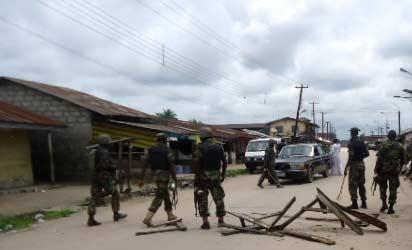
Military men on the streets of Kokori, Delta State, after Kelvin’s arrest
Ahead of the rescheduled general elections, there has been controversies over the constitutionality or otherwise of deploying soldiers during the polls. The two sides of the divide have cited the provisions of the constitution to support their positions. But the question lingers, is it constitutional or not? Two legal practitioners examine the issues.
Military in Nigerian elections — THE LEGAL ISSUES
By Ikechukwu Ikeji
RECENTLY, the issue of military involvement in Nigerian elections has become contentious such that politicians have attempted to use it to amass political capital and/or to score political points. Some see nothing wrong in bringing in the military to assist in election management processes while others view it as an aberration that should not only be condemned but must be stopped by all means.
In the light of the forthcoming general elections in Nigeria and the likelihood of the military being deployed to provide security during and perhaps after the elections, and given the opposition against this likely event, it is imperative that well meaning Nigerians weigh in with objective and legally sound opinions to help clear the maze and confusion caused by the proposition for, and opposition to, involving the military in the elections.
First, it is important to address the different facets of involvement of military in elections. Involvement may be in any of the following forms:
1. By way of being members of the electoral management body (INEC, in Nigeria).
2. By way of contesting elections as candidates.
3. By way of rendering administrative assistance or quasi-administrative support eg joining in registering voters, accreditation of voters or counting of votes.
4. By way of voting in elections
5. By way of giving security protection and/or cover to sensitive election materials or providing security against violence or sundry electoral misdemeanors like ballot box snatching or rascally or untoward conduct before, during or after the elections.
It is clear that with regards to the present involvement of the military in Nigerian elections today, nos. 1-3 are out of the question since the extant laws or conditions do not allow for them. No. 4 is clearly a fundamental right of military personnel as citizens of Nigeria to vote in elections. It is inalienable and as such, non-negotiable. It is with regards to no. 5 that issues in contention arise.
To answer the question arising from no. 5, it is important to ask the question whether there is any legal or statutory basis for the military to be deployed to assist in the electoral process. The question is, assuming it is agreed that there is need to use the military to give security before, during or after elections in the light of exigent circumstances, can the President of Nigeria, as the Commander-in-Chief of the Nigerian armed forces, lawfully deploy military under the circumstances raised by no. 5 of the points above?
Statutory provisions
To answer the above question, it is important to look at statutory provisions and juxtapose them with recent judicial pronouncements regarding the involvement of the military.
While delivering judgment upholding the election of Governor Fayose as Governor of Ekiti State, the Court of Appeal made an obiter dictum (by the way statement) pronouncement on the role of the military in the conduct of elections, saying the military ought not to have been deployed during the Ekiti governorship polls.
This is a very key judicial statement that touches squarely on prevailing arguments. However, even though this pronouncement was not part of the main judgment, some political commentators have asked the federal government to obey it and refrain from deploying the military for the elections. In point of fact, the House of Representatives has had the discussion tabled before it for deliberation.
It must be stated outrightly that nothing in the pronouncement of the Appeal Court binds the President as to stop him from deploying the military if he so decides to. This is because the power of the President to deploy the military in specific cases is premised on constitutional and statutory provisions, which may not be removed or encumbered except by express judicial declaration to the effect that the constitutional and/or statutory provisions are null and void. Since there is no such declaration of the provisions being null and void, it stands to reason that the provisions are still alive and breathing, and still operative.
The Nigerian Constitution in Section 218 clearly empowers the President of Nigeria to deploy the military in such circumstances as he deems fit to give effect to effective security of the nation or any part thereof. The Section provides as follows:
“218. (1) The powers of the President as the Commissioner-in-Chief of the Armed Forces of the Federation shall include power to determine the operational use of the armed forces of the Federation.
(2) The powers conferred on the President by subsection (1) of this section shall include power to appoint the Chief of Defence staff, the Chief of Army Staff, the Chief of Naval Staff, the Chief of Air Staff and heads of any other branches of the armed forces of the Federation as may be established by an Act of the National Assembly.
(3) The President may, by directions in writing and subject to such conditions as he think fit, delegate to any member of the armed forces of the Federation his powers relating to the operational use of the Armed Forces of the Federation.
(4) The National Assembly shall have power to make laws for the regulation of –
(a) the powers exercisable by the President as Commander-in-Chief of the Armed Forces of the Federation; and
(b) the appointment, promotion and disciplinary control of members of the armed forces of the Federation.”
On its part, the Armed Forces Act makes similar provision in Section 8 as follows:
“Section 8. Operational use of the Armed Forces
“(1) The President shall determine the operational use of the Armed Forces, but may, under general or special directives, delegate his responsibility for the day-to-day operational use-
(a) of the Armed Forces, to the Chief of Defence Staff; (b) of the Army, to the Chief of Army Staff;
(c) of the Navy, to the Chief of Naval Staff; and
(d) of the Air Force, to the Chief of Air Staff.
(2) It shall be the duty of the Chief of Defence Staff, the Chief of Army Staff, the Chief of Naval Staff and the Chief of Air Staff, as the case may be, to comply with any directive given to them by the President under subsection (1) of this section.
(3) In this section, “operational use of the Armed Forces” includes the operational use of the Armed Forces in Nigeria for the purpose of maintaining and securing public safety and public order.”
From the above constitutional and statutory provisions, it is clear that the President is empowered to deploy the military for the purpose of maintaining and securing public safety and public order. Herein lies the justification for the deployment of military to provide security for elections.
Instructively, is there any justification for the use of the military to prevent violence in our elections, given the antecedents of our elections?
Every keen and honest observer of previous Nigerian elections must answer the question in the affirmative. In the 1999, 2003 and 2007 elections, we all witnessed unprecedented levels of election violence and rigging that it was clear that the Nigerian Police was incapable of rendering security protection for elections. We also found out that the Police was not capable of living above board as they even assisted in compromising both the electoral process and the declared results. Police took bribes and turned the other way while atrocities were perpetrated. It was owing to the inadequacies of the Police that it became necessary to even use the military. Had the Police lived up to its responsibilities, there would have been no need to bring in the military in the first place.
To add to the story, as soon as the military got involved in elections, we saw a marked difference in how our elections turned out. For example, the elections in Edo State, Ondo State, Anambra State, Ekiti State and Osun State were all conducted under peaceful conditions and with very minimal rigging such that it became clear that the military can be useful to our elections until such a time that we, as Nigerians, have become orientated enough to imbibe democratic ethos as part of our culture. In the elections in the above States, we saw little or no ballot box snatching or stuffing. Even the Governor of Edo State, Comrade Adams Oshiomole commended the military for its role during the Edo State elections.
It is this writer’s humble view that the relevance and necessity of the military in providing security during our elections in present day Nigerian electoral conditions cannot be overemphasized. We can only look for ways to fine tune it to ensure minimal interference by the military in the process. It is also the view of this writer that the military in an electoral process should be used sparingly; limited to security issues and not interfere in the electoral process. It is also important that voters and other stakeholders have sufficient trust in the military if their role is to be seen as legitimate.
To all intents and purposes, the military being used for the elections can only be in such a way as to aid the successful conduct of the elections and not otherwise. To that extent, it becomes the agent of the electoral commission, INEC, who uses it in such a way that it deems fit to ensure the success of the elections eg to serve as military escort and then assist in securing counting centres. This much was stated by the Appeal Court in the Fayose case that as far as the election was concerned, the military could only be categorised as agents of INEC.
Certain foreign countries, including Latvia, allow soldiers’ participation not only in the organisational and technical aspects but also in the security preparation for elections. The military was used in the 1994 South African elections while in Bangladesh elections, the military is used in voter registration exercises because of its huge and unparalleled logistical capacity and good reputation.
Disclaimer
Comments expressed here do not reflect the opinions of Vanguard newspapers or any employee thereof.