
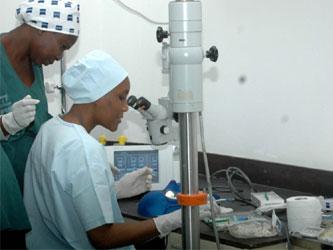
Doctors at the National Eye Centre, Kaduna, training with new diagnostic equipment for detection and prevention of blindness. (Photo: Royal Times). Concilia Concilia Umunnakwe (right) a patient of glaucoma recounting her experience.
By Sola Ogundipe
SINCE she was 13, Concilia Umunnakwe, has coped with glaucoma, a silent but irreversible eye disorder. Today, at 25, she has lost 60 percent of her sight to the dreaded ailment.
Concilia, who literally cannot see beyond her nose, blames her predicament on on gross ignorance and indifference that culminated in late detection.

Doctors at the National Eye Centre, Kaduna, training with new diagnostic equipment for detection and prevention of blindness. (Photo: Royal Times).
Sharing her experience with Good Health Weekly, the fair-skinned young lady stated that her travails began rather suddenly.
Warning signs: “I began seeing what appeared like a rainbow around any source of light whenever I attempted to glance at it.”
Concilia who shared her experience during the 2015 World Glaucoma Week event put together by St. Mary’s Catholic Eyes Hospital, Ago-Iwoye, Ogun State in conjunction with Pfizer Pharmaceuticals, recalled that she was in JSS2 when she first noticed the ‘halo’.
“My parents didn’t take my observation serious because I was still able to see quite well and put it down to stress caused by my hawking of wares for my mother after school.
“I felt no changes or pain in my eyes. I never knew the rainbow colour I was seeing around the bulb was a sign of glaucoma.
“I dismissed it. I could see well enough although I was unable to clearly see objects that were far away, such as the chalk board whenever I sat at the back of the class room.
”After my secondary school, I enrolled in a computer school for a six-month programme to acquire some skills. But on my graduation day, something quite strange happened. It was on 31st October 2009, on that day Concila became partially blind. “All I could see were shadows. Day almost turned into night. I could not tell if it was midday or midnight.
”Immediately after the event, my parents took me to St. Mary’s Catholic Eyes Hospital Ago- Iwoye, Ogun state. It was there doctors discovered I had lost 65 percent of my sight.”
It was a rude shock. Both her eyes were affected, though the right eye was worse. What Concilia thought was just a minor eye problem turned out to be a grave complication.
The doctor remarked that because Concilia had glaucoma, she was unlikely to see any sign or symptom until she had lost up to 40-60 percent of her sight.
“By that time, substantial, irreversible damage would have been done to my eyes. There is no cure and my only hope was to preserve and maintain the unaffected part.”
Not too long after, she went in for surgery.
“After the surgery even though I was still on drugs and wear my glasses, my vision remained dull and I could not see far objects. I was advised not to go out at night and when the weather is hot.”
Concilia’s case is typical of most glaucoma patients who “suddenly” discover that their sight is failing.
Silent epidemic
During the event which included a road show aimed at sensitising the community on the need to eradicate avoidable blindness through early screening, an ophthalmologist, Dr. Okwudishu Izuka, said lack of symptoms in glaucoma patients makes its detection difficult at the onset except through regular screening.
Izuka also worried at the alarming rate at which the elderly were losing their vision as a result of the disorder.
”The commonest type of glaucoma in our environment is usually symptomless, so before many patient present at the hospital they might have lost 40 to 60 percent of their vision.
“They come to the hospital with cloudy vision, even when the sight is deteriorating they attribute it to old age or family issue until they become blind totally. If glaucoma is detected early the problem of vision loss can be prevented.
Prevention tips: “Check your eyes once a year with an ophthalmologist to eradicate glaucoma-related blindness. Glaucoma is a silent destroyer of sight, early detection prevents blindness,’ he urged.’
Medical Representative, Pfizer Pharmaceutical, Pharm. Asiabaka Loveth urges persons diagnosed with the disease to comply with medical advice.
”The drugs they are going to be using is not to reverse those area that has been damaged in their eyes but to help them maintain good vision in the remaining part of the eyes that is not affected,” she added.
Data from the World Health Organisation, WHO, shows that the most common form of glaucoma in Nigeria is Primary Open Angle Glaucoma, POAG, which is characteristically symptomless in the early stages.
Experts describe glaucoma as a serious problem in Africa with approximately 70 percent of the world’s glaucoma patients being Africans.
Glaucoma is the leading cause of irreversible blindness in the world and the second leading cause of blindness in Nigeria being responsible for 16.7 percent of blindness in the country, according to a recent Nigerian National Blindness and Visual Impairment Survey.
Prompt diagnosis before significant visual loss has occurred, but requires the presence of a high level public awareness and a culture of periodic routine eye checks to increase case detection.
Experts however, worry that low awareness and inadequate detection facilities and expertise are driving a silent epidemic of glaucoma in the country. Improved awareness and better perception are recommended as measures to positively influence the accuracy of the eye health education messages and motivate regular glaucoma screening thereby enhancing prompt diagnosis, treatment and reduction of the risk of blindness.
Challenges in detection and treatment include high cost and difficulty assessing treatment. Problems in availability of screening and monitoring equipment contribute to low detection rates and very poor compliance with treatment even after a diagnosis.
Disclaimer
Comments expressed here do not reflect the opinions of Vanguard newspapers or any employee thereof.