
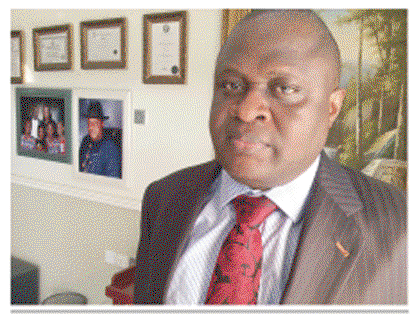
A Former Commissioner for Finance and Economic Development in Bayelsa State, Dr. Silva Opuala-Charles in this interview with Godfrey Bivbere, speaks on recent socio-economic developments in the country. Excerpts:

How best do you think the government can address this?
I think the key thing (which China did and which India is doing) is industrialisation. Massive labour intensive industrialisation is the way to take out this level of unemployment we have in this country.
What China did after it opened up its economy to the world in 1978 was to attract the Industrialised West, most of the Western companies moved to China because they found out that labour was cheap in China. China was very clear on its strategy; they wanted to create a convergent effect to see where they could begin to have technology transfer. They worked with the western companies and ensured that the companies coming in had a Joint Venture, JV.
Most of the foreign companies that went to China had a JV with the Chinese counterparts. This enabled China to quickly learn their technologies and quickly replicate them. The effect has been massive, as China has successfully transferred the western technologies to theirs. America also lost over 4 million jobs to China between 1998 and 2000 as a result of the JV system China utilised.
The best thing to do is to get most of the companies coming to Nigeria to form a JV with us. We have many Chinese companies but we are just bringing them to come and work here. We should not settle with just bringing Chinese companies to come here, the model that should work is to form a JV with them or do 50-50 agreements and also ensure there are job guarantees.
They should agree with the Nigerian government to reach something to close the infrastructural gap and unemployment in the country. The level of infrastructure gap is massive. If we look at housing alone, we are talking of about N5trillion to be able to meet the infrastructure demand on housing. If we ensure that we have JVs with these foreign nations that come into Nigeria, we can achieve massive job creation and also technological transfer.
Nigerians are very smart as you can see everybody active in Information Technology, IT; even those who are not educated are using Facebook and other social platforms. With this you will be surprised at the multiplication of jobs that will occur. Over the last 15 years China has grown using this model. China is currently on $11trillion and in terms GDP consumption China is bigger than America today.
Another thing I think must happen is functional privatisation. This is different from privatisation that just transfers our resources to few people without guaranteeing jobs. We cannot begin to operate on the western style of policies because their policy will tell you that one cap fits it all. Where they believe that privatisation means the transfer of government holdings to private individuals.
These private individuals become obsessed with making absolute profits and they kick out everybody and keep only a few people, but that is not the essence. The essence of privatisation is that when you privatise you also have to maintain national goals, such as providing jobs and keeping the unemployment ratio very low. We must ensure that our privatisation achieves the major goal, which is to create jobs rather than create unemployment and inequality.
If we don’t keep our eyes on the jobs when we privatise, the privatized companies will belong to some few persons who we refer to as the cartels and they can make all the money and the level of inequality would keep rising. I believe that to ensure that the privatisation works the government should not sell everything.
For instance, if they want to privatise a refinery they can sell about 60 per cent of its holdings and ensure that they keep the other 40 per cent to ensure the creation of a certain number of jobs. Job creation must be part of the privatisation process because at the end of the day most of these companies borrow money from banks and equity firms abroad.
These foreign firms sometimes determine the terms and make the companies slaves with their terms, but the government through its fiscal strategy must ensure that the job agenda must be very clear to any company that is privatised. It must be functional privatisation that should have the common wealth of the people at heart. We should not behave like the IMF and the World Bank, where they think that the way to structure the economy is to create austerity but we have moved beyond that.
China, Brazil and India are doing something completely different. Today, with one of the biggest companies in the world, SINOPEC, the Chinese government only sold about 30 per cent and this is one of the biggest companies in the world. China has more than 20 of the top 100 companies in the world and most of these companies China kept the major part and sold the others to the private sector to ensure that the job agenda is key.
This privatisation idea is great but it must be well managed by the government so it does not create more inequality and more unemployment. These two effects must be checked. The solutions are very clear but the government have has to come up with the policies to address these issues and there will be a reversal of this unemployment scourge.
How is the economy faring with the oil price fall?
The economy is doing well, the problem is that the oil price is coming down and that is bad because we have a monolithic economy. Agriculture is doing well but it can do much more to contribute to our economy than what it is doing now. So we can do the JVs with foreign companies. For instance, instead of importing rice from Thailand we can invite their businessmen to come and open the rice business here, take 40 per cent shares and open rice farms in Nigeria. If we can do this we would see our economy develop rapidly.
Disclaimer
Comments expressed here do not reflect the opinions of Vanguard newspapers or any employee thereof.