
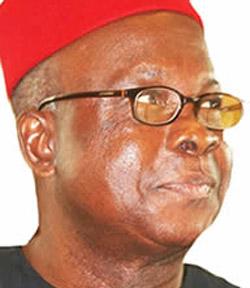
Elechi
By Jerry Uhuo
The power of impeachment or removal from office of the governor or deputy governor by the state House of Assembly is provided for in Section 188 of the Constitution. According to the Constitution, “The governor or deputy governor of a state may be removed from office in accordance with the provisions of this Section. Section 188 (2) (a, b, c) and subsections (2 to 10) provided for the various steps that will be taken for legal impeachment of the governor or his deputy”.
There is no need embarking on the repetition of the Sections here. What is paramount is to establish that the Ebonyi State House of Assembly has powers under the Constitution to impeach the governor if found guilty on the allegations raised against him.
The motion passed by 15 members of the House, which is more than the two- third required by law, stipulates that Governor Martin Elechi, committed several “acts of gross misconduct, which, we are convinced are in clear violations of the Constitution…” The motion went further to list eight allegations against the governor constituting the misconduct and breaches of the Constitution to include appointment of Coordinators and causing them to take oaths of office without reference to the House Rules No. 007 of 2007; appointment and taking of oaths of office of Caretaker Committee Chairmen for Local Government Councils without regard to the 1999 Constitution as amended; appointment and taking of oaths by Commissioners into listed state Commissions as against the constitutional stipulations in Sections 197 and 198 of the 1999 Constitution as amended; registration of two companies: Ebonyi State Company Ltd and Ebonyi Oil and Gas Ltd in the name of Ebonyi State but with names of Arch. Edward Nkwegu being highest share holder and Elechi Elechi, Governor’s son and funding same with government resources; and; the award of contracts for international market an opposition leader which was allegedly abandoned half way even when over N3.9billion was allegedly released to the company among others.
Looking at the details of the alleged violations, there is no doubt that the House is waking up to its constitutional responsibility even if belatedly. When investigations are carried out and proved and appropriate sanctions meted out, whether by way of impeachment or suspension from office, the holders of public offices in Ebonyi in particular will begin to understand that a breach of oath of office is an abuse of privilege of governance. The essence of the law is to check the excesses of public office holders and every other person in the society.
The argument advanced by those opposed to the motion relying on Section188 (4) may not be tenable because with seats declared vacant by the state House of Assembly in line with Section 109 (1) (g), the House has a total number of 18 and two-third majority of 18 members is 12. Section 188 (4) of the Constitution states: “A motion of the House of Assembly that allegation be investigated shall not be declared having been passed unless it is supported by the votes of not less than two-thirds majority of all members of the House of Assembly”.
Until INEC conducts new election to fill the vacant seats in the House, “all members of the Ebonyi State House of Assembly” is 18 in the present circumstance. The Supreme Court ruling in the case of Mike Diaplung, Speaker of the Plateau State House of Assembly, versus Joshua Dariye, in a similar matter in Plateau State on April 27, 2007, is a good example. Ebonyi State House of Assembly is on the right track.
•Uhuo is a public affairs analyst
Disclaimer
Comments expressed here do not reflect the opinions of Vanguard newspapers or any employee thereof.