
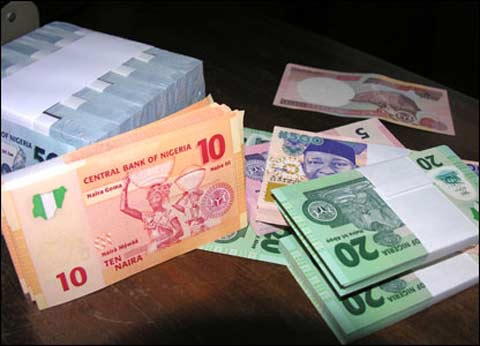
Naira
By Emeka Anaeto, Economy Editor
The Debt Management Office (DMO) has recommended a maximum of USD12.4 billion total borrowing (domestic and external) for Federal Government in 2015. This would amount to N2.5 trillion addition to the existing N7.9 trillion outstanding debt as at end 2014, bringing the total indebtedness to about N10.4 trillion.

DMO which centrally manages Nigeria’s debt however said in its Debt Sustainability Analysis (DSA) report, 2014 that the solvency and liquidity indicators under the Baseline Scenario show that Nigeria is at a very low risk of debt distress.
In fact Nigeria is actually under-borrowing as at today. But under its Pessimistic Scenario DMO report shows that though the results of its analysis indicated that the country would remain at a low risk of debt distress it also shows a rising trend for all the debt indicators throughout the projection period (2014-2034).
This means a prolonged deterioration in one or two variables such as reduction in GDP growth rate, increase in inflation, decline in revenue, etc, could increase the risk of debt unsustainability. Also a standard stress test under the Baseline Scenario shows the impact of most extreme shocks in the solvency and liquidity indicators which, though remained above the baseline for all the debt indicators, were well below internationally acclaimed standard thresholds.
The result further confirmed the fact that though the country has no risk of debt distress in the near term under both Baseline and Standard Stress Test Scenarios, DMO warns that the country is highly susceptible to revenue shocks based on deterioration in major macroeconomic variables. The revenue block, according to the report, clearly show that any shock in revenue would lead to debt distress in the medium-term with a high probability of being sustained in the long-term if other sources of revenue are not developed to bridge the gap.
Disclaimer
Comments expressed here do not reflect the opinions of Vanguard newspapers or any employee thereof.