
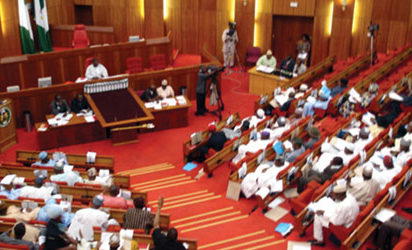
The Senate
By Johnbosco Agbakwuru
Budget estimate is an annual ritual encapsulating expected income generation and expenditure within a specified time.
It is an essential ingredient for planning and allocation of resources for the overall development of a country or an organization.
As a constitutional provision, the executive arm of government, through the Presidency at the national level or the governor at the state level, articulate the budget proposal for any fiscal year and send it to the legislative arm for scrutiny and passage.
The expected income through the nation’s natural resources and the internally generated revenue are key factors that determine the size of the budget which in turn will stimulate development and provision of infrastructures as well as cater for the workforce.

File: Okonjo-Iweala
However, the 2015 Appropriation Bill or budget projection has become a source of worry to the National Assembly, especially the Senate, following the dwindling price of oil in the international market which has, for long, been the main determinant of the nation’s budget. Nigeria, since after the discovery of oil around 1956, has remained a mono-product economy, solely depending on oil for its development and growth.
With the fall in the global oil price, Nigeria’s 2015 budget has been drastically affected and the development has generated uneasy calm within the ranks of those saddled with the responsibility to ensure that the country has a workable budget estimate.
Ordinarily, the budget is expected to have been passed before the end of the year, but this is not the case in Nigeria as the 2015 Appropriation Bill is still an issue of concern.
President Goodluck Jonathan had directed the Minister of Finance and Coordinating Minister of the Economy, Dr. Ngozi Okonjo-Iweala, to lay the budget estimate before the National Assembly in obedience to the Constitution.
The Federal Government, in October 2014, had proposed a benchmark of $78 per barrel
for the 2015 Appropriation against the $77.5 per barrel in 2014. Government in the 2015-2017 Medium Term Expenditure Framework, MTEF, and FSP also has the oil production projection at 2.2782 million per barrel daily, which was lower than the 2014 oil production projection of 2.388mbpd.
Government explained that the reduction on the oil production per day was a reflective of lack of new investments in the oil sector due to uncertainties owing to delay in the passage of the Petroleum Industry Bill, PIB, while the exchange rate was pegged at N160 per dollar.
The document noted that the rising US oil output has had a negative impact on the nation’s oil sales and that crude oil prices had hovered around $110/b in the last three years despite OPEC’s production disruptions.
“This is because almost all the oil production lost over the past few years has been replaced by the US shale boom and increased Canadian production. Consequently, the value of US import of Nigeria’s crude dropped by about 69 percent from $38 billion in 2008 to $12 billion in 2013.
“It is estimated that crude oil production in the US would average 9.3 million barrels per day in 2015-its highest level since 1972. This would put further pressure on oil price,” it stated.
Jonathan, again in November, 2014, transmitted the revised 2015-2017 MTEF and FSP, of $73 per barrel against the initial proposal of $78 to the National Assembly to reflect the economic realities in view of the global crash of the oil price from over $100 per barrel to less than $80 per barrel.
In the revised MTEF-FSP document, the 2015 budget estimate was reduced from the initial proposal of N4,82 trillion to N4,66 trillion against N4,724.69 in 2014
The exchange rate was increased from N160 per dollar to N162, while the oil production projection remained at 2.2782 million per barrel daily, which is lower than the 2014 oil production projection of 2.388mbpd.
In December 2014, the President again slashed the budget to N4.357 trillion while the benchmark was reduced to $65 and the exchange rate N165.
‘No iron-clad guarantees’
In the budget estimate presented to the National Assembly in October 2014, Jonathan proposed N4.817 trillion with the oil benchmark put at $78 per barrel. He later cut it to N4.7 trillion with the benchmark at $73 per barrel and for the third time revised the oil benchmark to $65 per barrel with the total budget size of N4.4 trillion as against N4,724.69 trillion budgeted in 2014.
He explained, “Given further developments in the international oil market, which have necessitated further revisions, amendments have been made to some parameters as well as to some fiscal estimates in the MTEF.
“As you know the first MTEF with the budget benchmark of $78 per barrel was submitted to the National Assembly on 30th September 2014, and discussion on the MTEF and budget construction based on those estimates began with the relevant Committees of the National Assembly.
“However, shortly after that first submission, oil prices began to fall precipitously leading to a revision of the oil benchmark price in the MTEF to $73 per barrel which was resubmitted to the National Assembly on the 18th of November 2014.
“Following this, the decision of OPEC (Organisation of Petroleum Exporting Countries) on their meeting in Vienna on the 27th November 2014, not to cut production to support the price led to further precipitous fall in the oil price to below $70 per barrel.
“This led, one more time to another downward revision of the benchmark price to $65 per barrel and the revised MTEF which was again submitted to you on 2nd of December, 2014. The uncertainty surrounding the global price of crude oil and its continuous fall has occasioned delays in both the submission of the final MTEF and budget estimates and we thus request your kind consideration of both these items together in view of our national budget calendar.
“We would like to confirm that having submitted these budget estimates, we are not proposing further revision of the oil benchmark price. Though prices continue to be extremely volatile and present and trend further downwards, there are indications based on price intelligence we have this time that prices may range between US$65-US$70 per barrel in2015.
“Nevertheless, we will like to emphasize that there is no iron clad guarantee where oil prices are concerned due to numerous underlining global geo-political factors that are outside our control and unpredictable.
“Should prices fall below the range; the country would have to make further adjustments.”
But as at last Wednesday when the budget proposal passed second reading in the Senate and was referred to the Finance and Appropriation Committees for further legislative actions, the oil price had further crashed to about $46.
Chairman, Senate Committee on Appropriation, Alhaji Ahmed Makarfi, said the budget would not be considered based on the parameters as submitted by the executive arm but on the realities on ground.
Unrealistic estimates
Leading the debate on the budget, described as deficit and unrealistic by many of the senators, the Senate leader, Victor Ndoma-Egba, stated that the budget estimate was predicated on $65 benchmark and N165 exchange rate.
The senators who spoke said it was unrealistic going by the drastic fall of oil price in the international market and that passing the budget with such assumption would lead to a deficit budget where huge sums would be borrowed to finance it.
They noted that the budget was a budget of caution and austerity measure where Nigerians were required to fasten their belts.
Makarfi told his colleagues that with the realities on ground, it would take time for the committee to come up with a more realistic benchmark.
He explained: “Even though it is based on a benchmark of $65 which surely is not realistic at the moment, it only provides N387billion for capital development which is over a trillion off what was budgeted for last year.
“So, this is not a budget you can look at as an expansionist budget. This definitely is an austerity budget – a belt tightening budget – but equally it should be a wake-up call that we must not continue to rely on financing public expenditure based on oil revenue which is highly volatile.
“We have to look out to other areas of getting revenues to the coffers of government and that is a long and tedious work on itself. There is also the average exchange rate of N165.
“These are key parameters of the benchmark used to produce the budget but it is actually out of tune with reality. We must cut down on cost of governance. When we say cutting down on cost of governance, we are not saying that you have to lay-off workers, but areas of wastage and other areas you can make adjustments that you can cut down on cost of governance.
“We have to equally, holistically, look at what we have been saying times without number that MDAs that achieve their revenue are paying what they like and declaring what they like that would be coming to the public consolidated revenue. It is high time we have a comprehensive review of the legislations creating these MDAs so that we can have a lot non-oil revenue into coffers of government to fund the activities of government.
“What I am saying is that it is a very trying moment. I support that we take it at the second reading stage and pass it to relevant committees but the caution is that it is more likely going to shrink than expand.
“Therefore, it is not a budget to see where we can add this or that; it is a budget for further belt tightening. The onus is on us to actually save the public finance by passing appropriate MTEF and a budget that we can finance.”
Wake-up call
The Deputy Senate President, Ike Ekweremadu, who presided over the plenary, commended senators for waking up to their responsibilities, adding that the development was a wake-up call to the nation following the challenging times of economic recession and the downward trend in the oil revenue the country was facing.
Senator Victor Lar, Plateau South said, “Whether we like it or not, all top government officials and political office holders must make sacrifices by cutting down considerably, the cost of governance in 2015 as part of the belt tightening measure that we should undertake to be able to implement the budget.”
Chairman, Senate Committee on Rules and Business, Senator Ita Enang, noted that there had always been loopholes from the government agencies who always generate money and keep the money without remitting to the Federation Account. Senator Enang said, “There is no point allowing the Central Bank of Nigeria, CBN, Maritime Agency and Communication Commission to generate money and keep without putting it in the revenue account.
“I celebrate the fall of oil so that we can go back to see the amount of money generated by these agencies and determine the 20 per cent they should spend and the 80 per cent they should transmit to the Federation Account. We should go back to these instruments”.
On how countries that do not produce oil survive, he said, “It is through money they generate internally. Where is the Excess Crude Account? The benchmark was $73 per barrel but oil sold over $100 per barrel. Where is the excess crude share of the Federal Government? We are guilty because I raised the alarm that no money from the excess crude should be expended without the consent of the National Assembly.
“My submission is that since we signed the 2014 Appropriation Act, there has not been application for supplementary budget. The President should therefore fund the 2015 budget with the reserve from the Excess Crude Account.”
The Deputy Senate Leader, Abdul Ningi, said the present economic realities called for caution in the preparation of the budget, but regretted that he did not see the caution in the letters of this budget, while Senator Ayogu Eze called for the expansion of the economy so as to put it on the path of sustainable growth.
Senator Olubunmi Adetunmbi said the assumption upon which the budget was prepared was totally exaggerated which he said implied that the expenditure that the committees were asked to look at were expenditures for which there would be no money to finance.
He said the reason there will be no money to finance those expenditures was that “right now there is the grossly exaggerated assumption that the price of oil is $65 per barrel. We know that the price for oil, as we speak, is in the threshold of $45 to $46 per barrel.
“Therefore, the budget we are sending to committees is in deficit of $28 per barrel of monies that will not come and the expenditure the committees to review. It is a pity that our committees may end up doing these work two times – to review the existing projections which are based on unrealistic oil pricing,
“It is also on record that Nigeria has not done 2.7million barrels per day – not in 2014, not in 2013 and I don’t know the empirical basis for which this volume of production is being projected. So we are shooting ourselves in the feet with a double barrel gun, an exaggerated benchmark price and an unrealistic volume of production and on the basis of which expenditure has been planned.
“This is clearly a deficit budge. Let us call it by its name and let us know where the deficit is going to come from. What is the basis of financing the deficit? I think that is what we should be talking about. I am not even sure given the current oil prices; the entire projection for our capital budget is not already eroded.
“We will be lucky in 2015, if Nigeria is going to be able to finance its recurrent expenditure from oil revenue.”
For now, it is difficult to work with what government has presented as budget unless a serious surgical operation is done on it.
Disclaimer
Comments expressed here do not reflect the opinions of Vanguard newspapers or any employee thereof.