
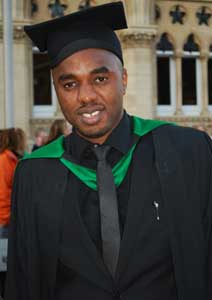
Obinna Edeh on his graduation day
By Amaka Abayomi
Twenty-nine-year-old Obinna Edeh has done Nigeria proud by graduating with distinction from University of Northampton, England, where he obtained a Master of Law in International Criminal Law and Security.
Edeh, who hails from Enugu State, graduated with a Second Class Upper Division from the University of Nigeria, Nsukka, UNN, where he studied law. He attended the Nigeria Law School and was called to the Nigerian Bar in 2010.
Speaking on his move to the UK and his experience at the Northampton University, Edeh, who is the last of two children, said: “The choice to study abroad either for an undergraduate or a post-graduate degree is one that requires huge sacrifice and investment. For someone like me, without any sort of external funding, studying abroad was a decision that required careful thinking and planning.
Thinking and planning
“My parents were civil servants and it was very difficult to raise the funds for the studies. But through the help of family members, I was able to pay the fees. I worked as a facilities manager for the University of Northampton which enabled me to take care of my living expenses during the programme.
“At the completion of my degree programme and training course at the Nigeria Law School, I decided to acquire more experience in research and study of Law. I had to choose the particular area of Law that attracted me and the varsity in which I could get the best of research and teaching in that area.
“I am hugely attracted to principles and ideas of criminal law and have always loved the scientific process of thoughts deployed in criminal cases. Since I had some of the best criminal law lecturers at UNN, I was already abreast with the Nigerian criminal law and procedure, so I decided to study international criminal law and security.
Disappointed with local varsities

Obinna Edeh on his graduation day
“The next challenge was the choice of varsity to study this course. I read the profile of most Nigerian varsities but was disappointed because, with the security challenges facing the nation, I thought the study of crime and security would be on the front burner.
“I could not find any school with a very strong research background in international criminal law and security and most of the law schools in Nigeria have not resorted to the use of research to find solutions to the parlous security situation in the country.”
Giving the peculiar challenges facing Nigeria as one of the reasons for his interest in the particular research area, Edeh said: “One would agree that the study of criminal law and security is not a course that attracts a lot of young people as most would rather go into oil and gas or corporate law studies.
“For a country like Nigeria, which is in dire need of solutions to end the security challenge, it is necessary that some persons take up the task of researching on how to use law to solve the nagging problem. I took up the gauntlet and hope to deploy my knowledge and skills in this area.
“I chose to study in the UK because of the incessant delays such as ASUU strikes, students’ unrest and other administrative delays in graduating post- graduate students from Nigerian varsities.
“Also, most varsities in Nigeria do not yet possess the research competence or erudite instructors and researchers in the area of international criminal law and security.
Nigeria’s obsolete law modules
“I must say that Nigeria has a very long way to go in research and development as some of the modules taught to law students do not have any relevance to solving our problems as a country.
“Again, the process of teaching and learning in some Nigerian varsities still focus on theories, memorizing case laws and statues, and regurgitating them during exams. This process is very unhelpful to the students who are not allowed to maximize their thinking abilities and find solutions to problems.”
During the course of his study, Edeh had the opportunity to attend a summer course at the prestigious Hague Academy of International Law in the Netherlands, where he had the very rare opportunity to meet with judges of both the International Court of Justice and the International Criminal Court.
He also took courses that provided broader insights on issues pertaining to International Criminal Law and Security. One very interesting aspect of this programme was that in all the discussions in the plenary and group sessions, the security challenge in Nigeria always took centre stage even as he compared notes with friends from Israel and the Arab nations who proffered suggestions on how they have handled their security challenges.
My Vision
My first desire is to get into the academia as that would give me freedom of thought to impact ideas and also learn from the students. I would love to partner with the government in the area of security and crime prevention which have advanced beyond the use of force, and with Nigerian and African governments on how to develop a more effective and far reaching solution to the problem of insecurity.
“It is also my intention to be in the classroom to join others who are desirous of changing the mode of teaching, learning and research in Nigerian varsities because there is the dire need to restructure and reorientate the teaching and non-teaching staff for our varsities to begin to receive global attention.
“I have compared the Nigerian Terrorism Act with those of other countries and discovered several loopholes in ours. As I argued in my Master’s thesis, the current system of using force to counter terrorism may not be very effective. There is need to also have a socio-political cum cultural arrangement with the aim to correct and prevent those issues that give rise to terrorism. I have visited several countries, interacted with experts in the area of security, read books on security and I believe that it is possible for Nigeria to overcome terrorism using more of a non-coercive model of conflict resolution and prevention.
Disclaimer
Comments expressed here do not reflect the opinions of Vanguard newspapers or any employee thereof.