
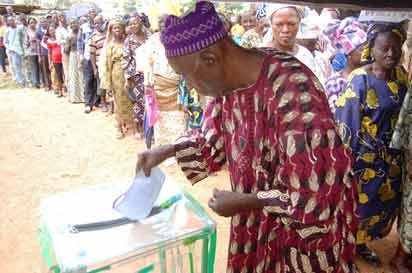
91 years old man casting his vote at Iyin Ekiti. Pic by Dare Fasube
By Dele Sobowale
“The most obstinate illusions are ultimately broken by facts.”
Trevor Roper, (VANGUARD BOOK OF QUOTATIONS p 100).
Only a fool would have expected the presidential elections to hold yesterday. That it took INEC until a week ago to realize their error merely proves, once again, that people can be very intelligent, but not wise. Professor Jega is the author of what will follow from now on.
Every election since 1999 had been held in April. Even, the 2011 elections conducted by the same Chairman of the Independent Electoral Commission, took place in April. Despite that, the first election almost brought the nation to the brink of chaos. We were saved in 2011 from INEC’s mistake by the fact that the opposition parties, ACN and CPC, were very weak and none of them reasonably expected victory anyway.
Times have changed. Today we have the makings of a genuine two-party system in which the opposition is as strong as the government’s own party. Any misstep by INEC would precipitate chaos – the ultimate end of which cannot be predicted. INEC has just made the first mistake by postponing the presidential elections scheduled for yesterday. However, before touching on some of the consequences of the decision to postpone the elections permit me to make some pertinent observations.
Last week, instead of commentary on the elections, I wrote a column about Chief Olufemi Daramola, KJW – my “Saviour”. I took a gamble which had paid off. By the time the decision to ignore the elections was made, it was clear to me that INEC had no choice but to postpone the elections. Too many things, which should have been done, and which were indispensable aspects of the elections were behind schedule. The last minute frantic efforts to distribute Permanent Voter Cards, PVCs, were only the most noticeable. Even if all registered voters received their cards by February 13, 2015, INEC would still not have been able to conduct a valid election on February 14, 2015.

File: 91 years old man casting his vote at Iyin-Ekiti.
The service chiefs and the National Security Adviser who later provided the alibi for the postponement of the elections only acted to save INEC’s face and to serve the interests of their Commander-In-Chief, C-I-C. The culprit for whatever will be the consequences of this decision remains INEC. The question is: how did INEC get itself and the nation into this predicament? Two short answers suggest themselves – “Too Know” professors in high office and our penchant for not learning from history; however recent. Permit me to take on first our unbecoming disdain for history in anything we embark upon.
Almost invariably the new managers of any public enterprise, whether elections, agriculture, poverty alleviation or census, behave as if theirs is the first attempt at it. Left to me, anybody elected or appointed to high office, anywhere in Nigeria, should appoint a historian or someone with a sense of history as one of his first advisers. And, his brief should include looking into the records to determine what was done in the past; establish the successful approaches and highlight the ones that failed. In each case he should also try to answer the question: what brought about that result? Even, the same team, setting out a second time to conduct the same exercise must subject itself to external appraisal to avoid the mistakes of the first outing.
Professor Jega is the second professor to head INEC. His predecessor, Professor Iwu, left under a barrage of criticisms. If our readers would recollect, the first election, held in April 2011 almost brought our democracy crashing down. If INEC was ill-prepared to conduct elections held in April 2011, why did the Commission think it could reduce the time by scheduling elections for February this year? The answer can be found in the “Too know” attitude of our professors when they occupy high office. Nigeria had paid dearly for this attitude. Highly intelligent, but perhaps not wise, individuals, plucked from classrooms, where their words were law to their students, enter office to dictate to Nigerians as if we are all their students. The present fiasco is an example of the mess they can create for the nation.
Most observers were startled when Professor Jega announced the election time table last year. To every objection raised that February was not realistic, there was a “clever” answer – like those dispensed at university seminars. Unfortunately for Jega, elections and academic exercises are miles apart. In the classroom and the Senate, he deals with mostly “reasonable” people. In Nigerian politics, he is forced to deal with the most unreasonable people anywhere in the world. Adequate time, not funds, therefore constitutes the most precious input in his plans. So, to me, the entire thing made no sense. But, I refrained from writing about it after observing Jega’s obstinacy against alternative suggestions. To me, it was obvious that the INEC Chairman was gripped by illusions of his ability to deliver a free and fair election in shorter time. Now he has a potential disaster on his hands and we in our country, if the postponement is not handled with maturity and patience….
THANKS MADAM FOR THE TRUTH
“30,000 jobs for Nigerians in 30 months” Minister for Petroleum.
According to advert in Sunday PUNCH of February 8, 2015. That means 1,000 jobs per month. With about 40 million Nigerians out of work, it will take Jonathan 40,000 months or 3300 years to create jobs for all. Can Nigerians wait that long?
Disclaimer
Comments expressed here do not reflect the opinions of Vanguard newspapers or any employee thereof.