
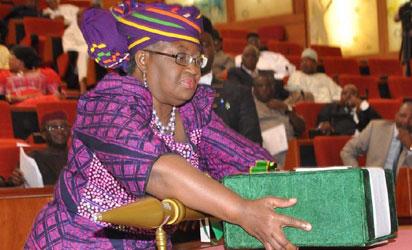
File: Okonjo-Iweala
By Johnbosco Agbakwuru & Joseph Erunke
ABUJA — THE Senate, yesterday, readjusted the 2015 Appropriation Bill as it slashed the Recurrent Expenditure from N2,616.01 trillion to N2,584.08 trillion and also jacked up the Capital Expenditure from the initial proposal of N633.53 billion to N700.78 billion.

File: Okonjo-Iweala
The Senate also cut the allocation for the Subsidy Re-Investment and Empowerment Programme, SURE-P, by N81 billion in the 2015 fiscal year and recommended the scrap of N360.94 billion Service Wide Votes domiciled at the finance ministry.
The Red Chamber further considerably slashed the subsidy payment for Premium Motor Spirit, PMS, otherwise known as petrol, from N200 billion to N100 billion and cut down the subsidy for kerosene from N91.08 billion to N45.52 billion.
These were contained in the report of the 2015-2017 Medium Term Expenditure Framework, MTEF, and the Fiscal Strategy Paper, FSP, submitted by the Senate Joint Committee on Finance and National Planning, Economic Affairs and Poverty Alleviation, which was adopted and passed yesterday.
Reduces SURE-P allocation by N81bn
The Senate specifically reduced the total expenditure for SURE-P from N102.50 billion to N21.03 billion, saying it was due to the fall in the price of crude and advised that details of SURE-P projects to be executed should be attached to the annual budget estimates for approval by the National Assembly.
It said that the reduction of petrol subsidy from N971.14 billion in 2014 to N200 billion in 2015, was not an indication of plans to alter the Federal Government subsidy policy on petroleum products, rather it was based on what it called “the projected lower crude oil prices in the international market.”
It recommended for an increase in the non-oil revenue projection for 2015 budget from N3,539.07 trillion to N4,024.11 trillion, a reduction of the Total Statutory Transfers from N411.85 billion to N363.27 billion and also pegged the crude oil production at 2,278.2 million barrel per day with $52 as the oil benchmark.
Orders stoppage of Service Wide Votes
While calling on the executive to provide details of the N360.94 Service Wide Votes to enable the National Assembly to see areas to apply any necessary cuts, it recommended that “there is no reason to include N63 billion for Presidential Amnesty Programme under Service Wide Votes when we have a Ministry for the Niger Delta.”
It further recommended that N22 billion provision for internal operations of the armed forces should be made under relevant ministry and that all sums provided as arrears of pension and gratuity should be reclassified from Service Wide Votes to relevant heads and warned that “Henceforth, this general provision should be discontinued.”
The Red Chamber said there was need for a drastic reduction in cost of governance and improved revenue collection be undertaken with a view to attaining a healthy recurrent/capital expenditure ratio, adding that the relevant committees of the National Assembly should oversight the kerosene subsidy provision to ensure its full implementation, availability and accessibility and that if it was difficult to attain, the subsidy on Kerosene should be discontinued.
The Joint Committee in its recommendations said it was a herculean task to implement the 2015 proposed expenditure programme of the government in a challenging environment of serious constraints in the face of the dwindling revenues, pressure to fulfil campaign promises, the imperative of fighting insurgency and other security challenges.
“Prudence, pragmatism, cooperation, collaboration and consultations between the executive and the legislature will, therefore, be required by the political leadership while implementing the inevitable austerity measures as well as protecting jobs, service delivery and implementing the capital budget as much as possible,” the Joint Committee had stated in its conclusion.
We have to tighten our belts —Mark
Senate President David Mark said that going by the letters in the budget and the prevailing circumstances, “what this clearly shows is that we all have to tighten our belts across the entire sectors of this government.
“We have for the last several years relied on oil as the main source of our revenue and I know that budget after budget we say we will diversify the economy. Every time this budget comes, we are still repeating the same thing. The impression I get from it is that, those who are responsible for producing the draft merely go there and reproduce what they have been bringing up.
“I think they need to do a little more; they may not be able to forecast accurately. There are a few things I think we must get right. The first thing is, let there be a cut across board, the executive, the judiciary and the legislature and we are prepared to lead in this.
“The areas of leakages, we must emphasize on them. The revenue generation and collection, we must make sure that we tighten them. What has impressed me in the entire discussion and the debate is the fact that this has been non-partisan, everybody has been very fair.”
It was alleged that the National Assembly has cut its budgetary allocation from the initial N150 billion to N115 billion in view of the reality on ground.
The Deputy Senate President, Ike Ekweremadu said that what the country was facing was as a result of her inability to save during the surplus period and advised that some expenditures should be cut down and that “we should begin to save money from oil for the sake of the generation unborn.”
Mono-product economy
Senator Ita Enang in his contribution lamented that the nation had remained a mono-product economy.
Enang wondered why the Coordinating Minister for the Economy and Minister of Finance, Dr. Ngozi Okonjo-Iweala, who he described as a proponent of the fiscal responsibility act was allegedly not seeing to the implementation of that Act.
He said: “Solid mineral sector should by today generate revenue for the country given the appropriation for the sector over the years”
He indicted the three arms of government of being responsible for whatever negative effects the economy had, stressing that the legislature sometimes in its oversight functions allowed certain things that were not supposed to happen.
Senator Solomon Ewuga said that the only remedy was to have a productive economy that grows instead of depending on one product economy.
Disclaimer
Comments expressed here do not reflect the opinions of Vanguard newspapers or any employee thereof.