
By Dele Sobowale
NOTE:
Back in May of last year, a warning was issued on these pages to those wanting to succeed incumbent governors about the financial disasters ahead. Few took notice. As you read the column again, several states owe staff salaries, some up to four months and the calamity is just unfolding. The drop in the price of crude oil, which was then mentioned as a possibility, is now a certainty and it is worse than anybody could have imagined and will last longer than imaginable. By May 2015, hardly any state will be able to fulfill its obligations to its workers. Hundreds of thousands of civil servants will be retrenched at Federal, State and Local Government levels and by the private sector. Please read on.
“Looking from the fact that the funds from the Federation Account are not judiciously utilized by the states and they are not accountable to the people and the state legislature, our concern is that even if they get money from bonds and it is not invested, the state will be left with a huge debt burden , which will hurt in the long term.” Dr Usman Muttaka, Head of Department of Economics, Ahmadu Bello University, Zaria.
That statement credited to Dr Muttaka was quoted in the PUNCH of May 25, 2014, in a report titled STATES RAISE N514BN THROUGH BONDS IN FIVE YEARS, written by Simeon Ejembi. The report could not have come at a better time as elections are about to be held in Osun and Ekiti States in a few weeks; and the rest of the country next February. For too long, elected governors in all the states of Nigeria had taken it upon themselves, to get their states into long term debts, mortgage the future stream of state revenue long after they have left office – with hardly anybody asking questions. And all these in a democracy.
LEAGUE TABLE OF BOND DEBTS BY STATES.
Below are the current levels of bond debts owed by some states. Those are not the only heavily indebted states, however. How much Akwa Ibom and Rivers as well as Ogun and Oyo States owe is not included yet. Naturally, the State of Excellence should set the pace and Lagos State has not disappointed in this respect. But, some of the other states should give their people a lot to worry about given their ranking, see below, on the revenue from the Federation account – which still constitutes the bulk of their revenue. The figures and the capacity of some states to carry the debt burden, in the event of a downturn in crude oil prices, should frighten those wanting to take over from outgoing governors.
The first thing which strikes a casual observer is the penchant for states with low revenue ranking to borrow comparatively more than those with high revenue profile. Lagos is unique among all the states on account of its relatively high Internally Generated Revenue, IGR, as a percentage of total revenue collected. But, most other states depend almost exclusively on the allocations from the Federation account. Most spend virtually every kobo collected now and they still experience difficulties in meeting their financial obligations. With federally allocated revenue on the decline, the states will experience increasing difficulties in meeting their financial obligations. Debt defaults loom as distinct possibilities.
Ordinarily, there is nothing wrong with governments borrowing to finance capital projects. But bond financing is supposed to be used for projects which will generate the funds with which the loan will be repaid. That means that funds meant for a project cannot be diverted to any other purpose –however urgent or meritorious. In mature democracies, the legislature ensures that this is done. But, there is probably no single independent State House of Assembly in Nigeria today. All without exception have become appendages or rubber stamps of the state governors.
It is therefore most likely that some, if not most, of the funds collected for some specific projects have been diverted to other end uses. It would have been bad enough if those projects are also yielding revenue to help repay the debt. It is worse when they go into drain pipes leading inexorably to private pockets.
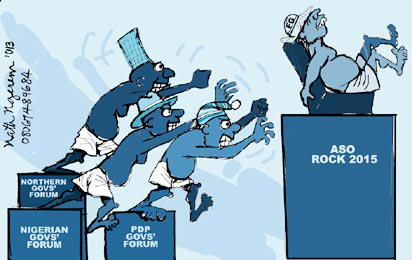
The lame duck governors, who can keep their lawmakers at bay, have had the benefit of enjoying a free hand to disburse public funds as they chose. They have enjoyed the benefits of exercising power unchecked and they can depart while passing the bill to their successors to pay. That explains why, with the exception of Osun and Ekiti, as well as Anambra and Edo, whose governors are not departing in 2015, every governor is eager to select his own successor.
None wants to pass the baton of office to a hostile or uncooperative new governor who might expose any shady deals that might have been associated with those projects. The would-be-successors are warned to be wary of the booby traps awaiting them in the Governor’s office. Once you have been imposed on the people by the outgoing governor, you will be expected to live with the problems which a mortgaged future will mean for the state. And, if it means sacking a lot of state workers, then the burden will be yours not that of the man who got the state into the mess in the first place.
Disclaimer
Comments expressed here do not reflect the opinions of Vanguard newspapers or any employee thereof.