
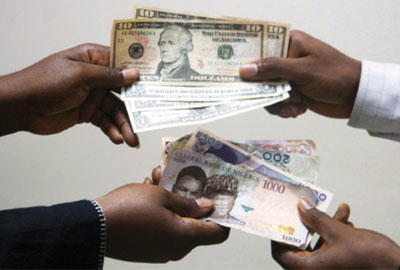
Indeed, Naira devaluation is probably the most potent weapon against the prosperity of Nigerians. Nigeria’s migration from a potential industrial power house with bustling social affluence, to a subdued and stumbling economy clearly began with the adoption of IMF’s Structural Adjustment Programme during Babangida’s regime: the chorus from International Agencies, at that time, was also that falling oil prices with an unserviced debt burden and the consequent restriction of trade credit to Nigeria, were the products of an allegedly overvalued Naira exchange rate.
By Muyiwa Adetiba
If a week- seven days- is said to be a long time in politics, then seven years must be an eternity. Time enough at least to write your name on marble or on a shifting sand on the beach. It took less than seven years for example for Obama and the US to bring America out of economic depression and start creating jobs and wealth again: or for Cameron to revise the downward trend of the British economy: or for the less transparent, less committed governments to sink deeper into the economic mire: or for Nigeria to become a football to be kicked around almost on all fronts.

Was it his track record as Governor, Deputy Governor or even before that? Was it his intellect, his competence, his integrity, his character or vision? We saw a man that seemed different from the norm – a man from a marginalised minority, a fresh face that did not seem to have the baggage of an unsavoury past, a PHD holder who could look the 21st century in the face and bring an intellectual bent to governance, yet a humble, if awkward personality with a disarming smile. In our desperation for change and desire for good governance, we saw what we wanted to see and the responsibility must be ours to bear.
In fairness, quite a few voices urged caution; but they were shouted down as naysayers. Our decision was not helped by the so called caucus that was hell bent in keeping the ailing Yar’Adua in power. Jonathan’s reticence in the ensuing power play was seen as a sign of humility and loyalty. It was also seen as a sign of a man who was not desperate for power. The press and the civil rights organisations rose up for an underdog as it were, and forced the vacillating National Assembly to come up with the doctrine of necessity.
So when the Presidential elections came around in 2011, the nation was ready. We were ready for change and Mr Jonathan in our minds represented this change. We ignored the fact that he was the candidate of the same party we were trying to get rid of; we ignored the fact that Mr know it all Obasanjo was his de facto campaign manager; that Mr Fix It and his reprehensible brand of politics was not far from the centre stage; and that a lion cannot give birth to a cat.
We wanted a change and we wanted to give the caliphate, those who felt they were born to rule, a strong blow and Mr Jonathan represented a unique opportunity to kill two birds with a stone. Now, four years later, who is reeling from the blows of a misguided judgement?
It seems so infantile, so naïve these days to hear ‘I voted for Jonathan and not for PDP’ but that was the mantra then. That was the illogical, emotional reasoning behind Mr Jonathan’s landslide victory in 2011. And that was how Mr Jonathan, preaching transformation, preaching change, got into Aso Rock. His good will was so much that AC as APC was then known, ignored its own Presidential candidate and voted enmass for Jonathan.
Today, four years later, the story is remarkably different. It seems pretty certain, from the comments in the print and social media, that his huge deposit of goodwill has been squandered. He said two years ago that he was the most abused President in the world. I wonder what he will say today about the negative comments making the rounds. And from the way these comments keep going round, you could tell they resonate with a lot of people.
I have watched a couple of his campaigns and he seems defensive and angry. His anger has also led him to make some un-presidential remarks which could hurt him further. In talking about his achievements, he has generalised where details and statistics would have helped- after all that is one of the advantages of incumbency. His billboards preach change instead of consolidation. This in itself is an admission of failure. He should be preaching continuity if he was proud of his six years in Aso rock. All told, you get the impression that his campaign handlers are either complacent or clueless. Mr Jonathan needs to connect meaningfully with the people he has led for six years; he needs to sway those who are still nervous about a Buhari presidency. He has to show how the next four years will be different. Unfortunately, he is not doing this. He is still doing what he has done throughout his tenure which is to blame everybody but himself for the ills of the country.
Its sad to see how a man whose popularity and goodwill transcended his party, who won so massively in spite of people’s disenchantment with PDP could become the butt of jokes and ridicule in less than four years. But the signs were always there. First, he refused to acknowledge, even to himself, that people were not happy with PDP and wanted a credible alternative because he refused to distance himself from all that was abhorrent in the party. A man who cannot clean the inside of his house cannot clean the compound.
Then his insecurity and lack of courage made it difficult for him to take prompt decisions on national ills and even on reports of committees set up by him thereby allowing many wounds to fester. The opportunities to heal the country were wasted because of the people around him and his personal failings. His vision to transform the country could not take off because of the indiscipline and the love of money which beclouded decisions at the upper echelon of government. He talked the talk on poverty, unemployment, insecurity and corruption but he could not walk the walk. All these eroded his stock of goodwill.
Mr Jonathan might seem a nice man. In fact people who have met him describe him as polite and respectful. However, not many people describe him as a leader of men.
Disclaimer
Comments expressed here do not reflect the opinions of Vanguard newspapers or any employee thereof.