
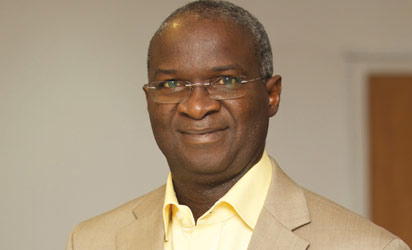
Babatunde Raji Fashola
By Akintola Omigbodun
In the periods before and immediately after Nigeria’s independence in 1960, doctors and mining engineers were amongst the best remunerated officials in the Nigerian civil service. There were also government establishments like the Lagos Executive Development Board which employed Architects, Town Planners, Engineers, Estate Surveyors, etc. who were better paid than their counterparts in similar positions in the Ministry of Works.

Babatunde Raji Fashola
However, the 1974 Udoji Public Service Review Commission introduced a unified classification and grading system in the public service covering government ministries and departments, local authorities, the police, the judiciary, public enterprises, the universities, the teachings service etc.
The grading system was such that a fresh university graduate would start as Officer II and the progressively higher positions are Officer I, Senior Officer, Principal Officer, Assistant Chief Officer, Chief Officer, Assistant Director and Director. Thus a university professor and a director in a ministry were at the same salary grade.
The new salary scale was implemented with backdated salary increases for everybody which payments gave everyone a good feeling. The basic premise was that public servants should be paid on the basis of the worth of the work performed.
During the last 15 years, the Revenue Mobilisation Allocation and Fiscal Commission has put in place a salary scale for political office holders that is much higher than what applies to other public servants. The Academic Staff Union of Universities has carried out many strike actions over the years and university teachers now earn enhanced salaries outside the public service scales.
Doctors in government service have also obtained higher salaries and allowances through strike actions led by the Nigerian Medical Association. We now have a situation in which other health workers in government hospitals are on strike and these hospitals are not attending to patients.
This is the last in the series about what the next governor of Lagos State should do for us. Nine of the candidates for the position of governor were at a public debate this past week and they gave their visions of a healthy and prosperous Lagos. The Lagos State Government, LASG, continues to provide new health facilities and also expands existing ones but with personnel problems in the health sector, the expenditure on facilities would not give the expected improvements in services to the populace. The personnel problems would appear to be national in scope as the unions representing the workers are national.
National minimum wage
However, whenever the issue of a national minimum wage is raised, the states usually indicate that they should be allowed to set the applicable minimum wage. The next governor should put in place a body that would look at the pay of public servants and political office holders in relation to the worth of the work performed. As a first step, the next governor should get his political party to agree to a cut in the pay of political office holders.
The debate of the candidates for the position of governor also had the candidates indicating their positions and policies regarding the provision of employment especially for young persons. I hope that whoever emerges as governor from the elections would draw from the ideas of the other candidates. This column covered the issue of secondary/tertiary education and youth employment in this newspaper on 6 November and 13 November 2013. One of the candidates warned that we must take steps to arrest the growth of an alternative youth economy in which young people demand payment from anyone who wants to carry out economic activities in their neighbourhood.
Disclaimer
Comments expressed here do not reflect the opinions of Vanguard newspapers or any employee thereof.