
By Amaka Abayomi & Tare Youdeowei
DESPITE considerable progress experienced in the education sector in 2014, stakeholders are still concerned that Nigeria is yet to overcome its numerous challenges bordering on; rot, kidnapping and killing of innocent school children in their schools by Boko Haram insurgents, increase in the number of out-of-school children, incessant strikes by staff unions over welfare and the state of teaching and learning facilities, and the dying prospect of meeting the 2015 United Nations’ deadline for Education for All.
Others are inadequate access to tertiary education, steep hike in tuition fees in some tertiary institutions, the rising army of unemployed graduates roaming the streets, mass failure in national examinations, craze for foreign education, and brain-drain as a result of mass exodus of teachers to foreign institutions, among other worrisome issues.

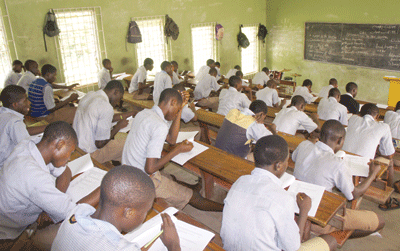
FILE PHOTO
As we step into a brand new year, we ask leading figures in the education sector for their assessment of the sector in 2014 while predicting what 2015 holds in store.
For the Academic Staff Union of Universities, ASUU, South-West Zonal Coordinator, Dr. Adesola Nasir, there is no radical change as there is no departure from what was obtainable in 2013 especially as the kind of environment and policy needed to launch the knowledge industry is still lacking.
“Technical colleges that are to power the industrial sector are yet to take off with a good number of them not functional due to lack of required facilities. The Universal Basic Education thing is not what it is supposed to be and this is responsible for the state of public schools.
“Higher education is not left out because, despite all efforts by ASUU, ASUP and COEASU to get the right funding for these institutions, we still do not have the right funding that would take us to the next level. Apart from the initial N220bn, government is yet to release more money and we are in deficit. We are still not there, the world is moving at a very fast pace and we lack the kind of input necessary to compete.”
On what should be expected in 2015, Nasir said; “It is quite difficult to predict what would happen in 2015. Though it is clear that 2015 would be a turbulent year in Nigeria, not just for the education sector but all sectors, we would continually assess the situation.”
In the same light, the President, Academic Staff Union of Polytechnics, ASUP, Mr. Chibuzor Asomugha, said the education sector in 2014 was filled with hiccups with nothing remarkable to celebrate.
“2014 had its ups and downs, but majorly more downs, and the perpetual neglect of the sector began to show with the prolonged unrest by the various academic unions which left a near irreparable damage in the sector, coupled with the fact that funding has been low.”
On his predictions for the sector in 2015, Asomugha said;
“There are no indications that anything remarkable would happen in 2015, except for the fact that we have better qualified officials in the education ministry who, if allowed to stay longer and given the right tools and environment to work with, are bound to make the right and necessary changes.”
When asked if the union would embark on another strike action should government fail to fulfill its end of the agreement due to the dwindling oil prices that would affect the budgetary allocation to the education sector, the ASUP President said; “Strike actions are not usually the first line of action unions take and since the education sector is part of the larger sub-sector of the economy, what happens in one sector is bound to affect others. Rather, government should have the political will to take the right steps for the sector to progress as nobody is against government’s tightening of its belt.”
The President, College of Education Academic Staff Union (COEASU), Mr. Emmanuel Asagha, is of the view that the sector is still miles away from its destination as sincere commitment to purposeful education is constantly eclipsed by corruption.
According to him, “the operators have no stake in the sector and nation at large so failed promises have come to characterize activities in the sector while our leaders continue to play costly politics with the future (education and health) of this country.
“In 2015, our trust for a new order rests with God because without a change of attitude, the deterioration will be colossal. Government should try to be responsible and act with the fear of God.”
Neo-liberal capitalist policies
Stressing that year 2014 was an especially bad year for the education sector due to government’s relentless pursuit of anti-poor and neo-liberal capitalist policies that effectively priced education out of the reach of the poor, the National Coordinator, Education Rights Campaign, ERC, Mr. Hassan Soweto, said there was intensification of efforts on government’s part to make education the preserve of the rich and an intensification of struggle to resist this anti-poor capitalist agenda by students and education workers.
“From the Lagos State University to the Obafemi Awolowo University, Olabisi Onabanjo University and most federal and state higher institutions, fee hike and intensification of commercialisation policies were the dominant features of the education sector in the year 2014.
“We also saw the continuous collapse of teaching and learning infrastructures in public primary and secondary schools as a result of the failure of the Universal Basic Education (UBE) programme to effectively turn around the fortunes of public education and increase enrollment.
“Also, the percentage of out-of-school children increased to about 10.5 million, which is one of the worst cases in the world, meaning that Nigeria has failed to meet the key mandate of the Millennium Development Goals whose target is the year 2015.
“Off course the rampage of the Boko Haram terrorist group which saw the burning of school buildings and abductions of school pupils, including the over 200 Chibok girls, also marked a significant drawback in government’s stated policy of promoting universal enrollment of all school-age children in Nigeria.
“2014 also witnessed tremendous struggle by staff unions like the ASUP and COEASU to compel government to implement signed agreements, revive our dying polytechnics and colleges of education and annul the dichotomy between HND and B.Sc certificates. Unfortunately, little progress has been made in this regard due to the recalcitrance of the Federal Government.”
On the prospects of 2015, the ERC National Coordinator said in all probability, intensification of anti-poor education policies and mass resistance would play out in 2015.

Capital projects
“If during the over one decade of oil boom our economy grew by about 7.5 per cent, and government pursued a policy of education underfunding and scant investment in capital projects in schools, then the worse should be expected now with falling crude oil price and a reviewed growth prospect of just around five per cent.
“This means that less funding will go to the education sector in the 2015 budget leading to a slowdown and, in some cases, halt of on-going capital projects in various schools, lack of funds for new projects, while tertiary institutions will be under pressure to ‘look inwards’ to seek for funds, which is another name for fee hike.
“ERC is particularly apprehensive that the concession gained by ASUU during the 6-month long strike in the later half of 2013 which saw the release of N200bn intervention fund to universities will be breached while other agreements with staff unions will most likely be affected under the excuse of economic crisis.”
Disclaimer
Comments expressed here do not reflect the opinions of Vanguard newspapers or any employee thereof.