
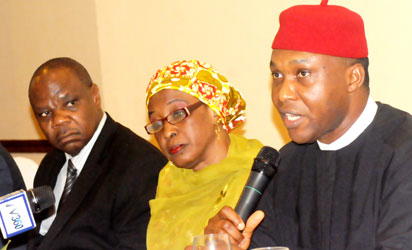
From left: Commissioner, Accident and Investigation Bureau, Dr Felix Abali; Permanent Secretary, Federal Ministry of Aviation, Dr Jumaila Shu’ara and Minister, Chief Osita Chidoka at a news conference in lagos on tuesday
By LAWANI MIKAIRU
The Minister of Aviation, Chief Osita Chidoka last week fielded questions from selected Aviation reporters after meeting with senior management staff of the aviation parastatals under his ministry at the Murtala Muhammed Airport, Lagos. He spoke about his plans for the Aviation Ministry. Excerpts:
You have hinted that the aviation industry would now contribute more to the coffers of the federal government. What plans do you have to improve the revenue generation of the agencies ?
We have setup a committee to review airport charges, both aeronautical and passenger charges in Nigeria to be sure that they are in line with regional pricing. Because of our goal to be a regional hub, we must make sure that we don’t price ourselves out of the market and we must make sure that there is no waste in the agencies. We have to ensure that they are not taking the resources that are coming and spending it within the agencies. So, we identified that there is need to review the charges of our agencies and enhance their revenue generation ability. We believe that the agencies should be able to remit to the federation account as stipulated by the fiscal responsibility act, 25 per cent of their gross earnings when we identify what those gross earnings are and make sure that they remit it to the federal government. Because the federal government has invested in the airport and it should be able to get benefits from that investment
Our airports are rated low both in Africa and in the world. What plans do you have to improve airport infrastructure and provide better services to passengers?
It cannot be done within the institutional frame work that we have, no matter how brilliant the new ideas are, we have to review what has happened to be sure that you are not reinventing the will. That said; one of the key things that I observed and evidence has shown is that our aviation industry is a very low contributor to our national GDP. Aviation industry in other countries contributes in the double digits to their GDP, but in Nigeria it is 0.4 per cent to the GDP. We also decided to find out from our passengers how they feel about Nigerian airports. We contracted a polling company to question the passengers and the result we got from them is that most of our airports are under performing. They ranked most of our airports below average, I think only MMA2 (domestic terminal, Lagos airport) came out with a 3.2 score out of 5. And we believe that only two airports among those they surveyed scored up to 2.7 and 2.6 the rest were below 2.5. This is a customer perception index to find out what the customers think.

FILE PHOTO: Aviation Minister, Mr Osita Chidoka and Dr. Jemila Shu’Ara, Permanent Secretary, Ministry of Aviation protecting themselves with gloves against the Ebola virus during their inspection of MM Airport. Photo Lamidi Bamidele
We also conducted a survey on what was the major problem for passengers. And we find out that it was waiting time at the airports; not the wait time to go through security but the bulk of the wait time is delays by airlines. So we figured there must be a way for us to improve turnaround times for our airlines. We also surveyed our airports and tried to see our connectivity from Nigeria to other countries. And we find out that compared to two major airports, Oliver Thambo in South Africa, Kenya and Ethiopia, Nigeria is poorly connected to the world. We do not have any direct flight between Nigeria, and the South-East Asia economies and China which are the major drivers for economic growth in the world today. The bulk of the passengers emanating from Nigeria on the Middle Eastern lines are heading to China. And we thought that, that was a minus for us so we identified poor connectivity as an issue.
But we saw that a lot of transformation has occurred in the remodeling of the airports, we have increased capacity, we have built up on open door opportunity for better passenger processing. We have remodeled our airports from the antic nature to very modern beautiful airports. And we have spent considerable resources making our airports good. And again we also believe that after all these remodeling we must put in the context of the larger master plan of what our hopes and aspirations are as a nation. So, going forward, we have decided that first we are going to do a master plan for Nigerian airports that would contain econometric studies of traffic patterns, land use in our airports and make sure that nobody will willfully violate the land use plans and the zoning in our airports.
Secondly, we found out that no Nigerian airport occurs in the 10 airports in Africa as widely reported by the media. No Nigerian airport occurs in the top 20 and no Nigeria airline occurs in this. And part for the reason for this is that we even found out that no Nigerian airport is certified by the International Civil Aviation Organisation (ICAO) standards. So we have given ourselves a target that by mid-2015 we at least certify two airport by ICAO standards in Nigeria preferable Lagos and Abuja and then we will follow through with Kano and Enugu, the international hubs so that we meet ICAO standard. And after that certification we hope that Nigerian airports will at least come into the first 20 airports by the next ranking in Africa by Skytrax and other agencies that do that. So we have set definite time line and target.
Nigeria has been recording accidents, they would be investigated and nothing is heard about the investigations and recommendations made are not implemented. Do you intend to do anything about this?
We have setup two committees. The first committee is to review all air crash (accidents) reports in Nigeria and find out how many recommendations were made by these reports, how much of these recommendations were implemented. After we do the gap analysis, we are going to enforce the implementation of all the recommendations to avert future occurrence of these crashes in Nigeria.
We are aware of the staff audit that is going on. Many of the agencies are understaffed. For example, there is inadequate staff in security and other departments of the Federal Airports Authority of Nigeria (FAAN). Do you intend to recruit the needed skills in these agencies?
The World Bank had conducted a study earlier about institutional strengthening. We have identified the challenges of our organisations and we are going to try to reverse the trends that are not good within them. We are going to improve the recruitment of professionals and technical staff in our key operational agencies as opposed to administrative staff to ensure that we have a 60-40 balance in favour of technical staff in our agencies. And hopefully to push it up until we get to 70-30. A situation where 80 per cent of the staff are administering 20 per cent is not good for the industry. We also noticed that there is a problem with capacity building and most of the people we have in NCAA, airworthiness people are experienced people and many of them are retiring but we don’t have the younger ones to takeover.
So, we have put in place a system to make sure that we don’t only attract and retain those young ones but that we make sure they go through the experiences that would allow them practice as regulators. Because of all the problems we saw with airlines, we have come up with a web portal that we will be commissioning on the 8th of December in Abuja. This web portal will contain real time data on airlines, schedule times and pick up times. And would show passengers the historical number of hours of delays on each route by every airline so that passengers can make an informed choice about which airline they will choose to fly and we will publish monthly reports about the level of service in terms of timings by the airlines.
This portal will also contain opportunity for people to make applications for certain function of the Ministry, including the request to import aircraft. We are asking people to submit that request online and we will give them 24 hours to get a response. We are also launching an initiative called Aviation Commits. The Aviation Commits initiatives which will also include the media will require contribution of all key stakeholders in the industry, we will look at their customer oriented functions and commit them to a minimum level of service of which we will have a warden to ensure that the airlines obey. For instance, a commit that you must not delay your planes for more than 30, 40 minutes if you delay more than one hour, you will give passengers either rebate in the next flight they board or you will agree with them how much compensation to pay for the staff for delaying them above the threshold. Same thing with NAMA, NCAA, if you apply for landing permit and you don’t get a response in 24 hours, you consider it approved. And we will hold that officer responsible who didn’t issue the permit.
So we are ensuring that every customer oriented function is time bound. As a steward that person takes responsibility for ensuring that that service is delivered. And every month we will publish the entire request we receive on this website and we let the media to report on those who haven’t carried out their functions as agreed.
Disclaimer
Comments expressed here do not reflect the opinions of Vanguard newspapers or any employee thereof.