
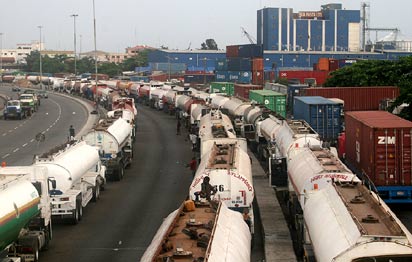
Standstill at Mile-2 to Tincan, along the Oshodi-Apapa expressway. Photo: Joe Akintola, Photo editor.
By Olasunkanmi Akoni
FEW months ago, when many Lagos residents and users of the everr-busy Oshodi-Apapa expressway thought solace had come their way over the perennial traffic gridlock witnessed daily on the road, their optimisms have been dashed following the worsened situation of the log-jam, which is not unconnected to the untidy job done by Julius Berger Plc, on the Berger-yard axis of the road.
This is even as several acclaimed solutions deployed by the Federal and the Lagos State Governments to mitigate the situation, seemed to have faded out, as the tankers container-laden trucks are back on the road, frustrating human and vehicular movements.
Also, efforts in the past launched by men of the Nigerian Navy, Lagos State Traffic Management Authority, LASTMA, Nigeria Ports Authority, NPA, and other stakeholders, have failed to yield lasting solution to the traffic gridlock within the axis.

The Oshodi-Apapa Expressway.
It is against this backdrop that last week, the Federal Road Safety Corps, FRSC, initiated a partnership with the Nigeria Customs Service, NSC, to address the perennial traffic gridlock experienced on the road.
Corps Marshal and Chief Executive of the FRSC, Boboye Oyeyemi, at the meeting, in Abuja, disclosed that the FRSC has drawn up an intervention strategy, which includes deployment of the heavy-duty trucks, donated by the World Bank, in addition to other logistics and personnel along the Oshodi-Apapa expressway to restore normal traffic flow.
To achieve results, he solicited the support of the NSC for the inauguration of a task force, made up of FRSC and Customs operatives, to further address the challenges on the Oshodi-Apapa road, which is linked to the Tin Can Port and several tank farms located in the area.
Boboye stated that Oshodi-Apapa Expressway traffic solution and the target of reducing road deaths by 50 per cent by the year 2015, as set out in the Accra Declaration (2007) by African Heads of States and Governments, and the United Nations Decade of Action for Road Safety: 2011– 2020 is attainable.
Vanguard gathered that the traffic gridlock on the road, has also defied Sundays, known for less traffic day in Lagos. Since last Thursday till Monday (yesterday) the no-movement traffic logjam was so devastating that motorists were forced to abandon their vehicles on the road, finding other alternatives home, even as commuters were seen trekking home ineir large numbers. As the yuletide aproaches, the road users have blamed the situation to the high influx of heavy duty vehicles across the states and the ongoing reconstruction work done at the Berger Yard-Mile 2 end of the road.
They have however, urged the Federal and Lagos State governments, Julius Berger Construction Company, handling the project, as well as the tanker drivers’ union to find a way out of the present logjam, lamenting that hoodlums have seized the situation to dispossessing them of their valuables at gun point.
They have bemoaned that men of the Rapid Response Squad, RRS, deployed to the area are helpless, as there are no access roads to scenes of robbery owing to the perennial logjam on the road.
Tanker drivers beg for understanding
Meantime, Petrol Tanker Drivers, PTDs, have appealed to road users, especially motorists, to be patient with the present situation on the road.
They blamed the traffic jam on the influx of petroleum tankers from every part of the country into Lagos as a result of scarcity of the petroleum products in many depots across the country.
The National Public Relations Officer, PRO of the PTD, of the National Union of Petroleum and Natural Gas Workers Union, NUPENG, Comrade Adebayo Atanda, said the situation leading to the gridlock was being worked on by the drivers’ union in conjunction with LASTMA officials and other traffic agencies.
Disclaimer
Comments expressed here do not reflect the opinions of Vanguard newspapers or any employee thereof.