
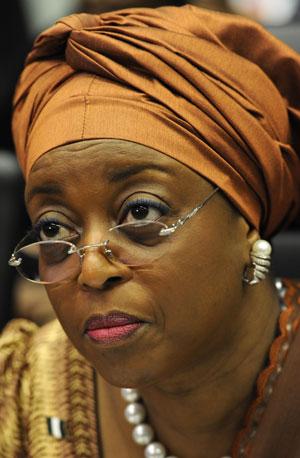
Diezani Alison-Madueke
By Bisi Lawrence
It would be in keeping with the spirit of the times to join our cheerful voices with the rising chorus of congratulations to Mrs. Diezani Alison-Madueke, the Minister of Mineral Resources, on her appointment as the President of OPEC. We live at a time when congratulations swamp the advertisement areas of newspapers, which a media animal like us would be the last to complain about.
Civil servants congratulate their bosses, even security personnel take out advertisements to wish their superiors luck, a woman congratulates her husband and a man felicitates with his wife, all on the ages of newspapers, and everyone is happy.
There have been congratulatory messages in competition with one another, from social, ethnic and professional quarters to show sincere appreciation for the seeming elevation of this worthy Nigerian to a position that is really of little circumstance in the order of hierarchy in the OPEC.
The Executive Officer of the organization is the Secretary-General who is hardly more than a plain secretarial officer in the most refined meaning of that office. In any case, Diezani had been the Alternate President of the organization for the past year, a position which is rotational among the member-countries just like that of the President which, itself, lasts for exactly the same term.
All the same, the Minister of Petroleum Resources has, on her own part, also extended the round of congratulations to President Goodluck Jonathan for appointing her, a woman, as Nigeria’s Petroleum Minister in the first place, in a world where only men occupy such a position. She felt it took some courage—or whatever—to accomplish that feat. That was veering to the province of risible communication in a country where the virtual Prime Minister is also a woman.
With all the problems of dipping oil prices all over the world, anyway, the centre stage in Nigeria belongs to Ngozi Okonjo-Iweala, the Co-ordinating Minister, never mind who the OPEC President may be or may not be. President Jonathan knows how to appoint them, male and female, and would hardly give a damn about congratulations—and all that stuff.
He has other at hand, at the moment, having surfaced as the sole delegate for the primary presidential election of the Peoples’ Democratic Party. He is not even overly bothered by the rolling drums of “impeachment”. Impeachment? By what manner or means? The Constitution which he relies on at convenient moments, clearly stipulates a two-thirds majority in an open ballot against the incumbent for any impeachment to see the light of day. That will never happen where Jonathan has his David as the Senate President.
That may of course take root in a sphere within the sway of his influence as we witnessed in the majority exercise of the vote for the Governors’ Forum where he welcomed the supremacy of 16 (or was it 17?) over 19. The case of the Ekiti States Speakers’ impeachment is still hanging, and it is felt by many that it would have crashed without the tacit support from his direction.
But all that is only in line with his disposition towards the problems which eventually led to the opting out of the Rivers State Governor, Rotimi Amaechi’s former party, the PDP, to the APC. In that case, it was a State Commissioner, who confronted his State Governor and lived to gloat about it. It was no big deal for the President thereafter when the Inspector-General of Police locked out federal legislators from their chambers. All of that exercise in abuse of power has been pushed under the umbrella of “impunity”, an ugly word that has amassed more revulsion with executive usage.
The stress on executive powers, however, slackens when it is open to non-domestic affairs. Nigeria was ever free to seek for the purchase of weapons away from the United States of America in the fight against Boko Haram which has done no little damage to the people’s confidence in our security forces. But we hung on to the apron strings of America, even when we had been turned down in no uncertain terms. This is where we could have applauded an executive effort to grant us the pride of independent decision by looking for arms and ammunition elsewhere. But we did not seem to have the courage (did someone talk earlier about “courage”?) to stride forth openly in another direction. Thank God, we have crossed that river now, and our armed forces of brave soldiers and excellent officers are gradually coming into their own.
But when a divine gift like our world-renowned Wole Soyinka, disdains presidential approbation to point out some of the shortcomings in our system, and the failings of its manipulations, petty apologists who abandon the honourable vocation of medical practice for the dubious occupation of a lickspittle attempt to claim centre stage. The Nobel Laureate’s closeness to Amaechi is seen as symptomatic of a legitimate censure of irrational use of a power-mad authority. Kongi, to recall a moniker hardly used for him of late, has every right to associate with whomever he pleases, but not for the glorification of misdeeds. The case of Gbenga Daniel, erstwhile Governor of Ogun State, may be cited here. Daniel fulfilled all the fond qualities of a progressive, young politician at the start of his tenure, and he found great favour with the famous writer. And then along the way, he faltered very badly, at which point Wole Soyinka publicly upbraided him and left him on his own. If Amaechi takes a wrong step, those who know Kongi well would be surprised if a reappraisal of relationships does not immediately follow.
One might add that Nebuchadnezzar fell from grace to grass, even in actual terms, after he abused the power and mercy of God. To compare a despot with him is not totally horrible, for he indeed finally regained favour with God; he started well, and ended well. ‘
This then is where this nation finds itself a matter of weeks before a general election—internal conflicts spawning distrust, mutual disfavour harbouring lethal suspicion, and all in the course of patent self-interest. We all seem to put the welfare of the nation aside, just to win the election. What will they achieve if they win the election in a country without any prospect of peace, or programme for progress? How can we abandon our future for a turbulent present? We can answer these questions whichever way we choose. The answer is in our hands. So, if I may ask, which one you dey?
Time out.
Disclaimer
Comments expressed here do not reflect the opinions of Vanguard newspapers or any employee thereof.