
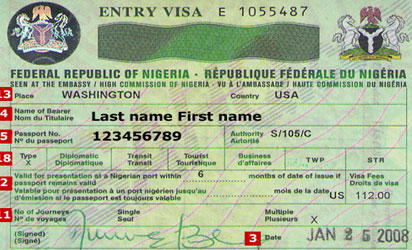
Nigerian visa
By PROVIDENCE OBUH
Visa Africa Integration Index report has shown that Nigeria’s integration index within the continent improved to 40.5 at the end of 2013 from 37.7 in 2011.
This was contained in the second annual Visa Africa Integration Index which measures the degree of economic integration within key trade corridors of sub-Saharan Africa, namely West Africa, East Africa and Southern Africa.
The purpose of the Index is to better understand and to help facilitate economic growth from greater cross-border interaction and economic openness.
In a statement, Ade Ashaye, Country Manager for Visa in West Africa, disclosed that since the launch of the Visa Africa Integration Index in 2013 the African economy has extended its best period of economic growth on record by delivering growth of 4.8 percent in 2013.
Ashaye said, “Nigeria will benefit enormously from greater integration, as its growing market matures and modernises, and the demand for capital and a diversity of trade partners rises to address the needs of increasing industrialisation, a rising appetite for production and services and growing sophistication in lifestyles.
Ashaye noted that it is widely expected that buoyant economic growth will continue for the foreseeable future and it is likely that the African economy will achieve a growth rate approaching 5.5 percent in 2014.
With a collective gross domestic product (GDP) of over $1.9 trillion a figure that is expected to exceed $2.6 trillion by 2020.
“Our objective was to construct an index for a number of selected sub-Saharan African countries to measure their global and regional integration. The Index is built from country-level macroeconomic data, and a wealth of proprietary data drawn from Visa in sub-Saharan Africa, that sum to more than four million observations measured across 19 elements.
Disclaimer
Comments expressed here do not reflect the opinions of Vanguard newspapers or any employee thereof.