
ByCHRIS ONUOHA
The Greek philosopher Socrates once declared that the unexamined life is not worth living. By this avowal, one is bound to look back and forth to ascertain the meaning of his existence on earth, the worth and the expectations.
The uniqueness of man as a sapient, different from the imbecilic nature of animal stands him out as specie created to co-exist with one another and bring about meaningful produce for his existence. However, on no account should man call himself a failure considering his sagacious nature, unless unprecedented inferiority set in which may emanate from his inability to discern his quality and attributes.
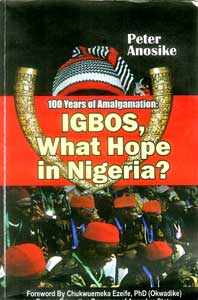
Against this background, comes this earnest reawakening spirited call by a veteran journalist Peter Anosike to his fellow brethren, the Igbos, to wake up, in a thought provoking and incisive book titled ‘100 years of Amalgamation: Igbos, What Hope in Nigeria?’
The 189 pages book segmented into eleven chapters with forward by Chukwuemeka Ezeife, former Governor of Ananmbra State, addresses critical issues concerning the Igbos like; “Who are the Igbos, the Igbo Can Do Spirit, Igbo and the Media, The Need for Re-Orientation, The charade called Nigeria’s Census and others, with the last chapter, Reconciling Nigerians: needs for Sovereign National Conference” and three structured appendixes that talked about attempt made by conscious Igbo citizens for Igbo Unity and the formation of Ohanaeze Ndigbo, a socio-political group that is championing the course of Ndi Igbo.
Looking at the title of the book, one may be pricked to ask if the author is calling for a revolution, but the spirit behind the rhetorical question is a straightforward ponder and demand for the Igbos and alike to re-examine themselves, where they are coming from, their travail and the way forward with attentions to those things that would make them a great nation.
In a nutshell, the book according to the author is not a praise song for the Igbos and the Igbo nation. He noted, how they have done well in some areas, failed in some, but the irony to a large extent points that the entity itself are part of their problems. It is a kind of mixed bag, applauding the great deeds on one hand, chastising and calling for attitudinal change on the other hand.
The first chapter is a narrative section of the origin of the Igbo tribe. By drawing attention from a discovery by an Anglican Missionary, G.T. Baseden, who was of the view that word Igbo came from Hebrew word, Heebo twisted to sound Ibo or Igbo. These tribes have a custom and etymological semblance between them which points to Igbos as descent from Jews: their itinerant nature, resilience, creative instinct, courage and self confidence which are the factors behind their successes in many spheres today.
These amazing attributes leads to his second chapter that dealt with “The Igbo ‘Can Do’ Spirit”. Obviously the most persuasive argument here is that the enterprising spirit of an average Igbo man did not develop after the civil war. It is simply part of their make-up and not something borne out of desperation as can be seen from their dominant role in governance before and after independence. As the author proceed from describing a typical Igbo man, he went further by pinpointing how they got it all wrong: The lack of interest by Igbos in utilizing the media extensively,The negative and selfish approach towards politics of national interest in the country and others.
Perhaps, chapter five is a respite with the title, ‘the need for re-orientation’. When a man retrieves his steps backwards and find where he faulted, the option left is solution to move forward. Although, for them to achieve this, unity and harmony is important, but the fact remains that other tribes who feels that the Igbos are the black leg of Nigeria or have mentally naturalized in another ethnic group should re-educate themselves to realize that they are leaving gold for bronze.
As he progressed with other facts in other chapters concerning the wellbeing of an Igbo race, perhaps the most important is the formation of the Ohanaeze Ndigbo Forum, the Aka-Ikenga and other groups that have been working hard for the repositioning of the Igbo race in the nation and diaspora.
The book, in its simplified English and devoid of voluminous words is a masterpiece and a tool of change through soul searching and unanswered questions of who Igbo are and also a window of untapped opportunities towards repositioning.
Disclaimer
Comments expressed here do not reflect the opinions of Vanguard newspapers or any employee thereof.