
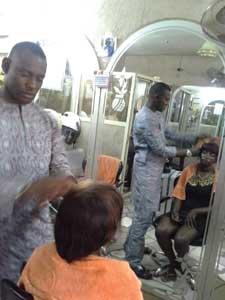
Mr Akeem Shobanke is the Managing Director/Chief Executive Officer of Ijesha, Lagos-based Uncle Super Hair Beauty Salon. In nthis chat with Financial Vanguard, he speaks on what led him to become a player in a field mostly regarded as a woman’s field.
Excerpts:
After his primary and secondary school education in Lagos, the native of Ogun Sttate decided to go and learn a trade as he could not make his papers that would have enabled him pursue a course in a tertiary institution. “I went to learn furniture making for a period of four years. Along the line, I lost my parents, so there was nobody to assist me financially to set up my business.”
Going into hairdressing:
Initially, Akeem had wanted to go into fashion designing but a visit to a friend’s hairdressing salon changed his course.
“I went to a friend of mine who introduced me to hairdressing. He owns a salon and while in the salon, I observed all the activities going on and I picked up interest and decided to go into hairdressing.
“I was moved by the beauty I saw and one week later, I went back to him and asked if I could join him in the business just to learn. He said if I have an interest in the the business, I should come in. He was joking but I was very serious. When I got there and started watching him work, I learnt really fast,” he said.
Breakthrough:

Akeem Shobanke…Discipline is the principal thing in this business
“One day, after being there for two months, he went on assignment (to do bridal hair) and left me and other staff in the salon.
“A customer came and there was no one to attend to her so I volunteered to attend to her but the others said: ‘Ah ah! You’ve been here for just two months and you want to do the job? No way!’ I pleaded with them to give me a chance because I was convinced I could do it as I have been watching them work, moreover, I spent four years learning to make furniture.
“After weaving the hair for me, I started sewing. When I finished sewing, it was time to cut and they said I should not do the cutting or else I would spoil the hair. I said there was no harm in trying, that they should allow me to do it. At that point, the lady told them to leave me alone to finish the job. “I was shaking but I summoned courage and began to do the cutting. When she looked at herself in the mirror, she could not believe that I started just two months earlier. When the boss came back and saw what I did, he was very impressed and began to give me more jobs to do.
Moving out:
“After learning the trade, I decided to go elsewhere to look for a job. I applied and got a job at Andy Beauty Salon in Ojuelegba. They were impressed with my job and they started calling me Super because I was eager to learn all I could from everyone so they gave me the nickname, Super Whole.
After some time, a friend of mine got married and his wife was going on maternity leave and needed someone to take care of the salon until the wife resumed. So they asked me to manage the shop for three months after I left Andy Salon. “People got to know me in that area as the first male hairdresser in the Lawanson. When the woman came back from maternity leave, I had to leave.
Setting up my own salon:
“I went to a salon and told them I would want to be their stylist so we drew up a contract. The woman gave me the shop to manage and at the end of every month, I’d pay her a certain amount of money. I worked hard and started saving some money. After two years, I decided to have a salon of my own in the same area because the woman said she wanted to close down and go into another business. With the little money I saved and help from relations, today, I have three shops – one in Lawanson managed by my wife, another in Odo Eran managed by my staff and this one in Ijesha managed by me. I am happily married with four children,” he enthused.
Initial capital:
Akeem said he started with an amouint below N200,000 most of which went into renting of shop. “The shop was N3,000 a month for two years and an extra N50,000 for agreement and agent fees. I had to sell my phone and my sister-in-law lent me some money too. For equipment, a friend of mine, an Igbo man that deals in hairdressing equipment gave me the equipment and asked me to be paying instalmentally. So every week, I made sure I paid in something into his account until I finished paying.”
Challenges:
Speaking on the challenges, Akeem who has eight staff and over 20 apprentices in his employ, noted that the customer is his number one challenge. “When they come in and you tell them the price, they start bargaining, and for you to let them see what you can do, you have no option than to bring down the price so by the time they see what you can do, they would not mind adding a little money. Also, most of the apprentices today are not committed; excuses here and there so when you expect five people to work today, you may see two or three and you have to call to find out what was wrong.
They will never tell you they will be absent on a particular day so that you can make arrangements to fill the gap. We make the customers beautiful so they can confidently go to work or party or wherever. I don’t go to parties.
“On Saturdays and Sundays, we come to work before seven in the morning for customers to come and see us ready. Also, discipline is the principal thing in this business. You must be disciplined in every sense of the word; be always available for customers, don’t be a party goer. The customer should always find you at your duty post.”
Power supply:
“I don’t believe in PHCN, I always have my generator and fuel ready. We spend N30,000 a week to power the three generators in the three shops. Once a customer comes in, we put on the generator until she leaves.”
Disclaimer
Comments expressed here do not reflect the opinions of Vanguard newspapers or any employee thereof.