
By Prisca Sam-Duru
When darkness shines brighter than light and lie is fabricated such that it turns into reality, overshadowing truth, men get lost in the pool of ignorance. Little wonder the Bible says “My people perish for lack of knowledge.”

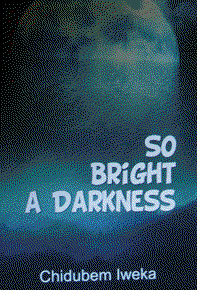
In So Bright A Darkness a 261- page book, with a total of 34 interesting chapters, Igwe Chidubem Iweka III of Obosi, Anambra State, a writer per excellence, chronicles in a fictional prose style, the gullibility of the led while exposing how leaders control the people through fear and deception.
Iweka’s book is a compelling, suspense-filled narrative, technically woven with so much suspense presenting the author as one endowed with the magic to paint darkness in such a way it shines brighter than light.
Readers are awed by the author’s incredible ability to fuse science, magic and traditions together as though the novel was birthed out of real life experience. Moreso, the title is a captivating salute to irony and oxymoron.
Set in the Eastern part of Nigeria in a fictitious land, Obodo Ogwari, an ancient town adorned with rules, secrets, customs and traditions, the novel interrogates the complacency of the masses in the face of authoritarianism.
The author in this suspense-filled narrative, critically examines the irony of a community which enjoyed bastion of peace, justice and security but yearning for change from idolatrous practices that are inimical to its development.
The book also exposes limitations of traditions which the people see as the only answer to teeming problems. It chronicles the resistance put up by Ogwariland against civilisation with the erroneous belief that any attempt at accepting modernisation, would lead to bastardisation of culture and destruction of peace experienced by the people.
Tough, mean and arrogant sergeant Okelue Okafor who spends most part of his life in exile as a result of his father’s banishment, gets promoted to the rank of a captain after his exploits during the war between government forces and militant guerrilla.
Subsequently, Okafor is honoured for rendering a meritorious service to his country and masterminding the government’s triumph. He is recalled from exile together with many other indigenes exiled for diverse offences, at his request.
The Caucasian, Philip Carter’s love for teaching and social work brings him to Africa, to Obodo Ogwari to be precise, not just to settle but to naturalise. He finds true love in Ngozi and after he becomes a traditional title holder, Ugoabata (the eagle has landed) and a member of the umu Ifeadigo clan, marries Ngozi. His attempt to preach the gospel of Jesus Christ in Obodo Ogwari, attracts the visit of the dreaded Ideamala bird as a warning.
At first, the characters and scenes appear unconnected but the arrest and detention of the 6th keeper of Ideamala Igo, during his visit to the Works Minister’s office in Abuja to stop the construction of expressway through the cave of Ideamala, brings the major acts; Okafor, Igo, Carter, Emodi and the military, together.
The dots begin to connect as the author weaves the story masterfully connecting the characters including the 6 keepers of Ideamala (priests who reside in the Ogwari cave and have the final say in Ogwariland), the soldiers as well as contractors assigned to construct the express road.
The truth about the great Ideamala bird, the cave and reason Ogwariland appears better without civilisation, is finally brought to the open when the minister insists on carrying on with the road construction in spite of heavy resistance put up by the keepers.
The minister, Hon. Jibril and officers refuse to bow to pressure emanating from Igo’s magic which he employs subtly to pose a stumbling block to the road construction.
The book further unveils a cascade of torment that befall invaders of the Ogwari cave while story climaxes in the death of the 5th keeper, Nji who becomes a renegade. Readers will find the content of the cave incredibly hard to believe. It is a world in sharp contrast with the Ogwariland it professes to be protecting for years.
Good narrative technique, captivating power of description spiced up with corresponding figurative languages contribute to making So Bright A Darkness, a masterpiece.
When the story was becoming tensed up with events of war and detention saga, coupled with display of magic and spiritism, the author in pages 148 – 150, flaunts his ingenuity with the introduction of romantic scene involving Ugoabata and his betrothed. Though the romance is short-lived, it is a huge source of relief.
In the book which is well designed with clear distinction between light and darkness, the author portrays himself as a craftsman well aware of the demands of storytelling as he interlards the narrative with realism, science fiction and fantasy, holding the reader spellbound.
Employing elements of flashback where necessary and sound narrative technique, the author creatively presents So Bright A Darkness in such classical manner that makes the novel un-put-down-able.
As interesting and easy to assimilate as the book is, non-Igbo language users may not find the use of some Igbo words without explanations funny. Instances are seen on pages 147, onye aka ebe meaning witness, white coloured nzu and red ufie, 193, ukwa (breadfruit), there is also nkwu enu (palmwine), and many others. In spite of the above, So Bright A Darkness is a must- have-book for every Nigerian both young and old.
Disclaimer
Comments expressed here do not reflect the opinions of Vanguard newspapers or any employee thereof.