
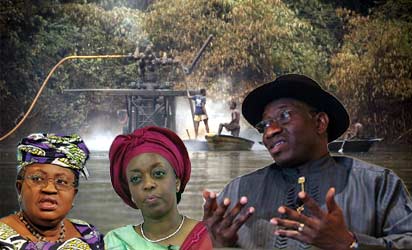
Okonjo-Iweala, Diezani and Jonathan
By Dele Sobowale
“We promise our people that even with the drop in oil prices, the economy will be stable.” President Jonathan. December 4, 2014.
For sheer fantasy, that declaration by President Jonathan will be difficult to surpass. He made it while receiving a delegation from General Electric, the global giant, to the Presidential Villa. The visitors, being very polite, naturally, kept a straight face, while listening to a good joke “from above”. It is not often they meet with a President who does not know basic economics; or who has no official to tell him the truth. The stability promised by Jonathan was already being shattered by three events which will have domino effect on the Nigerian economy.
Last week, the first part of this series ended with disclosure that the 36 States of Nigeria received about 20% less than the average monthly allocation for 2013. Bearing in mind that most states depend heavily on oil revenue allocation, it is difficult to imagine how the stable economy will be achieved. Moreover, the Federal Government had to kick in $2bn from the Excess Crude Account; otherwise the shortfall in allocations to states would have been worse.

Okonjo-Iweala, Diezani and Jonathan
The $2bn drawdown from the Excess Crude Account, ECA, has almost depleted that account. Unless, the Federal Government intends to close it in November, not more than $1bn can be taken from it. As it is, the ECA might cease to exist by December 2014. From January 2015, the Federal Government and States will share revenue from oil selling at under $70 per barrel, instead of $110-plus and with lower volume.
Meanwhile, the outlook for crude price reversal is bleak; and might remain so for years. When, the reversal occurs, it will be a different global crude market than we have known. As Peter Drucker, management guru, has told us, “The future will come; and, it will be different.” The most important question, which governments have not addressed in: why will it be different and how will it affect Nigeria?
Meanwhile, the Central Bank of Nigeria, CBN, had only a few days before that visit by GE to the President, devalued the currency, increased interest rates, started mopping up excess liquidity and started discouraging banks from granting loans to states. How the President and his economic advisers can imagine that “the economy will be stable”, given all these changes and the repercussions they will induce, is, again, hard to imagine.
At the same time, investors in the Nigerian Stock Exchange, NSE, are marching with their feet – away from the capital market. Is it possible, or has it ever happened anywhere in the world for investors to withdraw from the stock market in an economy expected to be stable?
President Jonathan is not an economist. And as the Governor of the CBN has stated, and I totally agree with Emefiele, nobody, in Nigeria is responsible for the sharp drop in the price of crude oil globally. It is unfortunate that it came during Jonathan’s tenure. But, like the Tsunami, which occurred during the tenure of a Japanese Prime Minister, he must deal realistically with the problem – instead of denying what a lot of people already know. Let me give two examples.
Virtually all the states and the Federal government owe public servants salaries, allowances and entitlements – which they are finding it difficult to pay. Contractors have abandoned several projects, which might become permanently abandoned, if out going governors fail to pay before departing. Meanwhile, the contractors are swelling the ranks of bad debtors increasing banks’ non-performing loans. To all these problems there is no relief in sight. On the contrary, dwindling allocations to states are expected to make things worse. How on earth can a gradual descent from bad to worse be called stable?
The CBN Governor had done the Federal Government a favour by exonerating Jonathan from responsibility for crude price decline. He had performed bigger service by looking ahead to the possibility that Jonathan might return for the second term – by which time the negative impacts of the crude situation will be felt. The President needs to be reminded that, in Nigeria and elsewhere, Presidents have been elected for second, third, fourth terms, who never finished them. A turbulent economy had invariably been the harbinger of social and political turmoil.
Disclaimer
Comments expressed here do not reflect the opinions of Vanguard newspapers or any employee thereof.