
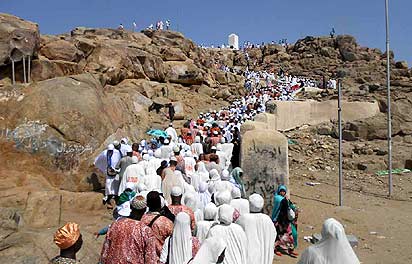
*Ogun Pilgrims at Mount Jabalithaor one of the holy sites in Makkah
By Haroon Balogun
All praise is for Allah the Mighty ,the Exalted, and may the peace and blessings of Allah be upon His final Messenger Muhammad Ibn Abdullah and upon his family and companions.

*Ogun Pilgrims at Mount Jabalithaor one of the holy sites in Makkah
The rights and obligations of Muslims with respect to one another are derived from the love of Allah and that of rosullulah that we share. That is why the spirit of brotherhood in Islam is stronger than even the family ties.
As thick as family bond, once a family member becomes a deviant religiously or better still professes another religion other than Islam which the rest of the family hold dearly to, there is that tendency that the love between them wane. Naturally, those who practice same religion will interact better and operate on the same spiritual plane than others who hold different spiritual ideals.
But that does not mean interaction with brothers of different faith will be closed. It may not be their fault entirely, it is Allah who gives guidance and whoever is not guided by Allah, no one can bring to the right path.
The focus therefore is not about guidance but about the duties and responsibilities of one Muslim to another. The connection however is basically because Islam endeavours to strengthen ties and relationship between one Muslim and the other.
The Prophet said a Muslim is a brother to another. He went further to establish some rights of a Muslim over another. These rights include such things as aid and assistance, affection, generosity, respect, justice, equity and fairness among others.
On the authority of Abu Hurairah (r.a) who said that the Messenger of Allah (s.a.w) said:
“ The rights of a Muslim over another Muslim are six.” These are: (1) Saying salamun alaikum to him when you meet him.
Indeed sending the salutations of peace is one of the reasons that will bring about love for the sake of Allah which is a cause of true faith (Iman) and could result in the individual gaining paradise, just as the Messenger of Allah stated: “I swear by the One who hands my soul is in! None of you will enter into paradise until you believe and you will not truly believe until you love one another.
Shall I not direct you to an action that, if you perform it, will cause you to love one another? Spread the greeting of peace between yourselves.” {collected in Sunan Abu Dawud}
This greeting is one of the beauties of the religion of Islam and it signifies that when two Muslims meet one another, one of them supplicates for the other to be protected from every evil and for him to be showered with mercy and for him to be blessed with every form of good. And he should follow this up with a pleasant demeanor.
If you notice, every phrase in this greeting is pertinent enough to bring about unification and love between the two and to remove any alienation or separation between them.
Thus the greeting of peace is the right of the Muslim and it is an obligation upon the Muslim whom it is conveyed to that he returns the greeting with one similar to it or better than it, as Allah says: “When a greeting is offered to you then return it with one like it or better than it…” (4:86)
Again, note that the better of the two, is the one who initiates the greeting first.
Secondly, the if he invites you, respond to his invite. It could be an invitation for a dinner, for merry making, visit or other form of halal socialisation, you should make your brother feel happy by obliging him, respond to his invite and make him happy.
This is become a wajib except you have an excuse to turn it down and this must be well communicated to him.
Thirdly, advise him if he seeks your advice. Although advice is an absolute obligation, it becomes even more emphasized when the individual actually asks for it or requests your honest opinion. So, it is incumbent upon you to advise him most sincerely.
If he wants to participate in any action, and wants to know whether he should go forward with it or not, then you should advise him with the same advice that you would value for yourself.
If the act is actually beneficial from all angles you should encourage him to go forward with it, however, if the act appears to be detrimental, caution him against it.
But if the act is inclusive of both benefit and detriment, explain this to him and measure the pros and cons of the situation accordingly. The Prophet (s.a.w) said: “Whoever deceives us is not from amongst us,” don’t deceive your fellow Muslim, no matter the situation.
And if in fact a Muslim deceives his brother Muslim by offering advice to him that he wouldn’t value for himself then he has abandoned the religious obligation of sincere advice.
Fourthly, You have a responsibility to pray for him when he sneezes and says Alhamdulilah. Then you should say: “May Allah have mercy on you (Yarhamukallah). This is because sneezing is a blessing from Allah. Allah allows this air, which has accumulated in the body of the individual, to be released with ease so that the sneezing person can loosen up.
Therefore it is necessaryfor him to praise Allah for this blessing and it is important that his Muslim brother say to him “May Allah have mercy on you” and it is obligatory for the Muslim to reply with “May Allah guide you and rectify your affair!”
And he who sneezes and does not praise Allah is not deserving of this supplication and he has no one to blame except himself. For he was the one who forfeited these two blessings from himself; the blessing of praising Allah and the blessing of the du’a (i.e. supplication) of his brother for him, which is a direct result of him praising Allah.
Fifth, visit him when he is ill. Visiting the sick and offering prayers for him is one of the rights of a Muslim, especially if he is someone whose right over you is emphasized, like a relative or a close companion or others with close consanguinity.
This is also one of the greatest righteous deeds that an individual can perform, as the Prophet (s.a.w) said: “Whoever visits his sick brother will continue moving towards Allah’s mercy until he sits next to him, and when he sits next to him, he will be immersed in it (i.e. Allah’s mercy).” {Sunan Ibn Majah}
The Prophet also said: “There is no Muslim who visits his brother Muslim in the morning except that seventy thousand angels supplicate for forgiveness for him until nightfall and he will be given a garden in paradise. And if he visits him at night seventy thousand angels supplicate for forgiveness for him until morning and will be given a garden in paradise.” {Collected in Sunan At Tirmithi}
It is also appropriate for the one visiting his brother to supplicate for him to get better and try to remove any difficulty or hardship from him and to ease his mind by giving him glad tidings of good health and to remind him about his responsibility of repenting to Allah and to return back to His obedience with the best possible advice in the best manner.
Lastly, when he dies, honour him and follow his funeral procession. For the one who follows the funeral procession until the prayer is performed over the deceased will be rewarded with a Qiraat which is like a tremendous mountain.
Again, if he follows the procession until the deceased buried then he will be rewarded with two Qiraat. The Prophet (s.a.w) said: “Whoever follows the funeral procession until the prayer is performed over him, he will be given a Qiraat and whoever follows the funeral procession until the deceased is buried, he will be given two Qiraat.” {Saheeh Muslim}
Disclaimer
Comments expressed here do not reflect the opinions of Vanguard newspapers or any employee thereof.