
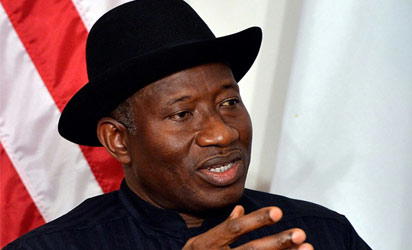
Former President Goodluck Jonathan
By Bisi Lawrence
We have once again just passed through the season when all the insufficiencies of our amenities are paraded for us to throw at the government of the day. For the past decade, or so, it has been the theme song on the occasion of our National Day celebrations as the routine answer in the consideration of how well we have fared as a nation in the preceding years.
The summary is the same: no adequate electricity supply, no good roads, no appreciable health service delivery, falling standards in education, flagrant acts of impunity, threatening political turmoil, deteriorating security, stifling unemployment, celebrated corruption… you name it and as long as it is on the negative side, you will be right.
It should make us pause, especially since these complaints are indeed based on the truth. Even if we sometimes seem to gloat over them more than we appear to feel aggrieved, they have to be mentioned to the hearing of those who are in direct control of our destiny as a nation. These are the people we have voted into positions of power in which they have accepted to improve our lot.
We frequently mention these deficiencies in their conduct of our affairs which they swore to safeguard and improve because it would sometimes look like they are not aware of the limits of their responsibility, or its tenure. An offensive excuse that often emanates from their defenders, and which they blandly advocate, is that these shortcomings did not come during their time in office, but have existed over a period of time.
There, of course, they miss the point and fall short of the nature of what the people expect of them. Everyone is aware of the fact that several of these issues have been with us for an appreciable period. That fact guided our desire to terminate their adverse effects on our lives when we voted, or thought we voted, for people who, in our estimation, could resolve these problems. That is the mission of the chief executives at the national and state levels—the President, and the Governors—who asked for our trust and promised to bring about a change for the better in our lives.
That is what they all did—even the military rulers who did not have to. And they all seemed not to have come up to scratch. That is not only why we have to remind them. What is more irritating is the manner they all, to a man give themselves a pass mark, usually on such an occasion as a national anniversary— apart from other opportunities.
For instance, it is incredible that anyone could have such glowing remarks to make about the progress in any sector of this nation, in the past five years, as President Goodluck Ebele Jonathan did in the 54th anniversary message to the nation. It is all happening around us, and we see it all. That is the most surprising aspect of the entire performance. Hardly anything he boasted can be said to exist beyond his bloated view of his own performance. And just as he was indulging in his self-praise worship, the Mo Ibrahim Foundation released its 2014 Index of African Governance which ranked Nigeria 37th out of the 52 nations covered by the survey on the Continent.
What is more, Nigeria actually performed worse than before in safety and the rule of law, two of the categories on which the report was based. That translates, basically, to loose security and permissive impunity. Yet we are daily fed with wild claims in place of genuine achievement and wishful thinking in stead of practical ideas, as amply demonstrated in the presidential anniversary address.
And so, journalists speak out, bless them The Nigerian Press makes one proud of its unrelenting stand against mediocrity, its unyielding opposition to injustice, and its constant rejection of irresponsibility in the structure of our governance The electronic arm, of course, shies away from direct editorial comment of a critical stripe, but the print media makes up for any gap of objectivity in the discharge of its pungent ‘leaders’, divergent though as they have to be.
That is probably why the list national honours pointedly avoids them. This country can justifiably boast today of professionals who are worth their salt in every area of the media, be it in news reporting, feature writing, editorial comment or even cartooning. Our standards compare favourably with the best in global output. We have been recipients of international awards in spite of discouragement at home. So one might say, what price, anyway, is the inclusion in a national honours’ list which several nominees have been known to rebuff?
But that would not be appropriate. It would evoke the negative attitude of the well-known “sour grapes” saga in Aesop’s fables. A national honour signifies a nation’s recognition and appreciation of merit in a person’s performance. It is a formal reward for an outstanding record. It reflects the qualitative contribution of an individual, or group of individuals, to the national wealth of sterling achievements and betokens a people’s desire for excellence.
It is to be cherished when properly conducted and presented. However, it demeans its own quality and adds little value to the dignity of the honour it seeks to bestow when the nominee is hard put to appreciate it. For instance, imagine being awarded an accolade inferior to an earlier one from the same source. That has happened, at least, on two occasions recently.
That is why we must write and continue writing about “the labours of our heroes past”. They will be forgotten very soon, because they are being subverted even as they are performed. The heroes of my youth followed the path of grace and honour. Some of them had made a name before their subsequent deeds proclaimed their patriotism. The example of Nnamdi Azikiwe who became the first President of the Federal Republic of Nigeria is easy to cite. But that was long before he had published that great work, “Renascent Africa”, and had founded and edited the historic “West African Pilot”, and further lent his name to the first nationalist movement in Nigeria, “The Zikist Movement” Of course, there are not many like him whose claim to heroism was multifaceted, jutting into diverse chapters of life.
Once Azikiwe’s name is mentioned, it is customary to pair it with that of Obafemi Awolowo, first Premier of the old Western Region in the next breath. Awo actually emerged on the heels of Zik, a hero of another model who earned his spurs through a dissimilar process. He was really there with Zik at the beginning. It is one of the circumstances of history that Awolowo was Azikiwe’s assistant when Zik was the scribe of the Nigerian Youth Movement at the dawn of our nationalistic awakening.
The story of their association must wait for another day. However, Zik’s acclaim as a hero especially among his own people, the Igbos from where it should naturally start, was inhibited by the traditional trait of the republican spirit which never had any strong roots among the Yoruba, thanks to the age-old system of monarchy in their own society.
Other heroes have come and gone without the credit of the due celebration of their noble deeds. You may never have heard of a man called “Marshall” Kebbi. He was one of my heroes when I was young. He was neither wealthy nor well-learned, neither a millionaire nor a high-ranking military officer. He was a man on the fringes of the journalistic profession who loved his country with an over-riding passion and dared to suffer because of his love. Today he belongs to that group of that unknown, unsung corps of dedicated whom fame shunned and honours neglected.
There were many groups of such patriots during the dawn of nationalism some six to seven decades ago. Those who are still alive, and they are very few, must be wondering today if it was all worth the effort all the turbulence and the turmoil, all the sacrifice and the stress, and “all that glee at high noon”.
Marshall Kebby belonged to the Zikist Movement which was named for the man who, in those days, was like a beacon in the darkness of colonial rule. They proclaimed him as their mentor and drank deep of his cup of bubbly rhetoric. And the more they imbibed, the more their thirst was sharpened for more zestful, more meaningful action. Eventually, unable to wait for their leaders, they took the lead themselves with all the vigour and rashness of youth.
In broad daylight, they called for revolution against British rule in Nigeria. They perpetrated this brave but brash action at an open lecture in the heart of Lagos, then the Capital of the colonial territory. And for their pains, they were sent to jail in shoals for sedition—brilliant, vigorous, young men in the prime of their lives. They are all but forgotten now.
In the main, the names and the awesome price they willingly paid are now shut out of our memory in a land that does not count records amongst its treasures. Their rightful places in our temples of honour and renown remain unfilled. The nation has held them in total disregard as though they had never been. They were all real-life heroes, although they have less to show than highly-rated footballers for their valour and towering commitment to the duty they felt they owed their country… even in the conferment of national honours.
But their labours have indeed not been in vain. They bore names that should be enshrined in our national archives, names that should flow and bubble in the stream of our national folk lore—Abdullah, Nzimiro, Enahoro, Amosu, Ntup, Osita Agwuna, Marshal Kebbi, Imoudu,and even Peter Osugo and others—men who looked tyranny in the eye and refused to blink. We must not stop writing about them lest the loud recitations of hollow success which now fill the air obliterate them from our minds.
For although only fragments of their patriotism still persist in our fading memory, a more ebullient remembrance of their brave actions will form a link of inspiration between their revolutionary spirit and succeeding generations.
Time out.
Disclaimer
Comments expressed here do not reflect the opinions of Vanguard newspapers or any employee thereof.