
FILE IMAGE
The impact of the falling oil prices may not be felt much on the Nigeria economy, if the government imbibed saving culture, said Mr. Bekuochi Nwawudu, the Director of CBO Capital, a Lagos-based investment advisory and project development.

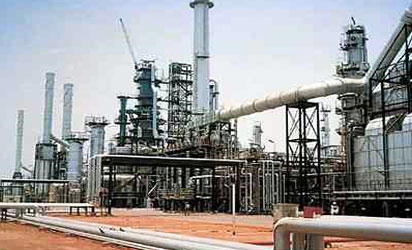
A refinery
Nwawudu, while reacting to worries being expressed by some Nigerians about the continued downward trend of global oil price, told Vanguard that Nigeria should save more now for the rainy days.
“We should save more now. The federal government should save more with the Nigerian Sovereign Investment Authority, NSIA, while at the state government level, there should be matching funds as well as tax breaks,” he said.
This came as the Managing Director of Seplat Petroleum Development Company, Mr. Austin Avuru, said there is no need to panic as oil prices will still go up, “but when? I do not know.” Geographies are shifting, but the energy mix as well as the demand and supply equilibrium has not changed much,” he said.
Avuru explained that technology has made it possible to discover more oil in the world to satisfy the global growing demand. According to him, ‘thanks to technology and pricing; there is still enough oil and gas to satisfy the growing demand through 2040. Wind and renewables have failed to be the solution.”
However, Nwawudu cautioned that given the country’s dependence on oil, the fall in prices will affect the foreign exchange and interest rates. ‘’Given oil’s current share, a significant fall in the price will have an immediate impact. This would be felt through foreign exchange rates and interest rates, then falling budgets and government spending,’’ he said.
Speaking on the impact of the price fall on the budget which benchmark is $78, he noted that although the price is still above the benchmark it is not going to harm funding; only that less ‘excess’ will go into the excess crude account or the NSIA.
He argued that the market view is that the price fall is likely to be short-lived, “so possibly, no cause for alarm.”
“There could be risks to the budget, but at this level, it is more likely that increased borrowing could fill the gap; we have low debt to GDP ratios. We also have solid reserves and these can be used to defend the currency in the near term.
“The question for us though is – why are we worrying? Why is the whole country watching the oil price? Is this how we should be thinking in 2014 and what Nigerian livelihoods and welfare should be exposed to? Is the hedging model (known/fixed/international credit risk) vs. the self-insurance (exposed/local credit risk) model best suited to Nigeria?
“If we hedged or forward sold a portion of our production say 50 percent for 10 years, then we would simply know that for X period Y price and Z revenue is coming in and get on with it. That the price has gone up or down is an issue for future years and something we can prepare for,” he said.
For government to cushion the effect of the falling oil prices, Nwawudu suggested borrowing to maintain the budget in the short term, while adjustments should be made in the long term.
Disclaimer
Comments expressed here do not reflect the opinions of Vanguard newspapers or any employee thereof.