
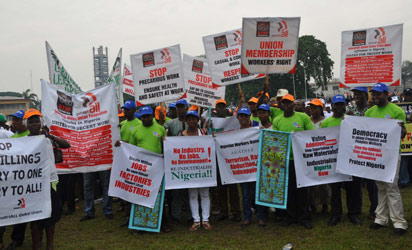
Cross section of Nigerian workers, during the 2014 Workers day commemoration, THEME: Building Enduring Peace and Unity, Panacea for Sustainable National Development, at Onikan, Stadium, Lagos Island. Photo: Bunmi Azeez
By Funmi Komolafe
THE decision of the Senate to de-list the National Minimum Wage from the exclusive list may put Nigeria in the special mention of the International Labour Organization, ILO, once again. Beyond that it means that the Nigerian worker would become more vulnerable to exploitation by employers.
The manner in which it was done is a clear violation of Convention 98 (Right to Collective Bargaining and Tripartism) of the International Labour Organization which Nigeria ratified at independence. This convention is one of the core conventions of the ILO.

The Senate
What is minimum wage? According to the ILO “the minimum wage may be understood to mean the minimum sum payable to a worker for work performed or services rendered, within a given period, whether calculated on the basis of time or output, which may not be reduced either by individual or collective agreement, which is guaranteed by law and which may be fixed in such a way as to cover the minimum needs of the workerand his or her family, in the light of national economic and social conditions”.
Then Governor Abubakar Rimi of Kano State was the first governor to introduce minimum wage in 1980. He was followed by his then Kaduna State counterpart, Alhaji Balarbe Musa. Both belonged to the Peoples’ Redemption Party, PRP. It was not until 1981 that Nigeria had the first national minimum wage of N100 basic salary per month during the administration of then President Aliyu Usman Shehu Shagari. It was backed by law. This was after an 11 day strike of May 1 to May 11, 1981.
Then in 1990, following organized agitation by the Nigeria Labour Congress after series of agitations and failed negotiations, the government of General Ibrahim Babangida raised it from from N100 to N250 per month. In 2000, the government of President Olusegun Obasanjo negotiated with the Nigeria Labour Congress under the leadership of Comrade Adams Oshiomhole and the Nigeria Employers Consultative Assocation, NECA, and agreed at N5, 500 per month national minimum wage.
The National Assembly backed it with a law which excludes any person employing five persons and below from paying the National Minimum Wage. A national minimum wage is the least basic that must be paid to a worker in Nigeria per month. It has never stopped sectoral collective bargaining. For instance, a clerk in a textile company and a clerk in the food an beverage industry still do not earn the same pay. Why? Collective Bargaining in the sectors vary and allowances are determined by this process.
The year 2000 national minimum wage was done in accordance with Convention 98 of the ILO for which Nigeria was commended. This commendation earned President Obasanjo an invitation to address the plenary session of the ILO the following year. Nigeria was cited as a good example. It must be noted that a national minimum wage in this context is the least pay a worker in Nigeria should earn on a monthly basis. In other countries, it is based on certain number of hours for which the worker is engaged. Perhaps what the Senate meant to do was to decentralize collective bargaining in the public sector. Even that has its implications. It should not be done without consultation.
What does the Senate mean? By de-listing “National Minimum Wage” from the exclusive list it is unclear what the intention of the Senate is. Minimum wage does not represent the totality of wage issues in Nigeria. However, the definition of national minimum wage varies from country to country. In some countries, it is the basic only while in others it is inclusive of allowances.
A recent study of the ILO’s Committee of Experts on the Application of Conventions and Recommendations on the components of minimum wage stated, “A number of national laws do not indicate the elements of remuneration that make up the minimum wage, and among those that contain indications on the subject, it is difficult to identify general trends due to significant differences on the following points: the inclusion of the basic wage only or, on the contrary, the inclusion of all or part of bonuses, tips, commissions, allowances and other additional payments; the taking into account of only money wages or, where applicable, also the cash value of benefits in kind; and the indication of whether or not “wages” within the framework of the legal provisions on the minimum wage, exclude overtime pay.”
The ILO Committee added, “The legislation in several countries simply provides that only the basic wage is taken into account for the purpose of the minimum wage. This is the case, for example, in Antigua and Barbuda, Chile, Hungary, Malaysia and the former Yugoslav Republic of Macedonia”.
However, it noted that in countries like Cameroon, Nigeria’s neighbour, ”the guaranteed inter occupational minimum wage (SMIG) is defined as a basic wage floor, to which any contractual or agreed bonuses and allowances granted to a worker recruited without any skills may be added. According to the interpretation of this provision, in determining whether an employee has received at least the minimum wage, the basic wage (the wage properly so-called) has to be taken into account, as well as supplements, such as commissions.”
Disclaimer
Comments expressed here do not reflect the opinions of Vanguard newspapers or any employee thereof.