
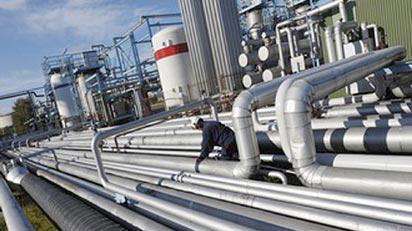
File photo of a refinery.
In the recent time you’ve been very passionate about modular refining system, what is fuelling this passion?

Leaving Nigeria in 1971 and returning in 2011 to find our citizens queuing endlessly at petrol stations for petroleum products (specifically Premium Motor Spirit (PMS or petrol/gasoline) and all other petroleum products, made me sick.
These are things taken for granted almost everywhere in the world, and was very painful for me to see in an oil producing country. So I thought, why wait for things to happen instead of making things to happen?
Yes, a simple modular refinery could solve this problem of fuel scarcity, thereby making life better for our people.
People are saying that modular refining is the answer to Nigeria’s products demand challenges and why?
A focused, educated, local experts or think tank would consider the demand and supply needs of our citizens and proffer solution. The first solution to filling the gap should not be to import, but to locally satisfy this demand. Long term thoughtful strategy is very important.
Personal primitive acquisition of wealth is not the solution. Therefore, setting up modular refineries at strategic demand locations would be a stop-gap pressure reducing measure to the product demand challenges. Fuel shortages will be greatly reduced if the companies/investors issued with licenses were committed and not use the licenses as a launch pad to seek contract for crude oil export.
As they say, build it and they will come. We are yet to see the result of the proposed six refineries to be constructed in modular forms within 30 months, at a cost of $4.5 billion. Each refinery will process 30,000 barrels per day, bpd, with expected total output of about 30 million litres of fuel every day.
So, after over 20 months after the said Memorandum of Understanding, MoU was signed, there is nothing on the ground to indicate that the project has actually commenced. According to Dangote, “With global demand for crude oil projected to keep dropping, the way forward is for us to start exporting refined products rather than crude. We will get far better money value that way…
All I will do is buy crude oil at the market price, refine and sell to marketers at the market price. If government continues to subsidise, marketers can buy products from us and then collect the subsidy from government.”
Modular refining has been proven to be flexible and a cost-effective supply option for crude producers in remote regions. This is particularly true where there is a need to adapt rapidly to meet local demand. Relatively low capital cost, speed and ease of construction are key advantages of a modular refinery.
How economic are the modular refineries compared to conventional refining system of big FCCUs, as we have in the nation’s four refineries?
Economies of scale are important here because you do not want to compare apples and oranges. The four big refineries have different product slates and processing units, that’s why they are conventional refineries. But a modular unit specifically targets specific products, e.g., petrol, kerosene, diesel, etc.
Adding a catalytic cracker unit will enable higher quality processing and profit margin. I think the main economic driver is the cost of buying the crude. It will become profitable if the entrepreneur could crack the bottoms to make more useful products. That’s the only way it could become profitable, in the long run.
The addition of a fluid catalytic cracking unit, FCCU, or a hydrocracker significantly increases the yield of higher-valued products like petrol and diesel oil from a barrel of crude. It allows a refinery to process cheaper, heavier crude while producing an equivalent or greater volume of high-valued products.
In our own case with lighter, sweeter crudes, we might need only primary distillation capacity, which means less capital expenditure. Also, adding a catalytic reformer unit, CRU, produces high octane petrol from naphtha.
If it’s so economic, why do you think the Federal Government is still shying away from adopting this system?
Remember, government is not there to make profits, but to regulate and create the environment for entrepreneurs to thrive.
Setting up a modular refinery will enable employment opportunities to be created for the citizens. When you have a job, you could train your children; you could have banks, hospitals, grocery stores, carpenters, accountants, lawyers, all kinds of occupations to support a town, all through the manufacturing of a product that provides employment.
We need to convince and persuade the government of the economic benefits from modular manufacturing processes.
The government is shy from adopting this system because of the fear of subsidising for crude oil, just like the current NNPC petrol stations. If the modular refinery entrepreneurs could justify economically, net present value and return on original investment, the government will sell crude to them at prevailing market value.
With modular refineries, our marginal field operators are in a better position to operate since they produce the crude to be refined without going through all the licensing processes.
Can you cite an example of an oil producing country like Nigeria that has adopted the modular system for either short term or long-term measure to meet its domestic petroleum products demand?
Most troubled oil producing countries have modular refineries. In the past 20 years, only three Greenfield refineries have been constructed in Africa. These were built in Adrar (Algeria), and Khartoum (Sudan), with China National Petroleum Company, CNPC, partnering with the governments, with capacities of 13,000 bpd and 100,000 bpd respectively.
The third one was built in Alexandria (Egypt) by Egypt General Petroleum Corporation, Egypt’s national oil company, NOC, with a capacity of 100,000 bpd. Planned new builds were constructed by Petrochina at Ndjamena (Chad), and Zinder (Niger) with same 20,000 bpd capacity.
The third is being constructed by Sonangol, Angola’s NOC at Lobito (Angola) with a capacity of 200,000 bpd. From the foregoing, refining in Africa is led by NOC’s, and new investments are dominated by the Chinese National Petroleum Companies.
Can the modular system rescue some indigenous companies that were licensed many years ago to construct private refineries?
If you consider the petrol filling stations currently in Nigeria, you will observe that ownership is by well-connected politicians and their friends. Similarly, those indigenous companies that were licensed many years ago to construct private refineries are waiting for subsidies from Government.
If the (indigenous companies) are indeed serious, they will refine by buying crude oil at prevailing market price. Economic viability comes from cracking to add petrol to the mix. Oil and gas value chain touches consumers through thousands of products such as fuels (petrol, diesel, jet fuel, heating oil and non-fuels (asphalt, lubricants, synthetic rubber, plastics, fertilizers, antifreeze, pesticides, pharmaceuticals).
Oil contributes over 80% of Nigeria’s revenue stream but only about 13% of the GDP due to its limited linkages to the domestic sector of the economy. Nigeria currently exports about 2.2 mmbbl/d mostly crude oil. However, nearly 80% of the fuels demand in Nigeria is imported (about 30 million litres/day of PMS) fuelling a significant part of our current account deficit.
Diversifying refined products from fuels only (PMS, AGO, Kerosene, LPFO) to value added feedstock for domestic manufacturing is vital to link the oil sector to the domestic economy and increase the contribution of the oil industry to GDP growth. Many natural resource rich countries are diversifying and transforming their economies using the hydrocarbon value chain for wealth creation.
In Nigeria, diversification should include diversifying the energy mix (from oil to gas) and fuels to non-fuels. Diversification will result in wealth creation through employment generation, import substitution and GDP growth. The keys to successful transformation lie in four strategies namely:
A) Create national focal point for developing industries beyond fuels;
B) Clear fiscal system for midstream oil with fiscal rules of general application;
C) Right incentives through price deregulation; and,
D) Industrial parks with pre-investment in infrastructure by the state. An integrated approach to implementing the identified strategies is vital for the expected wealth creation to be realised.
Funding has always been a major challenge in either turn around maintenance of existing refineries or constructing Greenfield ones, how easy will it be for investors to get financial support for modular refining?
Turn-around maintenance is a standard operating procedure for refineries all over the world. It is only in Nigeria that it becomes an issue because of poor technical leadership of the industry.
We need a dedicated technology group to take ownership of our processes such that any maintenance problem in Port Harcourt, Warri, or Kaduna, is solved immediately just like Boeing Corporation sending their crack technicians to anywhere in the world where their airplane has a mechanical problem.
If an entrepreneur will demonstrate to an investor a clear financial economic business plan showing profitability and return on investment, including cost of crude oil, investors will definitely support. This also requires the passage of the Petroleum Industry Bill, PIB to show seriousness with investments in the downstream industries.
Have you ever seen a patriotic country procrastinating on a law that will provide upward mobility for their country? Yes, Nigeria. So electing knowledgeable and educated legislators really matter.
To understand turnaround maintenance, remember that machines and other service facilities are subject to deterioration due to their use and exposure to process and environmental conditions. This deterioration requires to be duly taken care of by various maintenance interventions, techniques and at certain pre-determined intervals.
This is so that required use of facilities can be continued and service life extended until the point where maintenance costs become prohibitive and replacement action becomes inevitable. Our own car periodic service maintenance is an example.
Where an operating plant such as the refinery, must be shut down until work is completed and then restarted, thus ‘turning around’ the unit or plant is called Turnaround Maintenance.
The American Petroleum Institute, API, defines Turnaround as a periodic shutdown (total or partial) of a refinery process unit or plant to perform maintenance, overhaul and repair operations and to inspect, test and replace process materials and equipment.
Turnaround maintenance activity is required to undertake work that cannot be accomplished while the plant is operating.
The Turnaround period is that time a unit is off stream, i.e. between product cut-out and unit being brought back on-stream.
Unplanned outage of equipment in refineries, affect the continuity of operations. Overhaul of such equipment is thus carried out during planned Turnaround Maintenance of the process and utilities units. Unscheduled shutdowns result from equipment failure or process upsets.
Executing TAM as and when due will eliminate or minimise unscheduled shutdowns. Turnarounds are a critical part of refinery business and are the single most costly part of a plant or process plants maintenance budget.
What is your take on the rising incidence of crude oil theft?
On security issues, upsurge in the incidents of crude oil theft and other criminal activities in the sector are greatly affecting the future of the Industry.
Theft of crude oil pumped to the refineries is estimated at an average of 20%. The loss of revenue is significant to the stakeholders. The attendant pollution and environmental degradation from this criminal theft is huge. Also, the integrity of the pipelines is comprised.
Unfortunately, several enemies of the Nation’s progress are involved in this nefarious activity. To do nothing means to mortgage our future and that of our children yet unborn and continue to subject our beloved nation Nigeria to continue importation of petroleum products at huge cost and drain to our scarce foreign exchange. We appeal to the communities in the affected areas to rise up against these miscreants. To do nothing is not an option. It is our collective wealth and honour that is being besieged.
In view of the ongoing reforms in the petroleum industry, why are downstream operators/investors not thinking in the direction of modular refineries?
If you can fly, why walk? If you can import or not import and yet collect or earn revenues, why bother to construct or produce anything?
In the recent time, the federal government has been criticised for clamping down on illegal refineries in the Niger Delta. Critics argue that government should instead harness the raw skills and transform them into modular systems. Do you think that this is logical?
Yes, I think it is logical. To reduce unemployment, we have to turn the ‘illegal refineries’ into “legal refineries”. To make this to happen, we need to design a strategy and policy to set up an energy bank to provide financing, taxable at low interest rate. My colleagues argue investors should buy crude at competitive market price. I will argue we sell crude oil to them at slightly subsidised price. If you legalise, then you stop bunkering because it becomes unprofitable for their sponsors. They will become proud “owners” of a business, and kerosene, petrol (gasoline), diesel, will be everywhere, satisfying the demand in the country. Remember the British and our illicit gin? Yes, they turned round and sold us Gordon Dry Gin. I will persuasively argue that offering them opportunity for ownership, to set up their own businesses, will be a disincentive to break pipelines, hence, becoming useful citizens. If you think about it, who is the real loser in all these? We, the people. Let our successful businessmen and politicians set up industries in their home towns. Providing jobs for your fellow citizens, in your village, is a legacy to remember when we are all gone. Remember the funeral song … “only remembered by what we have done”?
The “illegals” already have the necessary raw production skills. We just need to provide guidance and training. The knowledge gap in distillation processes will be provided on appropriate standards, codes, specifications, and catalysis. This will in turn stop environmental pollution and degradation because all the refining fractions currently poured in rivers (depriving us of safe and reliable drinking water), will be fully utilised in some other process plants. Stopping pollution is very important, because having money is no guarantee of good health. By providing jobs and reducing unemployment, the Federal Government and 36 states will then have enough money to share.
Path forward, we need to stay technically focused. We need to develop value systems that see service above self-interest. The world is changing, where previously, hard men, now know when to be soft with their people. There is potential for growth, and we should not under-rate human ingenuity and innovation. So, the issue here is clear:
a) Prioritise and test the idea of modular refineries;
b) Set up a Refining and Petrochemicals Authority to have a focal point, and,
c) Let illegal become legal. It is sound reasoning. It is practicable. It is demonstratively a true paradigm shift for the good.
Finally, how soon do you think Nigeria can get out importing refined products to exporting them like crude, as expected of a big producer?
Have you heard the saying: “If you cannot beat them, join them?” Refining is a mature technology. It is governed by standards and specifications. Most of the Middle-eastern refineries are in partnerships with IOCs. With these partnerships, you will not have shortages in spare parts, manpower and capacity building. It is a question of live and let live. What you do not have, you make up. It appears we are always sleeping, not thinking long term. We are always waiting for things to happen, instead of making things to happen. There will be no development if we do not produce, manufacture, make things, design things, right here in Nigeria.
Disclaimer
Comments expressed here do not reflect the opinions of Vanguard newspapers or any employee thereof.