
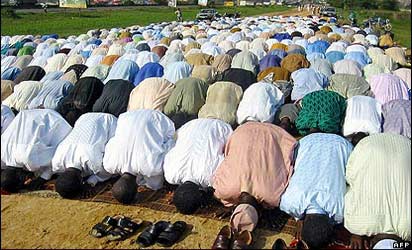
*Muslims at prayer
BY HARUNA RAZAQ
The importance of emulating Prophet Ibrahim (A.S) cannot be overemphasized in Islam. Allah states: “…Indeed, there has been an excellent example for you in Prophet Ibrahim…” Allah distinguished Ibrahim first in the Qur’an with the title of Khalilu llah (intimate friend of Allah). On this Allah says: “…And Allah did take Ibrahim as an intimate friend (Q 4:125)
Again, Allah addressed him as Ummah, Obedient, Hanif, in the following verse of the Qur’an: Verily, Ibrahim was an Ummah (a leader having all the good righteous qualities); or a nation obedient to Allah, Hanifa (i.e. to worship none but Allah), and he was not one of those who were Al-Mushirikeen (the Polytheists).
Thirdly, at the station of Ibrahim in Ka’abah, the Hujajj are encouraged to perform two Nafilah after tawaf. Prophet Ibrahim (A.S) is regarded as the father of the religion with revealed books more importantly Islam. A surah (chapter) in Qur’an (i.e. Suratul Ibrahim- Chapter 14 was named after Ibrahim. Prophet Muhammad (SAW) named one of his sons after Prophet Ibrahim (AS). The great acts of worship in Islam such as Hajj, Umrah, Day of Arafah, Eidul-Adha, Al-Udhiyyah, Ayyamut Tashriq, etc. emanated from Prophet Ibrahim (AS) and his family to mention but few.
But, most of us do not really understand what Ibrahim (AS) went through before he became prominent in the sight of Allah to the extent Allah commands believers to emulate him as mentioned earlier. It is on record that despite Ibrahim was born in the land of Al-Kaldanieen (Chaldeans) or Babylonia into the environment of idols worship where the head of the family was not even an ordinary idolator, but was one who used to carve idols, he (Ibrahim) did not follow his people in error, rather he sought the guidance of Allah (Q 6:76-78) and was guided (Q21:51); He called his people to Islam (Q26:69-82); He faced persecution from idol worshippers; He did not mind their idol; Allah saved him from their fire (Q; 21:70); when his peoples were not ready to accept his dawah he migrated with his wife and lot to Ur, to Haran, to Palestine (Q29:26) to Egypt etc. He was asked to discard his family (wife and son) in a barren land (Makkah); Allah tested him with regard to his faith e.g. he did not gave birth to a child until his old age; he was asked to slaughter his only son (Q37:103) among other trials; he prayed to Allah to bless his progeny (Q14:37); he carried out all the commandments of Allah; he was given righteous wives and children; he did not only visited his family at Makkah number of times despite the distance between there and where he stayed but also made meaningful impact on their lives during his visits; he usually honoured his guests; he and his son (Ismail) built the Ka’abah.
Disclaimer
Comments expressed here do not reflect the opinions of Vanguard newspapers or any employee thereof.