
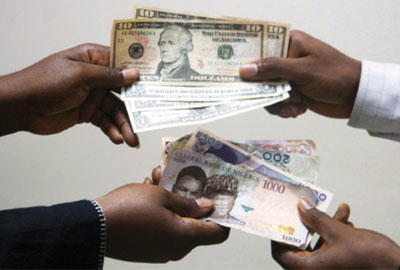
Indeed, Naira devaluation is probably the most potent weapon against the prosperity of Nigerians. Nigeria’s migration from a potential industrial power house with bustling social affluence, to a subdued and stumbling economy clearly began with the adoption of IMF’s Structural Adjustment Programme during Babangida’s regime: the chorus from International Agencies, at that time, was also that falling oil prices with an unserviced debt burden and the consequent restriction of trade credit to Nigeria, were the products of an allegedly overvalued Naira exchange rate.
By Johnbosco Agbakwuru
ABUJA—THE Federal Government has proposed $78 as the benchmark for the 2015 Appropriation against the $77.5 per barrel in 2014, just as the debt profile of the country as at March this year remained $65.26 billion.
The Federal Government in the 2015-2017 Medium Term Expenditure Framework, MTEF, and FSP also has the oil production projection at 2.2782 million per barrel daily, mpbd, which is lower than the 2014 oil production projection of 2.388mbpd.
Government explained that the reduction on the oil production per day was a reflective of lack of new investments in the oil sector due to uncertainties owing to delay in the passage of the Petroleum Industry Bill, PIB.
The MTEF and FSP document further explained that production was estimated at 2.3271 mbpd and 2.4067 mbpd for 2016 and 2017 respectively, adding, “These projections are indicative of government’s position to improve actual production capacity of the oil sector.”
The exchange rate is pegged at N160 per dollar.
The MTEF and FSP document stated that the Excess Crude Account, ECA, which had been depleted was gradually being rebuilt and that balances had dropped from about $9 billion as at early 2013 following drawdowns to augment shortfalls in revenue in 2013 to about $2.28 billion in December 2013.
It, however, stated that with prudent management of the 2014 budget, some built-up was expected in 2014, adding, “It stands at $4.09 billion.
On the expenditure outturns, government said that it had been on track notwithstanding the delayed passage of the 2014 Appropriation Bill and that of the total capital expenditure of N1, 135. 17 billion, N10.01 billion had been released as at the second quarter, while the sum of N226.97 billion (or 61.98 percent) had been released as at July.
It also said that the 2014 budget had a revenue projection of N3, 731 billion and an expenditure outlay of N4, 724.69 billion and that as at June, the prorated revenue inflow was N1, 552.70 billion, which was 83.23 percent of the target as against N1,865.50 billion budget as oil and non-oil revenue sources fell short of their budget targets.
According to the document, net oil revenue after derivation was N22.62 billion short of the half-year prorated budget revenue of N, 179.93 billion.
On the total debt stock and breakdown, it stated that overall, Nigeria’s public debt stock was the equivalent of about $65.26 billion as at March, 2014 and that of the amount, the Federal Government was responsible for about 80 percent while the 36 states and FCT accounted for the balance of 20 percent which implied a debt to the Gross Domestic Product, GDP ratio of 12.8 percent.
“The total debt stock is comprised of external debt stock of $9.17 billion and domestic debt stock of $56.09 billion,” it stated.
Disclaimer
Comments expressed here do not reflect the opinions of Vanguard newspapers or any employee thereof.